Lebanon's Palestinian refugees fear for their families in Gaza / Photo: ANWAR AMRO - AFP

 Botched US execution leaves murderer unconscious on ventilator: lawyers

 Cornell rape case exposes sexual violence at US colleges
 France held by Italy in Zidane's homecoming after Olise stunner

 Ethiopian pro-government militia claims Tigray airport as regional tensions spike

 Ohtani shaking off injuries as Dodgers launch MLB post-season
 Sea levels to rise in California as coastal wave surges up west coast

 New rallies urged in France as protests disrupt over 730 schools

 Djokovic survives China Open scare, Sabalenka starts strong
 King Charles to evoke colonial 'darkest days' on Caribbean tour

 Tesla shares jump after global car sales top estimates

 DR Congo Ebola outbreak killed more than 4,000: official figures

 Djokovic survives China Open scare against wildcard world no. 104
 Lula, Bolsonaro trade blows in final scramble for votes in Brazil
 New clashes erupt as protests disrupt over 560 French schools
 NY governor vows to close loophole after alleged Cornell gang rape

 Ethiopia Tigray rebels pushed back as regional tensions spike
 Stocks rise, yields fall as US job numbers disappoint

 Man City verdict a 'big topic' for England players, says Tuchel

 NY attorney general tasked with investigating alleged Cornell gang rape

 China widens military footprint with Laos air base
 G7 talks as US pressures Europe over diesel stocks
 Man City launch appeal against explosive financial ruling
 Swiss president to quit government
 Europe rejects US threats over diesel stocks, urges joint G7 action

 Philippines tennis star Eala says 'I get overwhelmed sometimes'

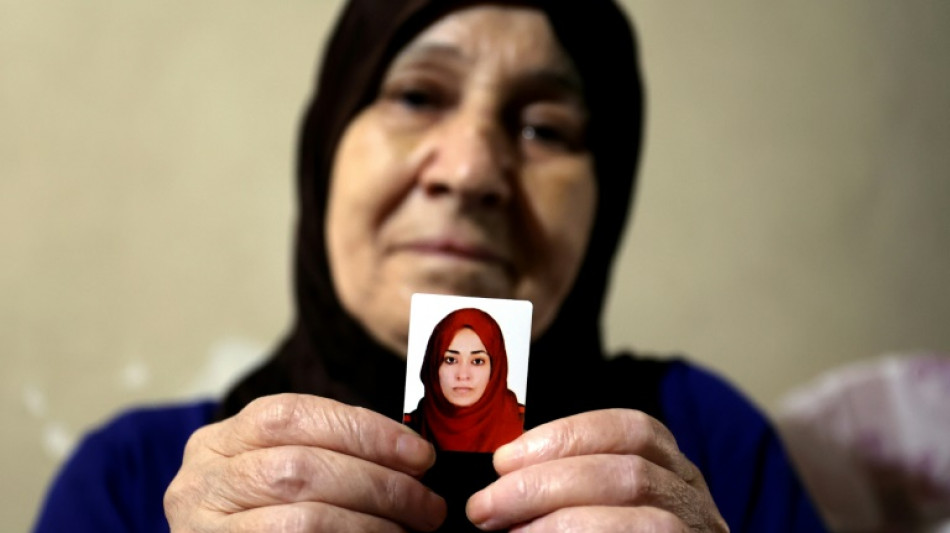
In a ramshackle Palestinian refugee camp in Lebanon, Hayat Shehadeh wrings her hands as she watches the Israel-Hamas war. Her daughter is in Gaza, and she has not spoken to her for a week.
"I can't sleep. I get up at 3:00 am... I go to watch the television," said the 69-year-old from her dark flat in south Beirut's Burj al-Barajneh Palestinian camp.
"Sometimes she writes to me, 'I'm fine'. She doesn't write more than that" because she has no way to recharge her phone battery, said the elderly woman, a baby grandchild playing with a Palestinian flag on the floor nearby.
Gaza-based Hamas militants attacked southern Israel on October 7, killing 1,200 people, most of them civilians, and taking about 240 hostage, according to Israeli officials.
Israel has since carried out a relentless air and ground offensive in Gaza that the Hamas government says has killed some 12,000 people, including thousands of women and children.
With pain in her voice but trying to maintain her composure, Shehadeh said her daughter had separated her three children, sending them away with different relatives.
"She was crying, she said 'I split up the kids'," her mother said, so that "if someone dies, they don't all die."
The Burj al-Barajneh camp is a labyrinth of alleyways, some bearing pictures of former Palestinian leader Yasser Arafat, or stencils and posters in support of Hamas and other Palestinian groups, some glorifying the October 7 attacks.
Lebanon hosts an estimated 250,000 Palestinian refugees, many living in the country's 12 official camps, according to the United Nations agency for Palestinian refugees (UNRWA).
- 'Dear to me' -
Shehadeh said her daughter, aged in her thirties, had been living in Lebanon in recent years but a few months ago "her husband came and took her" back to Gaza.
"She's moving around... I don't know what area she's in now," Shehadeh said, requesting the young woman not be identified by name.
More than 1.5 million people have been internally displaced in Gaza, and UN agencies have warned of rapidly deteriorating conditions.
UNRWA chief Philippe Lazzarini has described children sheltering at a UN school "pleading for a sip of water or for a loaf of bread".
On Friday, network provider Paltel group said communications with Gaza were severed due to a lack of fuel.
Shehadeh's family came to Lebanon from the Acre area, now in northern Israel, survivors of what Palestinians call the Nakba, or the "catastrophe", when more than 760,000 Palestinians fled or were forced from their homes by the 1948 war over Israel's creation.
She said the family had feared for their lives, including after Jewish paramilitary groups massacred more than 100 Palestinian villagers at Deir Yassin, near Jerusalem, in April that year.
The elderly woman said if she could talk to her daughter, she would tell her not to cry.
"I want to tell her that her tears are dear to me," she said.
- 'Nothing left' -
Beirut's dilapidated Burj al-Barajneh camp was partially destroyed in Israel's 1982 invasion of Beirut and during Lebanon's 15-year-long civil war, according to UNRWA.
In her small flat in the camp, Palestinian Fatima al-Ashwah, 61, is also glued to the television, praying her family members in Gaza are not among those being pulled dead from the rubble, or hoping to get a glimpse of them in footage of displaced people at shelters.
Originally from Al-Kabri, now in northern Israel, Ashwah has some 70 extended family members in Gaza, including her cousins and their families, the eldest in their seventies, the youngest just one year old.
They used to live in northern Gaza's Beit Hanoun, near the Erez crossing with Israel, Ashwah said, but now "their houses are all gone... because they're on the front lines. There's nothing left."
Israel has for more than a month been calling on the population in northern Gaza to evacuate south as it pushes ahead with its war against Hamas.
Ashwah's relatives have fled from place to place, with some now sheltering in schools near Gaza's southern Rafah crossing with Egypt.
She said sometimes she had been able to hear bombing during short telephone calls.
Her relatives have told her: "'We're hungry, we're afraid, the children are afraid, they're terrified'," she said.
"The situation breaks your heart," she said. "I can't stand the sound of crying and screaming anymore".
Fighting back tears, she recounted how she had visited Gaza in July, and how the family greeted her and another relative with drums and dancing in celebration at the Rafah crossing.
"God willing it will be over and Gaza will go back to how it was before," she said.
R.Halabi--SF-PST