
-
 Malta PM Abela Refuses Parliamentary Question on Maritime Borders Amid Turkey-Libya Deal
-
محافظ طولكرم يدعو لمبادرة مجتمعية لخفض تكاليف الأعراس وتعزيز التكافل

-
 OPEC Chief: Oil to Remain Major Energy Source for Decades Amid Global Shift
-
Shinde Clarifies Torn Photo Controversy Amid Sonia Gandhi Book Protest

-
 Hyundai Offers £1,000 Deposit Contribution on Black Friday for Tucson, Santa Fe, Kona, Ioniq 9 and Bayon
-
AI Hacking Tool Artex Enables Global Cyberattacks by Low-Skill Actors

-
 Peaceful Repeat Vote in Douglas Ward 3 Amid Heightened Security
-
BING X: اختفاء 22,624.66 وحدة من عملة SNC على منصة بينغ إكس — ما مدى أمان الرموز المودعة لدى المنصة؟ وهل يُعلَّق ترخيصها بموجب لائحة MiCAR

-
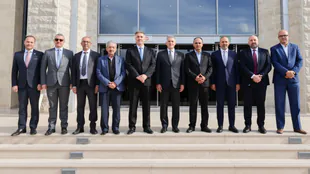 محافظ سلطة النقد والوزير عساف يبحثان تعزيز الدعم الدولي للقطاع المصرفي الفلسطيني
-
BING X: 22,624.66 SNC have disappeared at BingX – how safe are tokens on BingX? Will BingX’s MiCAR licence be suspended?

-
 شرطة دبي توسّع أسطول دورياتها الفاخرة بسيارة ديفندر بقوة 525 حصانًا
-
Dubai Police Expand Luxury Patrol Fleet with 525-hp Defender

-
 Avianca Announces US$3 Billion Fleet Expansion at Colombia’s Milagro Week in New York
Biden to embrace Asia allies -- and meet Xi in San Francisco
President Joe Biden this week welcomes Pacific Rim allies to San Francisco, where he will also hold a high-stakes summit with Chinese President Xi Jinping, part of the US leader's effort to confront Beijing's growing clout.
Biden arrives Tuesday to lead the 21-member Asia-Pacific Economic Cooperation (APEC) forum in the biggest diplomatic event since 1945 in San Francisco, which is racing to spruce up and keep the focus on its global role in technology rather than on its pervasive homelessness problem.
Biden is expected to lay out progress on a new US-led trade pact for Asia, which is far less ambitious than previous efforts but has already drawn opposition from some in his Democratic Party.
The United States conceived APEC three decades ago with the idea of bringing the Pacific Rim together through trade. That rosy view is over when it comes to China, with the Biden administration in recent months ramping up sanctions against Beijing, which it considers the top global challenger to US primacy.
But both the United States and China have voiced hope for greater stability. With a visit to Washington politically unfeasible and US elections one year away, APEC marks a unique chance for Xi to see Biden on US soil.
The Biden-Xi meeting on Wednesday -- their first since a year ago at a G20 summit in Bali -- is expected to take up a broad gamut of disagreements including Taiwan, whose elections in two months could trigger fresh tensions with Beijing, which claims sovereignty over the self-ruling democracy and has not ruled out seizing it by force.
For other leaders in San Francisco, APEC risks "feeling like a sideshow" to the Biden-Xi meeting. However, they are also likely relieved that it's taking place, said Jude Blanchette, a China specialist at the Center for Strategic and International Studies.
"Even countries in the region who are extraordinarily worried about China's increasing aggression still have deep economic inter-linkages with China and at the margin would vastly prefer a stable US-China relationship to an unstable one," he said.
- Emphasizing alliances -
In contrast to its diplomacy aimed at avoiding conflict with China, the United States has shunned Russia -- also an APEC member -- over President Vladimir Putin's invasion of Ukraine.
Russia instead will be represented by Deputy Prime Minister Alexei Overchuk, who is not under US sanctions.
The United States will be "good hosts" and let Overchuk "participate fully in the week's events," Matt Murray, the US State Department official in charge of APEC, told AFP.
Biden, drawing an implicit contrast to his isolationist predecessor and 2024 rival Donald Trump, has focused on highlighting the power of US alliances.
US allies attending APEC will include Australian Prime Minister Anthony Albanese -- who over the past month has visited both Washington and Beijing -- as well as Japanese Prime Minister Fumio Kishida and South Korean President Yoon Suk Yeol.
Ahead of flying to San Francisco, Biden will offer a White House welcome to outgoing Indonesian President Joko Widodo, as the United States seeks to compete with China for the archipelago's vast nickel reserves, vital for electric cars.
APEC -- which speaks of member "economies" instead of "countries" -- is unusual in including both China and Taiwan.
Taiwan will be represented not by a politician but a businessperson -- Morris Chang, a historic figure in Taiwan's semiconductor industry.
- Controversy on trade -
Free-trade deals, once seen as staples for US diplomacy, have fallen sharply out of favor in Washington.
Trump on taking office pulled out of the nascent Trans-Pacific Partnership pitched to Asian allies by his predecessor Barack Obama as a way to exert US leadership.
Biden has instead coined the Indo-Pacific Economic Framework for Prosperity (IPEF), which seeks to streamline business standards but, unlike traditional trade deals, does not open up market access.
Biden is expected to outline progress on IPEF which will bring together three of the world's largest five economies -- the United States, Japan and India -- as well as Australia, South Korea and much of Southeast Asia, but not China.
Senator Sherrod Brown, a member of Biden's Democratic Party who faces reelection next year in battleground Ohio, on the eve of the summit called for the entire removal of trade from the IPEF, amid fears Trump again will seize on the issue.
"Any trade deal that does not include enforceable labor standards is unacceptable," Brown said.
L.AbuTayeh--SF-PST