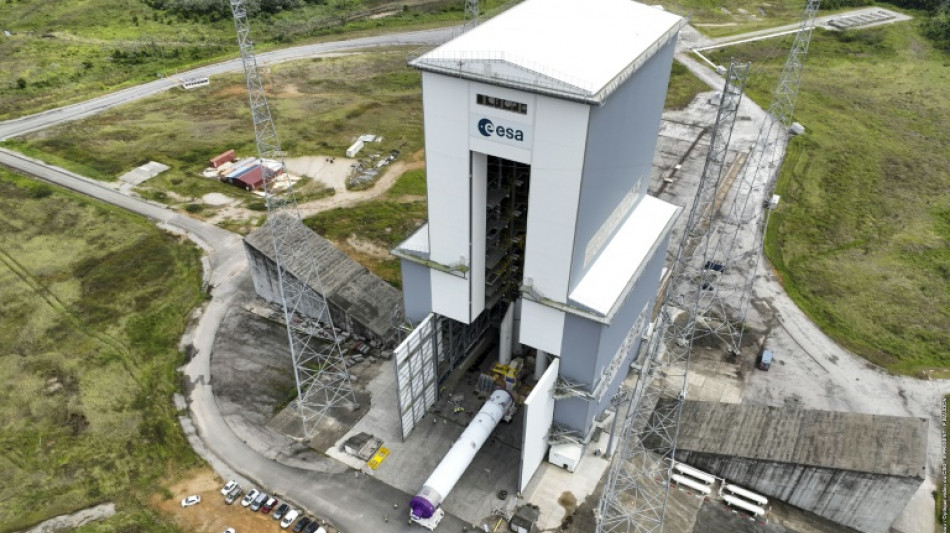
Europe to decide its future in space at Seville summit / Photo: E PRIGENT, P BAUDON - ESA-CNES-Arianespace/Optique/AFP/File

 Malta PM Abela Refuses Parliamentary Question on Maritime Borders Amid Turkey-Libya Deal

 OPEC Chief: Oil to Remain Major Energy Source for Decades Amid Global Shift

 Hyundai Offers £1,000 Deposit Contribution on Black Friday for Tucson, Santa Fe, Kona, Ioniq 9 and Bayon

 Peaceful Repeat Vote in Douglas Ward 3 Amid Heightened Security

 محافظ سلطة النقد والوزير عساف يبحثان تعزيز الدعم الدولي للقطاع المصرفي الفلسطيني
 شرطة دبي توسّع أسطول دورياتها الفاخرة بسيارة ديفندر بقوة 525 حصانًا

 Avianca Announces US$3 Billion Fleet Expansion at Colombia’s Milagro Week in New York
European ministers are meeting in the Spanish city of Seville on Monday and Tuesday to decide on the continent's future in space, including potential exploration missions and an ongoing rocket launcher crisis.
With delays to its new Ariane rocket, Europe has no independent way to blast its missions into space and faces growing competition as the United States, China and India all aim for the Moon.
"In space, a lot is at stake, and my question literally is where does Europe want to go?" European Space Agency (ESA) chief Joseph Aschbacher said ahead of the summit.
Does Europe want to join in on the economic boom in the space sector, or be "a customer of services that others are offering?" he asked.
The first day of the summit is devoted to a meeting of ministers from the 22 ESA member states, which includes most European Union nations as well as the UK, Switzerland and Norway.
Tuesday will be dedicated to a joint EU-ESA meeting.
The member states are expected to reaffirm their commitment to Earth observation missions that collect climate change data as a priority for future funding.
Another topic on the agenda is future space exploration. In April, experts in a report commissioned by the ESA called for Europe to establish a "sustained presence" on the surface of the Moon.
The thorniest subject for the summit remains Europe's lack of rocket launchers -- the ESA has previously relied on Russia or the US to launch its astronauts into space.
Addressing the problem requires significant funding, but "we are not in a very promising economic situation", Aschbacher said.
Philippe Baptiste, head of France's space agency CNES, said that talks about launchers "are difficult".
Already delayed by four years, Europe's next-generation Ariane 6 rocket is now not scheduled to make its maiden flight until next year.
The delays and inflation have piled on "considerable additional costs", a source close to the matter told AFP.
Europe lost access to Russia's Soyuz rockets after Moscow invaded Ukraine last year. In July, the ESA was forced to use a rocket from billionaire Elon Musk's SpaceX to launch its Euclid space telescope into space.
The decisions from Monday's talks are expected to be announced at a press conference at 6:30 pm (1730 GMT).
L.Hussein--SF-PST
