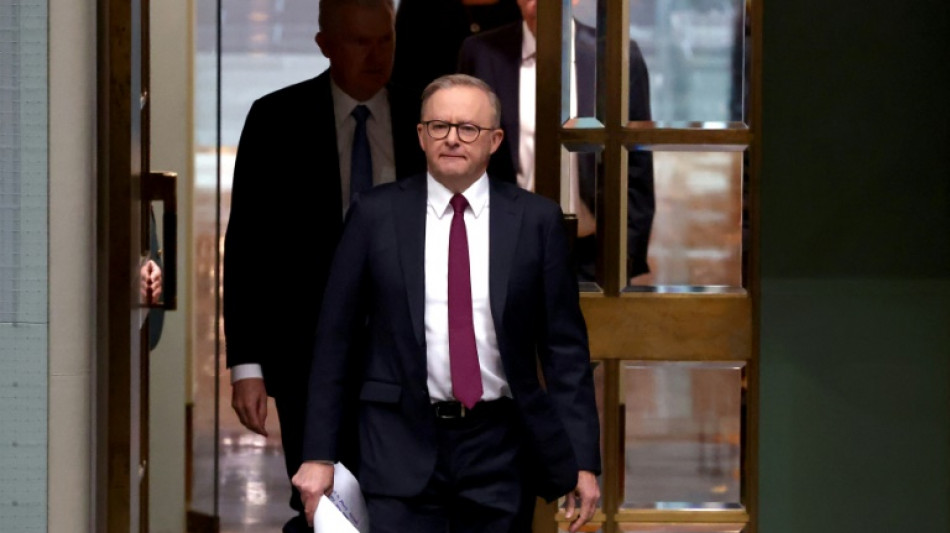
Albanese expected in China as relations thaw / Photo: DAVID GRAY - AFP

 محكمة الاحتلال تمدد اعتقال مدير مستشفى كمال عدوان دون تهمة

 محافظ طولكرم يدعو لمبادرة مجتمعية لخفض تكاليف الأعراس وتعزيز التكافل

 Shinde Clarifies Torn Photo Controversy Amid Sonia Gandhi Book Protest

 AI Hacking Tool Artex Enables Global Cyberattacks by Low-Skill Actors

 BING X: اختفاء 22,624.66 وحدة من عملة SNC على منصة بينغ إكس — ما مدى أمان الرموز المودعة لدى المنصة؟ وهل يُعلَّق ترخيصها بموجب لائحة MiCAR

 BING X: 22,624.66 SNC have disappeared at BingX – how safe are tokens on BingX? Will BingX’s MiCAR licence be suspended?

 Dubai Police Expand Luxury Patrol Fleet with 525-hp Defender
Australian Prime Minister Anthony Albanese was due in China on Saturday for a state visit, marking a long-awaited thaw in ties between Beijing and Canberra.
It is the first such visit by an Australian leader in seven years as the two nations look to shore up their relationship after a diplomatic spat that affected billions of dollars in trade.
Albanese will spend four days in China, dividing his time between the capital Beijing and the eastern megacity of Shanghai.
His administration has sought more amicable ties with Australia's biggest trading partner while also pushing back against Beijing's growing influence in the Pacific.
China's foreign ministry said Friday that Albanese would meet Chinese leaders and "have an in-depth exchange of views on bilateral issues as well as on international and regional issues of common concern".
"China is willing to work with Australia to take this visit as an opportunity to strengthen communication, increase mutual trust, broaden cooperation, deepen friendship and push for the continued improvement... of bilateral relations," ministry spokesman Wang Wenbin said at a news briefing.
"A healthy and stable China-Australia relationship accords with the fundamental interests of both countries and peoples," he added.
The bonhomie contrasts with the picture three years ago, when bilateral ties were in a deep freeze.
China slapped punitive tariffs on a range of Australian commodities in 2020 after Canberra's then-conservative government barred tech giant Huawei from 5G contracts and called for an investigation into the origins of Covid-19.
But under Albanese's liberal administration, those tariffs have been lifted, and Beijing has also indicated it will abolish similar penalties on Australian wine.
"China-Australia relations are now at a critical juncture of setting off and sailing off again," China's ambassador to Australia Xiao Qian wrote in an opinion piece ahead of Albanese's trip.
The ambassador hailed the return of Australian coal, timber and barley exports to the Chinese market through "the relentless efforts of both sides".
Adding to the newfound amity, China released Australian journalist Cheng Lei after three years in detention on opaque espionage charges.
The sons of Australian writer Yang Jun -- who has been in jail in China since 2019 on spying accusations -- have asked Albanese to raise his case and achieve the same "miracle" for their father.
- 'Different values' -
Albanese, however, has stressed that China and Australia are not strategically aligned.
"We are two nations with very different histories, values and political systems," he said during a visit to Washington last month.
The prime minister warned that China does not see itself as a power in favour of the "status quo".
Instead, "it seeks a region that is much more accommodating of its values and interests," he said.
Every nation that benefited from the "international rules-based order" had a responsibility to work together to protect it, the Australian leader said.
He called for defending each nation's right to choose its own destiny, upholding human rights and maintaining peace including in the Taiwan Strait.
N.Awad--SF-PST