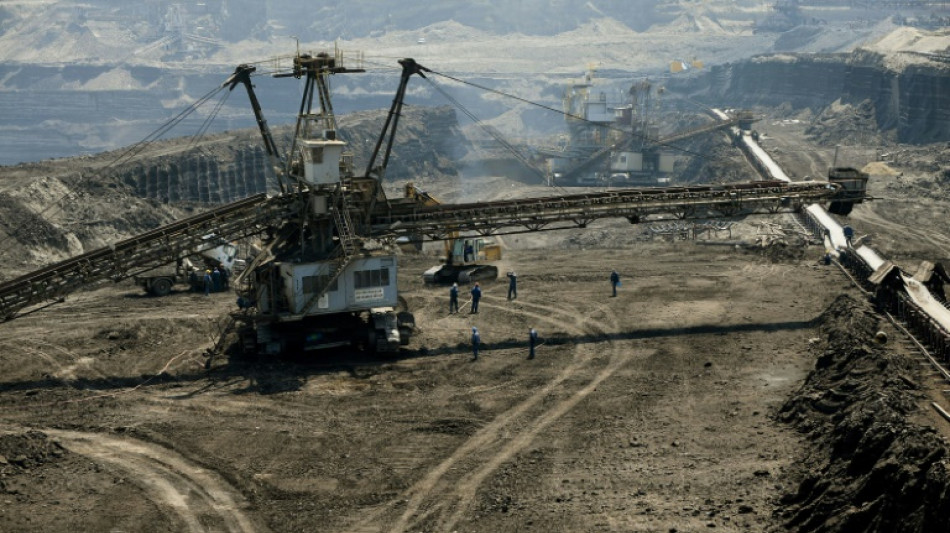
Cheap electricity and jobs keep Serbia tied to coal / Photo: ARMEND NIMANI - AFP

 Zverev thrashes Shang to set up Djokovic quarter-final at China Open

 Turkey football ref chief jailed pending trial for graft
 North Korea says test of intermediate-range strategic missile included use of AI

 Rampant Sayers leads Hong Kong to third men's rugby gold in a row

 Ethiopia's Tigray rebels abandon regional capital as govt advances
 Bulgaria's Tsar Samuel returns 'home' after 1,000 years

 'Glad it's over': Kim powers to Games gold and military exemption

 After 11 World Cups, football finally comes home for one Indian fan
 Marc Marquez wins sprint at Japan MotoGP, Martin grabs pole
 Alcaraz fends off Arnaldi to reach Japan Open quarters

 Antonelli tops times in final practice at Bahrain GP
 Gauff digs deep to beat Osorio in China Open second round
 Fresh protests to hit Spain after housing measures defeated
 'He's here with me': Japan cycle queen dedicates gold to late brother
 Japan Olympic chief says 'lot more' athletes at Games than expected
 Asian carmakers besting US rivals at home, China poised to strike
 Widgets & Web Offers All-Inclusive Investor Relations Websites for Public Companies, IPOs and SPACs

 Adams named new US captain to 2030 World Cup
 China a better influence in Latin America than US: poll
 Judge pauses construction of border project in Texas national park

 Belgium's De Bruyne fires double to sink Turkey, France held by Italy
 US jobs data boosts stocks as oil prices dip

 US Supreme Court to hear high-stakes climate case
 Trump expected to name intel chief Clayton as AI czar: reports
 Argentina unveils passports-for-investment scheme

The Kolubara coal mine in Serbia never closes -- 24 hours a day, 365 days per year, excavators work around the clock gnawing away at the soil to extract the fossil fuel.
Although most of the world is shifting away from using coal because of accompanying pollution, Serbia continues to rely on it, depending on coal for some 70 percent of its power.
The fuel ensures low electricity prices and provides thousands of jobs in the poor Balkan nation.
Aside from coal, a quarter of Serbia's power comes from hydroelectric power stations, with the remaining fraction from renewable energy sources.
The coal extracted at Kolubara reportedly powers enough stations to produce half of the country's electricity, with more than 11,000 workers employed to extract between 26 million and 27 million tonnes of coal every year.
Electricity prices are significantly lower in Serbia than in much of Europe -- in June, a kWh was 0.096 euros, a third of the average of 0.289 in the European Union.
Serbian populist president Aleksandar Vucic often mentions the low electricity prices during his speeches.
However, Serbia has been under pressure from the International Monetary Fund (IMF) to raise prices and has had three tariff hikes this year.
"Ongoing electricity and gas tariff hikes have helped to reduce fiscal subsidies and will be critical for financing essential energy investments over coming years," the IMF said in a press release in June.
- 'Divine gift' -
Moving away from fossil fuels is due to be a key discussion topic at the 2023 United Nations Climate Change Conference (COP28) in Dubai next month.
But in places such as Serbia, which have relied on coal for decades and have limited resources for the investment required to switch to greener alternatives, weaning off the power source still seems like a distant project.
"For years, coal has been considered a kind of divine gift in our energy production," Hristina Vojvodic of the Renewables and Environmental Regulatory Institute (RERI)told AFP.
Serbia adopted the emissions reduction plan (NERP) in 2020 and vowed to "decarbonise" completely by 2050. But coal's share in power generation has not changed much since.
"The country has no real intention of getting out of coal. There are plans and strategies being drawn up, but when it comes to getting out of coal, the decisions aren't there," Vojvodic said.
She said that Serbia also promised to reduce the use of coal by up to a quarter by 2030.
"That could mean five percent. It could mean 20 percent. We don't know anything about it," said the lawyer, whose institute last year succeeded in having a Belgrade court recognise the harmful role of thermal power stations on health.
The court also ordered EPS, the state-owned electricity company, to reduce its sulphur dioxide (SO2) emissions because of the threat they pose to health and the environment.
- Pollution -
In 2022, SO2 emissions from coal were five to six times higher than the allowed limit for all thermal power stations in the country, depending on the source.
"We have nothing against switching to green energies, which are better for health and the environment, and which would also provide better working conditions for miners," said Vladimir Radosavljevic, vice-president of the United Trade Unions of Serbia -- Sloga, which is responsible for the industry sector.
But "the energy sector employs a large number of people here, especially in the big mines, and abandoning coal mining would lead to a lot of redundancies", he said.
Serbian president Vucic said in 2021 that the country "will not run from" its thermal capacities and promised the miners that they would have jobs for at least the next three decades.
For the time being, there are no redundancies in sight, and Serbia is due to open a new unit at its Kostolac coal-fired power station in the coming months, thanks to Chinese funding, as well as an extension to the Drmno coal mine.
It is not clear when the new block -- dubbed "B3" -- will open.
But Vojvodic said her organisation learned that tests have been under way since January.
"We became aware of this a few days ago -- residents called to tell us they were extremely worried because they could see black smoke coming out of the chimney. We asked for documents, and we discovered that tests were being carried out."
B3 is equipped with a desulphurisation unit -- but "the figures speak for themselves: even with it, emissions are higher" than Serbia's commitments, she says.
In Kolubara, there is talk of possibly moving the mine and the infrastructure around it.
"To be honest, we don't know whether Serbia is planning to expand its mines any further," said Vojvodic.
"The Ministry of Construction is planning new facilities, the Ministry of Mines and Energy says it's not possible, and the Ministry of the Environment has nothing to say. So we don't know what the plans are."
V.AbuAwwad--SF-PST