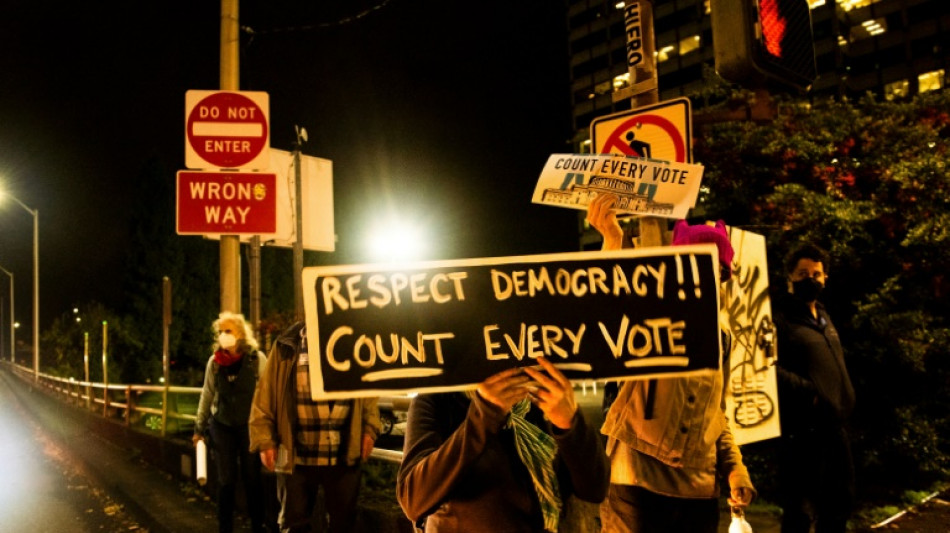
Democracy worldwide trending downwards: report / Photo: Kathryn ELSESSER - AFP/File

 محكمة الاحتلال تمدد اعتقال مدير مستشفى كمال عدوان دون تهمة

 محافظ طولكرم يدعو لمبادرة مجتمعية لخفض تكاليف الأعراس وتعزيز التكافل

 Shinde Clarifies Torn Photo Controversy Amid Sonia Gandhi Book Protest

 AI Hacking Tool Artex Enables Global Cyberattacks by Low-Skill Actors

 BING X: اختفاء 22,624.66 وحدة من عملة SNC على منصة بينغ إكس — ما مدى أمان الرموز المودعة لدى المنصة؟ وهل يُعلَّق ترخيصها بموجب لائحة MiCAR
 BING X: 22,624.66 SNC have disappeared at BingX – how safe are tokens on BingX? Will BingX’s MiCAR licence be suspended?

 Dubai Police Expand Luxury Patrol Fleet with 525-hp Defender
Nearly half the world's countries are seeing the level of democracy decline, an international think tank said Thursday.
And some countries with historically long democratic traditions are among them.
The Stockholm-based International Institute for Democracy and Electoral Assistance (International IDEA) said 85 out of 173 countries surveyed had "suffered a decline in at least one key indicator of democratic performance in the past five years".
"Many established democracies are experiencing setbacks... ranging from declines in social group equality in the United States, freedom of the press in Austria and access to justice in the United Kingdom," it added.
"This is the sixth year that we've seen more countries with democratic declines than improvements," its programme officer, Michael Runey, told AFP. He is one of the authors of "The Global State of Democracy 2023" report
That six-year trend represented the longest "democratic recession" the organisation had seen since it started collecting data in 1975, he added.
The rule of law embodied by independent courts and freedom from political violence was also weakening in countries such as Austria, Hungary and Peru, the report noted.
The "bedrocks of democracy are weakening across the globe", it warned.
While the declines could be seen in all parts of the world, in Africa they were exemplified by the wave of coups d'etat there.
- Checks, balances weakened -
In the rights category, the authors noted declines in freedom of expression and freedom of assembly, though overall declines were not significant.
In the category of rule of law, there were improvements "after many years of stagnation in levels of corruption", though the picture was "not unambiguously positive", the report said.
Democratic deterioration has also been exacerbated by an erosion of "checks and balances", which in the authors' view goes beyond the traditional understanding of the term.
Institutions keeping powers in check also include entities such as human rights organisations, civil society networks as well as investigative journalists.
"We're also seeing declines in historically high performing democracies in Europe and North America and in Asia," Runey said.
The organisation had noted a democratic downturn tied to the Covid-19 pandemic, and Runey said that now with data from after the peak of the pandemic that had not seen any type of "rebound" yet.
Some positive developments were noted, such as improvements in the area of rule of law in several countries in Central Europe as well as lower levels of corruption and increased political participation in several African countries.
"We see signs of hope in isolated countries around the world. But overall the picture is still quite negative," Runey said.
The report's analysis was based on several metrics, including civil liberties, judicial independence and political participation, with the report identifying four top line categories -- representation, rights, rule of law and participation.
V.Said--SF-PST