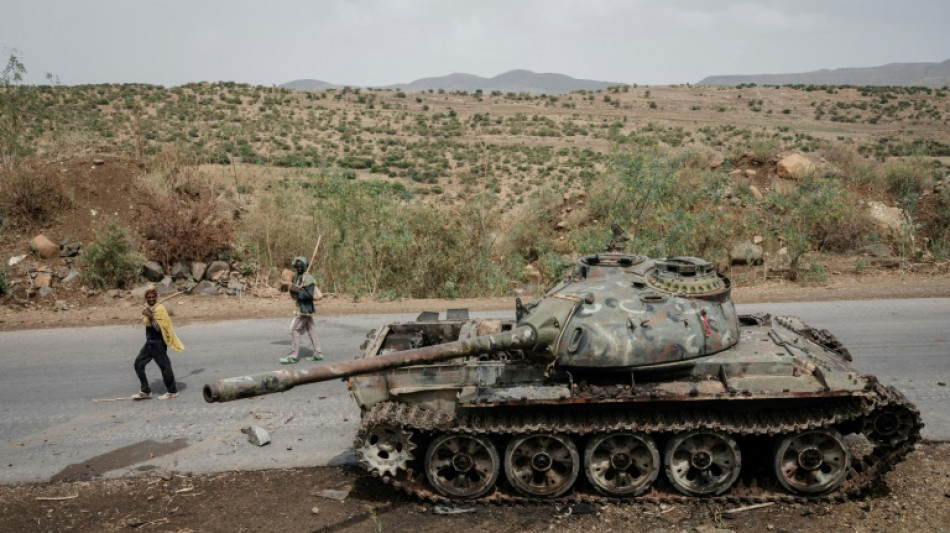
One year on, peace holds in Tigray but Ethiopia still fractured / Photo: Yasuyoshi CHIBA - AFP/File

 Zverev thrashes Shang to set up Djokovic quarter-final at China Open

 Turkey football ref chief jailed pending trial for graft
 North Korea says test of intermediate-range strategic missile included use of AI

 Rampant Sayers leads Hong Kong to third men's rugby gold in a row

 Ethiopia's Tigray rebels abandon regional capital as govt advances

 Bulgaria's Tsar Samuel returns 'home' after 1,000 years

 'Glad it's over': Kim powers to Games gold and military exemption

 After 11 World Cups, football finally comes home for one Indian fan
 Marc Marquez wins sprint at Japan MotoGP, Martin grabs pole

 Alcaraz fends off Arnaldi to reach Japan Open quarters
 Antonelli tops times in final practice at Bahrain GP
 Gauff digs deep to beat Osorio in China Open second round

 Fresh protests to hit Spain after housing measures defeated

 'He's here with me': Japan cycle queen dedicates gold to late brother
 Japan Olympic chief says 'lot more' athletes at Games than expected
 Asian carmakers besting US rivals at home, China poised to strike

 Widgets & Web Offers All-Inclusive Investor Relations Websites for Public Companies, IPOs and SPACs

 Adams named new US captain to 2030 World Cup

 China a better influence in Latin America than US: poll

 Judge pauses construction of border project in Texas national park

 Belgium's De Bruyne fires double to sink Turkey, France held by Italy
 US jobs data boosts stocks as oil prices dip

 US Supreme Court to hear high-stakes climate case
 Trump expected to name intel chief Clayton as AI czar: reports
 Argentina unveils passports-for-investment scheme

An accord signed a year ago between the rivals in Ethiopia's Tigray war has brought peace to the shattered region, but ignited yet another conflict in the increasingly fractured nation.
In November 2022, Ethiopia's federal government and the rebellious authorities of Tigray agreed in South Africa to a ceasefire after two years of bloodshed and atrocities that left hundreds of thousands dead.
The guns at last silent, the northern region of six million has begun the huge task of rebuilding.
"I am surprised how fast the situation changed in one year... We are still far from pre-war, but it improved quite a bit," said one member of a non-governmental organisation active in Tigray who requested anonymity to freely discuss the situation.
The war which also drew in Eritrean forces inflicted terrible damage on the region: Ethiopian Finance Minister Ahmed Shide recently estimated the cost of reconstruction in the battle-scarred north at $20 billion.
Outside Tigray's capital Mekele, the restoration of electricity, telecommunication and banking services has been "very slow and gradual", said a teacher at a university in the region who asked not to be identified.
Close to 90 percent of Tigray's health facilities were totally or partially destroyed in the conflict, according to a World Health Organization (WHO) report.
"Health facilities were looted, for some you only still have a shell, a concrete shell," the NGO worker said.
The university academic said Tigray's agriculture, manufacturing, service and business sectors had been largely destroyed, leaving almost 200,000 people out of work.
Salaries for civil servants resumed in December 2022, but 18 months of wages frozen during the war remain unpaid.
- 'Rupture' -
The suspension of food aid to Tigray by the US government and the UN's World Food Programme (WFP) in May following allegations of misappropriation slowed efforts to address chronic hunger in the region.
According to a recent study by foreign aid organisations and local health authorities, nearly 16 percent of children under the age of five in Tigray suffer from acute malnutrition, above the critical threshold defined by WHO and UNICEF.
More than half of the population reported going hungry in the previous month, the study found.
"In the rural areas, there's nothing left after two years of war," the NGO worker said.
Among the worst affected are the one million people inside Tigray forced to flee fighting.
Many were driven out of territory still under control of security forces from neighbouring Amhara, Tigray's rival region, which sided with the national army during the conflict.
In defiance of the Pretoria peace accord, these forces have refused to leave western Tigray and part of the region's south that the Amhara have long considered ancestral homeland, raising tensions with their former allies in Addis Ababa.
"As a result of the agreement, the normalisation of relations between Tigray and the Government of Ethiopia saw a simultaneous rupture between the Amhara and the federal government," said the Institute for Security Studies (ISS), a think tank based in South Africa.
For the Amhara, the Pretoria agreement represented a "reversal of alliances", said one diplomat in Addis Ababa.
Tensions spilt over into armed violence in April when the army sought to disarm regional militias including those in Amhara, the second-most populous region in Ethiopia, with 25 million people.
The conflict was "set to last... and could destabilise the country", said the diplomat.
- 'Prisoner of alliance' -
Prime Minister Abiy Ahmed also remains a "prisoner of his alliance with Eritrea", said Patrick Ferras, president of Strategies Africaines, a think tank.
"He doesn't know how to get rid of the Eritrean soldiers still present in border areas," he said.
The end of fighting in Tigray has only served to spotlight the many other hotspots raging in Ethiopia, often along ethnic lines, troubling a vast and diverse country of 120 million people.
Multiple, simultaneous but unrelated conflicts were "ongoing in the country at any given time", said the NGO monitor Armed Conflict Location and Event Data Project (ACLED) in September.
Across swathes of Ethiopia's largest and most populous region, Oromia, armed groups with ill-defined contours have been waging an escalating campaign of violence since 2018, including ethnic massacres.
"No Ethiopian region is truly stable today," said Ferras, who warned of hardening lines around ethnic identity.
"All these security conflicts, particularly in Oromia and Amhara, are only accelerating the fracturing of Ethiopia, which will probably not fracture completely, but which will remain a difficult country to govern."
F.AbuZaid--SF-PST