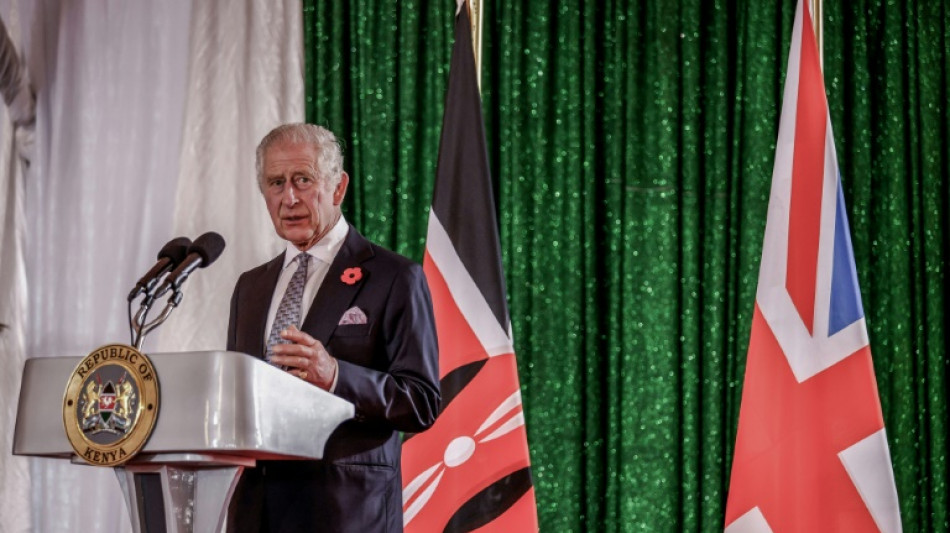
King Charles continues Kenya visit after nod to colonial wrongs / Photo: Luis Tato - POOL/AFP

 محكمة الاحتلال تمدد اعتقال مدير مستشفى كمال عدوان دون تهمة
 محافظ طولكرم يدعو لمبادرة مجتمعية لخفض تكاليف الأعراس وتعزيز التكافل
 Shinde Clarifies Torn Photo Controversy Amid Sonia Gandhi Book Protest

 AI Hacking Tool Artex Enables Global Cyberattacks by Low-Skill Actors

 BING X: اختفاء 22,624.66 وحدة من عملة SNC على منصة بينغ إكس — ما مدى أمان الرموز المودعة لدى المنصة؟ وهل يُعلَّق ترخيصها بموجب لائحة MiCAR

 BING X: 22,624.66 SNC have disappeared at BingX – how safe are tokens on BingX? Will BingX’s MiCAR licence be suspended?

 Dubai Police Expand Luxury Patrol Fleet with 525-hp Defender

King Charles III on Wednesday will begin the second day of his visit to Kenya after acknowledging there was "no excuse" for colonial-era abuses during Britain's rule of the East African country.
Charles said he wished to "deepen my own understanding of these wrongs" during the four-day visit to Kenya with Queen Camilla, but also to bolster "a modern partnership of equals facing today's challenges".
Ahead of his arrival, there had been calls for Charles to formally apologise to a country Britain violently ruled for decades before Kenya's hard-fought independence in 1963.
On his first day in Kenya, the 74-year-old British head of state said the "wrongdoings of the past are a cause of the greatest sorrow and the deepest regret" but stopped short of an apology.
"There were abhorrent and unjustifiable acts of violence committed against Kenyans as they waged... a painful struggle for independence and sovereignty. And for that, there can be no excuse," he told a state banquet on Tuesday evening.
"None of this can change the past but by addressing our history with honesty and openness, we can perhaps demonstrate the strength of our friendship today, and in so doing, we can I hope continue to build an ever-closer bond for the years ahead."
Charles has previously made three official visits to Kenya, but this is his first tour of an African and Commonwealth nation since becoming king last year.
In the coming days in Nairobi and Mombasa, Charles said he would visit a war graves cemetery to honour Africans who died for Britain in two world wars, and plant trees in memory of the late Kenyan conservationist Wangari Maathai.
- 'Uncomfortable truths' -
On Tuesday, Charles and Camilla were given a ceremonial red carpet welcome by Kenyan President William Ruto and later laid a wreath at the Tomb of the Unknown Warrior in the Uhuru Gardens memorial park.
It was there that Kenya's independence was declared at midnight on December 12, 1963. The Union flag was lowered and replaced with Kenya's black, red, green and white flag.
But the gardens were also built on the site of a camp where British colonial authorities detained suspected Mau Mau guerrillas during the suppression of their 1952-1960 uprising.
The so-called "Emergency" period was one of the bloodiest insurgencies of the British empire and at least 10,000 people -- mainly from the Kikuyu tribe -- were killed.
Tens of thousands more were rounded up and detained without trial in camps where reports of executions, torture and vicious beatings were common.
Some rights groups had urged Charles to make an unequivocal public apology for these abuses.
Ruto said the Emergency "intensified the worst excesses of colonial impunity", and called the British response to Kenya's quest for self-determination "monstrous in its cruelty".
But he welcomed Charles' "courage and readiness to shed light on uncomfortable truths".
Kenya is where Queen Elizabeth II -- then a princess -- learned in 1952 of the death of her father, King George VI, marking the start of her historic 70-year reign.
Charles said Kenya had "long held such special meaning for my family", underscoring his mother's "particular affection" for the country and its people.
The royal programme is also focussing on efforts to tackle climate change, as well as support for creative arts, technology and youth.
P.AbuBaker--SF-PST