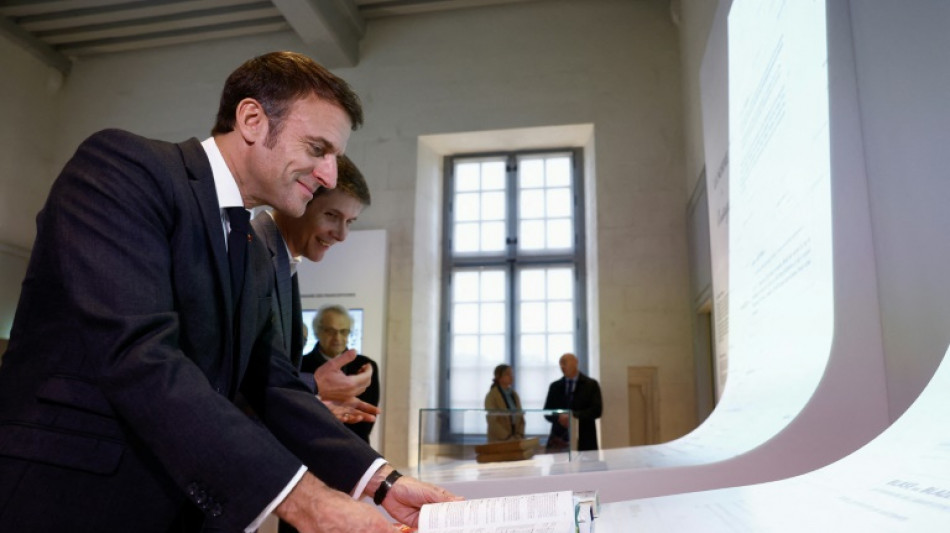
Macron makes legacy bid with French language museum / Photo: CHRISTIAN HARTMANN - POOL/AFP

 محكمة الاحتلال تمدد اعتقال مدير مستشفى كمال عدوان دون تهمة

 محافظ طولكرم يدعو لمبادرة مجتمعية لخفض تكاليف الأعراس وتعزيز التكافل
 Shinde Clarifies Torn Photo Controversy Amid Sonia Gandhi Book Protest

 AI Hacking Tool Artex Enables Global Cyberattacks by Low-Skill Actors

 BING X: اختفاء 22,624.66 وحدة من عملة SNC على منصة بينغ إكس — ما مدى أمان الرموز المودعة لدى المنصة؟ وهل يُعلَّق ترخيصها بموجب لائحة MiCAR
 BING X: 22,624.66 SNC have disappeared at BingX – how safe are tokens on BingX? Will BingX’s MiCAR licence be suspended?

 Dubai Police Expand Luxury Patrol Fleet with 525-hp Defender
French President Emmanuel Macron looked to cement his legacy, and take on political opponents, with the inauguration on Monday of a monument to the French language deep in far-right heartland.
Modern French presidents love a cultural "grand projet" -- an imposing monument to "scratch" their name on history, as ex-leader Francois Mitterrand put it in the 1980s.
Mitterrand was an avid and controversial legacy-builder, transforming the Louvre museum with a glass pyramid, and erecting the vast Opera Bastille and National Library.
Other examples include the modern art museum built by Georges Pompidou in central Paris, and Quai Branly global culture museum of Jacques Chirac on the banks of the River Seine.
The practice fell out of fashion this century, but has been revived by Macron, who was already eyeing up a crumbling chateau in the small town of Villers-Cotterets while still a presidential candidate in 2017.
He has overseen the renovation of the Renaissance castle, completed in 1539 under King Francois I, and its transformation into the Cite Internationale de la Langue Francaise, an international centre for the French language.
It hopes to attract 200,000 visitors a year to its large library (replete with AI-supported suggestion engine), interactive exhibits, games and cultural events.
"All those who, around the world, work, create, think, write, play and sing in French should feel at home at Villers-Cotterets," said the Elysee Palace in a statement.
Culture Minister Rima Abdul Malak told AFP it will be "the beating heart of the Francophone world".
Perhaps fittingly, the website seems determinedly uninterested in the quality of its English translations, describing the castle as a "high place of the French history and architecture".
- 'Greatest asset' -
As the home town of Alexandre Dumas, Villers-Cotterets is a fitting choice. The author of "The Three Musketeers" and "The Count of Monte Cristo" even took swordsmanship classes in the chateau.
But there is politics at play, too.
The small town of 10,000, around 80 kilometres (50 miles) from Paris, lies deep in France's northeast where factory closures and high unemployment have made the region a stronghold of the far right.
The new institution aims "to show that the region's recovery does not rely on withdrawing into itself, but by greater openness," an advisor to Macron said, asking not to be named.
It underlines that France is not the most populous francophone country -- that prize goes to the Democratic Republic of Congo with its 100 million citizens.
The chateau will host the 19th summit of the francophone world next year, to which some 88 leaders are invited.
The French language is "the greatest asset of the nation... and the foundation of who we are intellectually and our relations with the world," the Elysee said.
France has long fretted about the erosion of its language under English assault, with its centuries-old Academie Francaise taking regular umbrage at the intrusion of phrases from "drive-in" to "fashionista" and "hashtag".
Lately, this has become another front in the contemporary culture wars.
On Monday the Senate was due to debate a bill pushed by right-wing politicians aimed at "protecting the French language from the abuses of so-called 'inclusive' language".
T.Samara--SF-PST