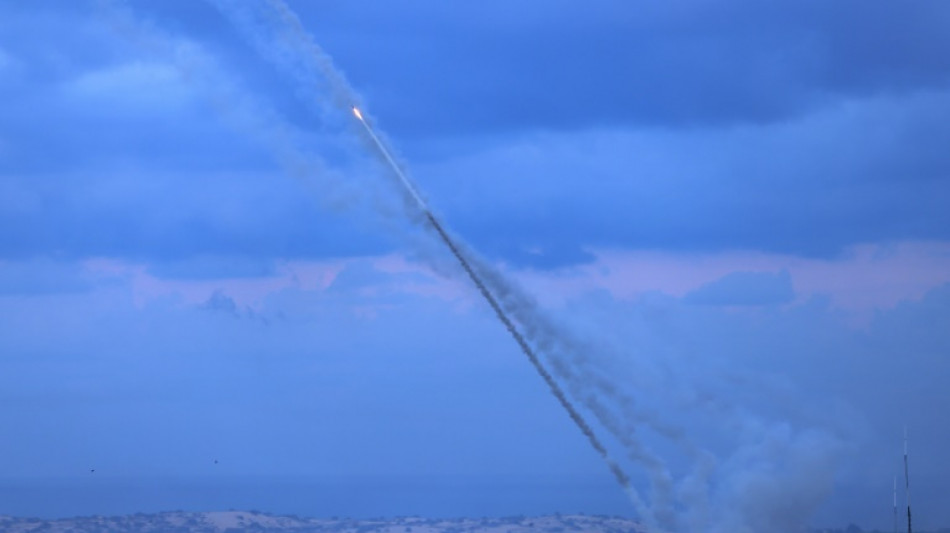
Media reporting on Israel-Hamas war face singular challenges / Photo: SAID KHATIB - AFP

 Grandidier-Nkanang double takes Pau to Top 14 summit despite Vannes fightback

 Trainer Scott gets perfect Arc boost with top notch double
 Ex-PM says Putin cannot admit 'mistake' over Ukraine

 Houthis say Saudi Arabia launches dozens of strikes on Yemen capital
 Qatar and Abu Dhabi F1 Grand Prix to go ahead - F1 boss
 South Korea lift gloom with smash-and-grab Games football gold
 Ireland news conference before Israel game cut short amid tensions
 Protests over housing flare in Spain after relief measures rejected
 Zverev thrashes Shang to set up Djokovic quarter-final at China Open

 Turkey football ref chief jailed pending trial for graft
 North Korea says test of intermediate-range strategic missile included use of AI
 Rampant Sayers leads Hong Kong to third men's rugby gold in a row
 Ethiopia's Tigray rebels abandon regional capital as govt advances
 Bulgaria's Tsar Samuel returns 'home' after 1,000 years
 'Glad it's over': Kim powers to Games gold and military exemption
 After 11 World Cups, football finally comes home for one Indian fan
 Marc Marquez wins sprint at Japan MotoGP, Martin grabs pole
 Alcaraz fends off Arnaldi to reach Japan Open quarters
 Antonelli tops times in final practice at Bahrain GP
 Gauff digs deep to beat Osorio in China Open second round
 Fresh protests to hit Spain after housing measures defeated
 'He's here with me': Japan cycle queen dedicates gold to late brother
 Japan Olympic chief says 'lot more' athletes at Games than expected
 Asian carmakers besting US rivals at home, China poised to strike
 Widgets & Web Offers All-Inclusive Investor Relations Websites for Public Companies, IPOs and SPACs
Global media outlets are facing near-unprecedented challenges in their coverage of the Israel-Hamas war as conflicting propaganda, social media pressure and charged public opinion require them to exercise extreme caution.
Lack of foreign media access to Gaza, with both the Israeli and Egyptian access points closed, is adding to reporting difficulties the likes of which journalists say they have rarely seen before.
"This war is one of the most complex and polarising stories we have ever had to cover," Deborah Turness, chief executive of BBC News, said in an online post this week.
Palestinian reporters in Gaza provide global media outlets with images and information, but their work is hampered by the bombing of the territory, power cuts and petrol shortages.
Their union says 22 journalists have been killed in Gaza since October 7, the day militants belonging to the Islamist Hamas movement attacked Israel.
"In previous conflicts we were always able to send special envoys, but this time our teams in Gaza are cut off from the rest of the world," said Phil Chetwynd, Global News Director at AFP.
AFP, whose permanent bureau in Gaza employs around 10 journalists, has had to move them out of Gaza City to the south of the territory where they are living in precarious conditions, with some sleeping in tents.
A total of 2,050 journalists have come to Israel to cover the war, according to the government.
The biggest contingent, 358, is from US media. British media are second with 281, followed by French outlets with 221.
Media in Ukraine, which is itself fighting a war at home, have sent two journalists to Israel.
- 'Suffocating journalism' -
Reporters Without Borders (RSF), a nonprofit organisation defending press freedom, has accused Israel of "suffocating journalism in Gaza".
For the International Federation of Journalists (IFJ), this has forced reporters to rely heavily on "official" sources, without being able to verify their claims.
"Confusing haste with speed, many media have published false information and images that have not been contextualised, verified or presented as reliable," the IFJ said.
One notable example was the claim that Hamas militants had beheaded babies, which got widely picked up in media, including in a live report on CNN, without having been confirmed.
"I needed to be more careful with my words and I am sorry," CNN anchor Sara Sidner later posted on X after reporting the claim live on air.
Another example is the high-profile case of the Ahli Arab hospital in Gaza.
On October 17, several media, including AFP, reported on a statement by the Hamas health ministry that 200 to 300 people had been killed in a strike on the hospital, for which it blamed Israel.
Israel later denied the claim, saying a "misfired rocket" by the Palestinian Islamic Jihad had caused the damage.
Several media have since leaned towards Israel's version, based on intelligence reports and video analysis.
But extensive checks of footage, and interviews with analysts and weapons experts, do not allow ruling out either scenario, or determining the number of victims.
- 'Lacked caution' -
The New York Times and French paper Le Monde have since acknowledged that initial reporting fell short of their usual standards.
"The early versions of the coverage -- and the prominence it received in a headline, news alert and social media channels -- relied too heavily on claims by Hamas, and did not make clear that those claims could not immediately be verified," The New York Times said Monday.
"We lacked caution," Le Monde said a day later.
AFP's Chetwynd said that "we should have been more careful in our wording, and given more context on what we did not know".
"It is easy to say this with hindsight, but less obvious in a real-time news situation," he added.
Adding to the pressure on news organisations is the growing role of social media, where any statement or image can go viral and spark angry accusations of bias in the media.
"We need to remind ourselves in every conflict that knowing with certainty takes time," said Douglas Jehl, International Editor at The Washington Post.
"It's particularly difficult in this case, given the passions on both sides, the often opposite viewpoints that each side brings to the conflict and scrutiny that everyone brings to our coverage," he told the Recode Media podcast.
Global media have also been giving priority to scrutiny of which terms to use -- or avoid -- in their coverage of the war.
"Terrorism" and "terrorist" are often top of the list.
The BBC, sometimes called out for avoiding either term when describing Hamas, has said it will use "terrorist" only in quotes, but not in its own reporting.
AFP has adopted a similar policy.
T.Khatib--SF-PST