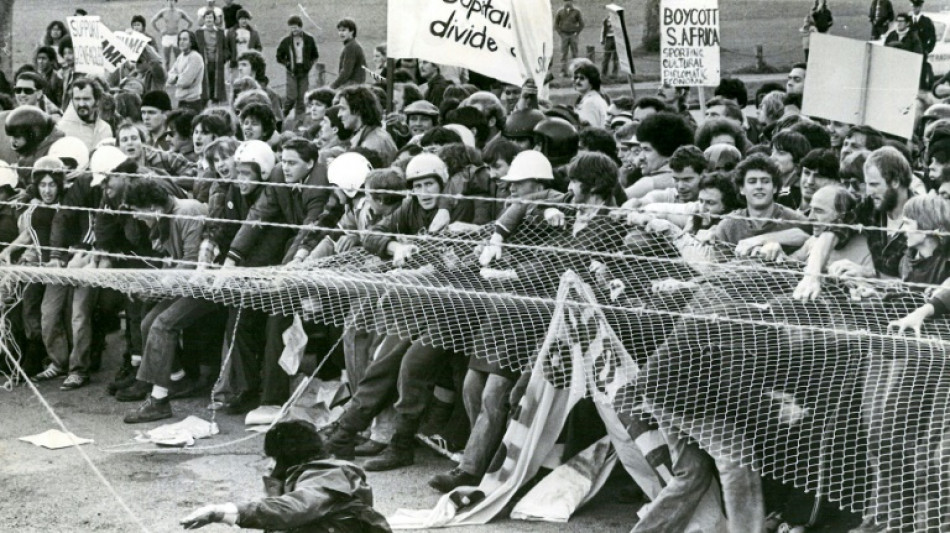
Riots, barbed wire: S.Africa's stormy 1981 rugby tour of New Zealand / Photo: Paul ESCOURT - NEW ZEALAND HERALD/AFP

 Grandidier-Nkanang double takes Pau to Top 14 summit despite Vannes fightback
 Trainer Scott gets perfect Arc boost with top notch double
 Ex-PM says Putin cannot admit 'mistake' over Ukraine

 Houthis say Saudi Arabia launches dozens of strikes on Yemen capital
 Qatar and Abu Dhabi F1 Grand Prix to go ahead - F1 boss
 South Korea lift gloom with smash-and-grab Games football gold
 Ireland news conference before Israel game cut short amid tensions
 Protests over housing flare in Spain after relief measures rejected
 Zverev thrashes Shang to set up Djokovic quarter-final at China Open
 Turkey football ref chief jailed pending trial for graft
 North Korea says test of intermediate-range strategic missile included use of AI

 Rampant Sayers leads Hong Kong to third men's rugby gold in a row
 Ethiopia's Tigray rebels abandon regional capital as govt advances
 Bulgaria's Tsar Samuel returns 'home' after 1,000 years
 'Glad it's over': Kim powers to Games gold and military exemption
 After 11 World Cups, football finally comes home for one Indian fan
 Marc Marquez wins sprint at Japan MotoGP, Martin grabs pole
 Alcaraz fends off Arnaldi to reach Japan Open quarters
 Antonelli tops times in final practice at Bahrain GP
 Gauff digs deep to beat Osorio in China Open second round
 Fresh protests to hit Spain after housing measures defeated
 'He's here with me': Japan cycle queen dedicates gold to late brother
 Japan Olympic chief says 'lot more' athletes at Games than expected
 Asian carmakers besting US rivals at home, China poised to strike
 Widgets & Web Offers All-Inclusive Investor Relations Websites for Public Companies, IPOs and SPACs
All Blacks fans will gather to watch the World Cup final against the Springboks on Saturday, but there was a time when their rugby team's links to apartheid-era South Africa bitterly divided New Zealanders.
The Springboks' 1981 tour of New Zealand was blighted by violent protests.
The rugby-mad host nation was split by New Zealand rugby's insistence on maintaining ties with South Africa's apartheid regime while other countries supported a sporting boycott.
The flashpoint came soon after the Springboks arrived.
There were bloody scenes as pitched street battles erupted between protestors and police, rocking the normally peaceful nation.
Lines were drawn between New Zealanders who were either eager to see their heroes face the Springboks or vehemently opposed to the tour.
"It split the country, you were either for or against it -- there was no middle ground," former All Blacks winger Stu Wilson, 69, told AFP.
The presence of the South Africa team divided many New Zealand households, including his own.
"My wife at the time was protesting against them and I was playing them. It was quite unusual," recalled Wilson, who was 27 at the time.
"She didn't try to talk me out of it. She had her views and I had mine."
The All Blacks now regularly play South Africa, but in 1981, it had been 16 years since the Springboks had previously visited New Zealand.
"I was pretty happy that they toured. I had no problems playing, but a couple of my mates did," Wilson said, referring to then All Blacks' captain Graham Mourie and star centre Bruce Robertson, who both declined to play the South Africans on political grounds.
"A lot of us had never had the chance to play the Springboks, let alone try and win a series against them."
While Wilson and his team-mates were trying to beat the Springboks on the field, anti-apartheid protestors were doing their best to halt the tour.
A violent edge developed after the second match of the tour was cancelled when protestors linked arms on the pitch in Hamilton.
- 'Stop the tour' -
"We weren't going out to just hold banners and protest, we were going to try and stop the tour," John Minto, the national leader of the protest group HART (Halt All Racist Tours) in 1981, told AFP.
"The country was certainly the most divided that I've ever seen with strong emotions on both sides and a lot of violence."
Minto was among the protestors who forced the game in Hamilton to be cancelled, amid angry scenes.
"I got injured many times during the tour, but ended up in hospital twice in Hamilton that night for stitches," he said, having been repeatedly struck by objects thrown from furious rugby fans.
Minto, now 70, was unaware what impact the abandoned match would have. "We were chanting 'the whole world's watching' - hoping like hell that they were."
Years later, Minto learned the news had reached the prison cell of Nelson Mandela, jailed in South Africa at the time as an anti-apartheid activist, but who united the nation as president after his release.
Mandela, who died in 2013, met Minto on a visit to New Zealand in 1995.
"Mandela told me that when they heard that the game had been stopped by a protest, the prisoners rattled their cell doors to celebrate," Minto added. "He said it was like the sun came out."
In the wake of the abandoned game in Hamilton, New Zealand police responded with increasingly rough tactics, staging baton charges on crowds of demonstrators outside parliament in Wellington in what became known as "The Battle of Molesworth Street".
Protestors in turn became more radical, arming themselves with clubs and bats, while donning motorcycle helmets and makeshift body armour.
Tensions reached fever pitch before the decisive third and final Test at Auckland's Eden Park.
The ground was ringed with barbed wire as more than 2,100 police -- 40 percent of the entire national force -- faced off against crowds of protestors in the streets.
During the match, protestors flew with a single-engine plane over the pitch and dropped flour-bombs, one of which felled All Blacks prop Gary Knight.
- 'Like a war zone' -
"A flour bomb knocked out Gary -- our biggest, strongest man," said Wilson. "If it had hit anyone else, it probably would have killed them."
At one point, Wilson tackled an opponent, only to discover several fish hooks, thrown onto the pitch by protestors, had stabbed his leg.
He scored a try in a nail-biting 25-22 victory. Wilson remembers the relief when a late penalty by New Zealand full-back Allan Hewson sailed between the posts to seal a 2-1 series win.
"We knew if we lost, and with the country already divided, then that was going to be worse, so it motivated us to put these guys away and try to repair the damage the tour had done," said Wilson.
Outside the ground, fighting erupted as protestors clashed with police.
"We waited three or four hours for the fans to disperse and the protestors to go. We left in a bus, heading to the hotel and there were cars burnt out. It was like a war zone"
The divisions caused by New Zealand rugby's stance took time to heal and damaged the game's standing among Kiwis.
"The sad thing is, it took years to recover, the country was a bit battered after the tour," said Wilson.
When New Zealand hosted the inaugural Rugby World Cup in 1987, then prime minister David Lange was still so disillusioned with the sport that he refused to attend.
"Looking back, we were attacking the central pillar of New Zealand cultural life, which was rugby," said Minto.
"It was New Zealand's most important link with South Africa. The country polarised dramatically and quickly."
Q.Najjar--SF-PST