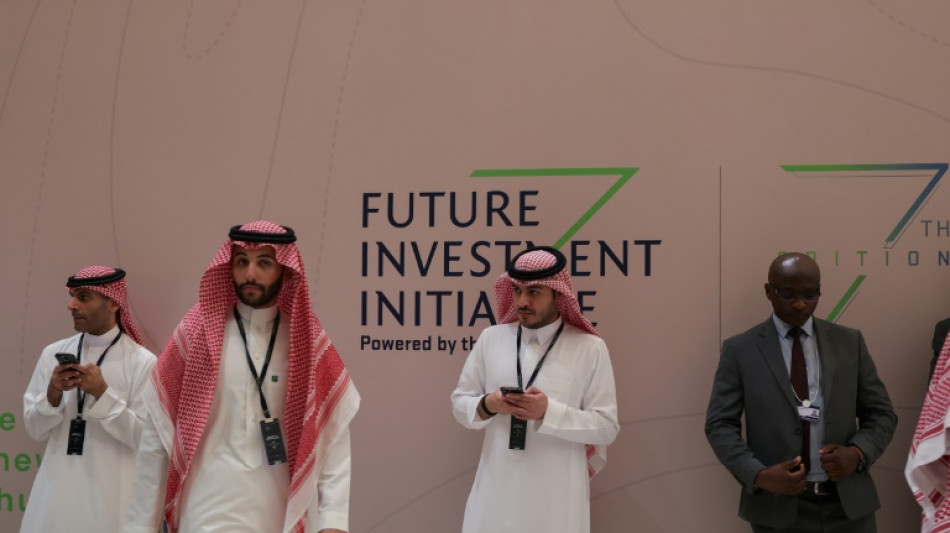
Israel-Hamas war already hitting regional economies: IMF chief / Photo: Fayez Nureldine - AFP

 Grandidier-Nkanang double takes Pau to Top 14 summit despite Vannes fightback

 Trainer Scott gets perfect Arc boost with top notch double

 Ex-PM says Putin cannot admit 'mistake' over Ukraine

 Houthis say Saudi Arabia launches dozens of strikes on Yemen capital

 Qatar and Abu Dhabi F1 Grand Prix to go ahead - F1 boss
 South Korea lift gloom with smash-and-grab Games football gold

 Ireland news conference before Israel game cut short amid tensions
 Protests over housing flare in Spain after relief measures rejected

 Zverev thrashes Shang to set up Djokovic quarter-final at China Open

 Turkey football ref chief jailed pending trial for graft
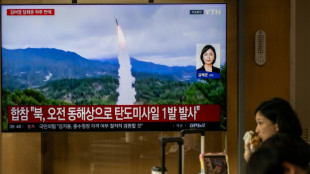 North Korea says test of intermediate-range strategic missile included use of AI

 Rampant Sayers leads Hong Kong to third men's rugby gold in a row

 Ethiopia's Tigray rebels abandon regional capital as govt advances

 Bulgaria's Tsar Samuel returns 'home' after 1,000 years

 'Glad it's over': Kim powers to Games gold and military exemption

 After 11 World Cups, football finally comes home for one Indian fan
 Marc Marquez wins sprint at Japan MotoGP, Martin grabs pole

 Alcaraz fends off Arnaldi to reach Japan Open quarters

 Antonelli tops times in final practice at Bahrain GP
 Gauff digs deep to beat Osorio in China Open second round

 Fresh protests to hit Spain after housing measures defeated

 'He's here with me': Japan cycle queen dedicates gold to late brother

 Japan Olympic chief says 'lot more' athletes at Games than expected
 Asian carmakers besting US rivals at home, China poised to strike

 Widgets & Web Offers All-Inclusive Investor Relations Websites for Public Companies, IPOs and SPACs

The raging war between Israel and Hamas is already battering the economies of nearby countries, the managing director of the International Monetary Fund told a Saudi investor forum on Wednesday.
Israel's neighbours are feeling the effects, especially those that rely on tourism, Kristalina Georgieva said at the Future Investment Initiative (FII) in the Saudi capital Riyadh.
"You look at the neighbouring countries -– Egypt, Lebanon, Jordan –- there the channels of impact are already visible," Georgieva told an audience that included global banking elites.
The Palestinian militant group Hamas mounted a shock attack on Israel on October 7, killing more than 1,400 people and taking 222 hostages, according to Israeli authorities.
Israel has responded with relentless air strikes and a near-total land, sea and air blockade of Gaza, where the Hamas-run health ministry says 5,791 people have been killed in the war so far.
Georgieva spoke one day after Wall Street titans told the forum that the war could deal a heavy blow to the world economy, especially if it draws in other countries.
"What we see is more jitters in what has already been an anxious world," Georgieva said.
"You have tourism-dependent countries -- uncertainty is a killer for tourist inflows," she said, describing the potential economic cost for countries in the region before listing specific risks.
"Investors are going to be shy to go to that place. Cost of insurance -- if you want to move goods, they go up. Risks of even more refugees in countries that are already accepting more."
- Peace derailed? -
The annual FII event, dubbed "Davos in the Desert", has typically served as a chance for Saudi Arabia to showcase domestic economic reforms whose success Saudi officials say partly hinges on regional stability.
This year, Saudi Arabia has restored ties with Iran and Syria, pushed for a durable ceasefire in Yemen and was in talks towards recognising Israel before the violence erupted on October 7.
An official familiar with the discussions on possible normalisation told AFP this month they are paused for now, though analysts say they could resume depending on how the war plays out.
"Before October 7, a lot of de-escalation (had) happened which brought a lot of hope for the region, and we don't want recent events to derail that," Saudi Finance Minister Mohammed al-Jadaan told an FII panel on Wednesday.
His counterpart from Bahrain, which recognised Israel as part of the US-brokered 2020 Abraham Accords, also preached regional integration.
"The traditional lines that have existed, that have been lines of previous generations I like to call them -- those could be ethnic lines, those could be religious lines –- are all now lines that we have to not look at," Shaikh Salman bin Khalifa Al Khalifa said.
He added that those "who are looking to destroy" should not be "part of writing that future".
Jared Kushner, a White House adviser under president Donald Trump and an architect of the Abraham Accords, said the Hamas attack was intended to disrupt normalisation.
"The progress between Saudi Arabia and Israel was progressing incredibly well, and I do think that that poses a big threat to the forces of evil," he said.
"If you have the Abraham Accords continuing and everyone coming together, that's something that obviously people will want to stop."
- 'Everything will go ahead' -
While several high-profile speakers have addressed the current regional turmoil, FII attendees have highlighted the capacity for Saudi Arabia, the world's biggest oil exporter, to withstand shocks and finance reforms using its deep-pocketed sovereign wealth fund, the Public Investment Fund.
The Vision 2030 agenda of the kingdom's de facto ruler,Crown Prince Mohammed bin Salman, aims to transition the economy away from fossil fuels by turning Saudi Arabia into a tourism and business hub marked by so-called giga-projects, including a $500 billion futuristic megacity known as NEOM.
"In Saudi Arabia itself, everything will go ahead, and the companies in Western countries and India and China will not miss out on the Saudi market," said Naser al-Tamimi, Middle East analyst at the Italian Institute for International Political Studies.
"You're talking about the biggest economy in the Middle East, the biggest construction market in the Middle East."
L.AbuAli--SF-PST