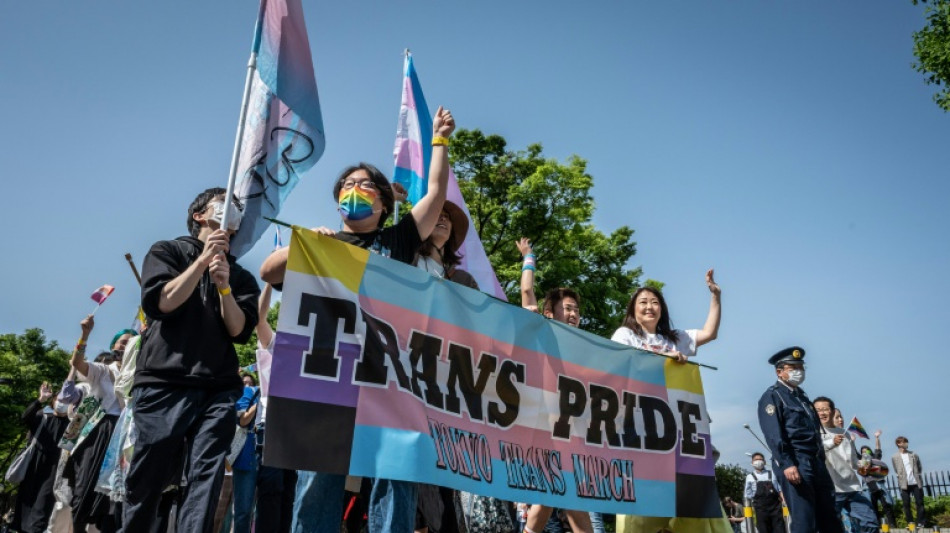
Japan court says gender change sterilisation rule unconstitutional / Photo: Yuichi YAMAZAKI - AFP/File

 Grandidier-Nkanang double takes Pau to Top 14 summit despite Vannes fightback

 Trainer Scott gets perfect Arc boost with top notch double

 Ex-PM says Putin cannot admit 'mistake' over Ukraine

 Houthis say Saudi Arabia launches dozens of strikes on Yemen capital

 Qatar and Abu Dhabi F1 Grand Prix to go ahead - F1 boss

 South Korea lift gloom with smash-and-grab Games football gold

 Ireland news conference before Israel game cut short amid tensions

 Protests over housing flare in Spain after relief measures rejected

 Zverev thrashes Shang to set up Djokovic quarter-final at China Open

 Turkey football ref chief jailed pending trial for graft

 North Korea says test of intermediate-range strategic missile included use of AI

 Rampant Sayers leads Hong Kong to third men's rugby gold in a row

 Ethiopia's Tigray rebels abandon regional capital as govt advances

 Bulgaria's Tsar Samuel returns 'home' after 1,000 years

 'Glad it's over': Kim powers to Games gold and military exemption

 After 11 World Cups, football finally comes home for one Indian fan

 Marc Marquez wins sprint at Japan MotoGP, Martin grabs pole

 Alcaraz fends off Arnaldi to reach Japan Open quarters

 Antonelli tops times in final practice at Bahrain GP
 Gauff digs deep to beat Osorio in China Open second round

 Fresh protests to hit Spain after housing measures defeated

 'He's here with me': Japan cycle queen dedicates gold to late brother
 Japan Olympic chief says 'lot more' athletes at Games than expected
 Asian carmakers besting US rivals at home, China poised to strike

 Widgets & Web Offers All-Inclusive Investor Relations Websites for Public Companies, IPOs and SPACs

Japan's top court said on Wednesday that requiring transgender people to be sterilised in order to change their legal gender was unconstitutional.
The requirement "restricts a person's free rights not to have their bodies invaded against their will," the supreme court said in a keenly awaited decision.
Under rules introduced in 2004, transgender people applying to legally change their gender must meet criteria including forfeiting reproductive capacity -- effectively involving sterilisation.
Other rules include being unmarried, not having children and being officially diagnosed with gender dysphoria.
Only a handful of countries around the world allow transgender people to change their status with a simple declaration.
But campaigners say that conditions imposed by Japan, the only Group of 7 wealthy country that does not recognise same-sex marriage or civil unions at a national level, forced people into highly invasive, lengthy and potentially risky medical procedures.
"The procedure for changing one's legally recognised gender, which requires sterilisation surgery and an outdated psychiatric diagnosis, is anachronistic, harmful, and discriminatory," Human Rights Watch had said in a 2019 report.
The advocacy group blasted it as rooted on a "pejorative" notion that transgender identity amounts to a "mental illness".
Pressure though had been building ahead of Wednesday's decision, with a regional family court ruling this month that the sterilisation criteria was "unconstitutional and invalid".
Recent years have seen traditionally conservative Japan take small steps towards embracing sexual diversity.
In July, Japan's Supreme Court ruled in favour of a transgender bureaucrat who sued the government over access to female toilets at work.
Opinion polls have shown growing support for LGBTQ-friendly laws, especially among younger people, but the ruling Liberal Democratic Party has been reluctant to push ahead with reforms.
And in recent months activists have warned of a rising tide of hateful online rhetoric, particularly targeting transgender women, fuelled in part by contentious debate around anti-discrimination legislation that passed this year, albeit in watered-down form.
- 'Still in pain' -
At the heart of Wednesday's case was a transgender Japanese woman seeking to be legally listed as female without surgery.
She has called the obligation to be sterilised a "grave human rights violation and unconstitutional".
Her past petitions to a family court, and then a higher court, were both rejected.
This was the second time the Supreme Court has weighed in on the constitutional question of the sterilisation requirement, having ruled it "constitutional as of now" in 2019.
Judges had defended the requirement as meant to preclude "confusion" that can arise from transgender people having children after changing their legal gender.
Wednesday's top court ruling has been hotly anticipated among Japan's transgender community, including 34-year-old transgender man Tomoya Asanuma.
At 23, Asanuma's womb and ovaries were taken out in order to legally change gender and be allowed to marry his female fiance at the time.
"Making surgery a condition for changing legal gender is too risky for trans people in all aspects -- physically, emotionally and financially," Asanuma said.
"I am still in pain. It's really frustrating to think I wouldn't be suffering as much as I am now, if only I had been allowed to change my gender without surgery."
T.Khatib--SF-PST