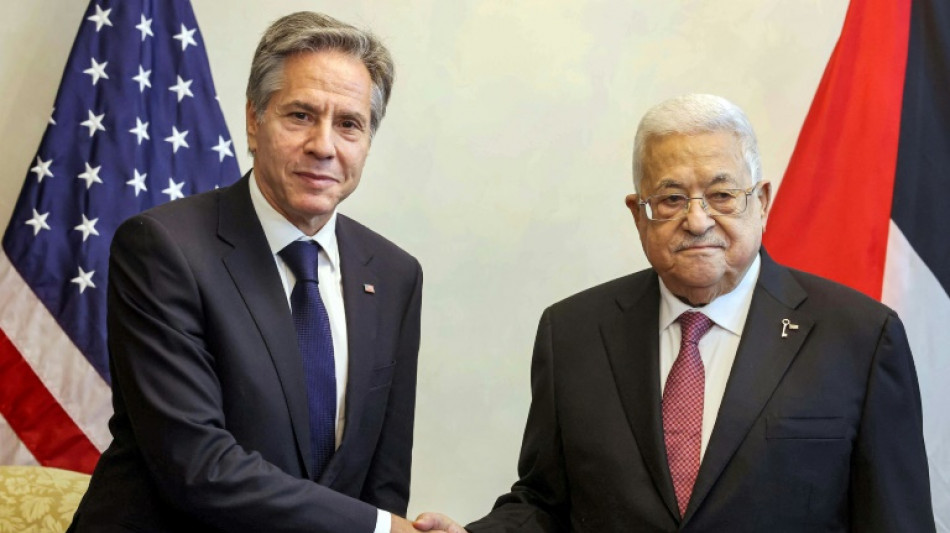
Gaza war heaps pressure on Palestinian president Abbas / Photo: Thaer GHANAIM - PPO/AFP/File

 Yamal on target as Spain hold off Czech Republic

 Latvian exit polls suggest pro-European choice
 Lula, Bolsonaro wrap up campaigns ahead of knife-edge election
 Tuchel hails 'complete' England after Croatia demolition

 Fury to invite Trump to lead ring walk before Joshua showdown

 Fashion industry in 'precarious moment', says Vivienne Westwood supremo

 Seventh heaven for England in Nations League rout of Croatia

 Storms, flooding cause chaos on Greek holiday island of Crete

 #IAmJaneDoe: online support campaign in US university rape case

 Brazil shine on Selecao's first visit to India
 Zverev sets up Djokovic quarter-final at China Open, Rybakina out
 Happier at home, Bordeaux hammer Lyon in Top 14

 Lula, Bolsonaro in final push for votes ahead of knife-edge election

 Boisterous fashion week barnstorms 'sleepy' Nigerian capital

 UAE investigators say flydubai co-pilot was planning 'terrorist act'

 Rahul smacks century in India v Windies ODI

 Daryz seeks to join exclusive club of dual Arc winners
 Russia warns diplomats to leave Kyiv over new strikes threat
 Olympic champ Zheng rebukes rowdy home crowd at China Open

 World No.1 Sinner pulls out of Shanghai Masters to delay return
 Red Bull's Verstappen grabs pole position for Bahrain GP

 India beat Pakistan in blockbuster as golfer Kim wins 'crazy' gold

 India beat arch-rivals Pakistan to win Asian Games cricket gold

 Ethiopia's Tigray rebels abandon regional capital as govt advances: journalist

 Tom Kim powers to Games gold and exemption from military service

The widely unpopular Palestinian president Mahmud Abbas is facing growing anger on the streets of the occupied West Bank as Israel wages its war against Hamas in Gaza.
The 88-year-old leader is seen as out of touch with the increasing desperation of the Palestinian people and Israel's furious response to the October 7 attacks by Hamas has only exacerbated their discontent.
After a rocket strike on a Gaza hospital this week caused fresh outrage, hundreds of Palestinians took to the streets in a rare demonstration shouting "Abbas step down!" before being dispersed by security forces.
Abbas has led the Palestinian Authority (PA) for 18 years but has only limited authority over the West Bank and none over Gaza where the authority was violently ousted by Hamas in 2007.
On the world stage, Abbas has clung to the unrealised promises of the 1993 Oslo Accords.
The PA was meant to be a first step toward an independent Palestinian state, but negotiations have been at a standstill for more than a decade.
Abbas has been powerless against the rapid expansion of Israeli settlements and military control in the West Bank and annexed east Jerusalem, both occupied since 1967, fragmenting what was meant to be a contiguous Palestinian territory.
Violence against Palestinian civilians by Israeli settlers and clashes between the Israeli army and Palestinian armed groups have increased.
Conditions have only worsened after the formation of Israel's most far-right government in history in December, under Prime Minister Benjamin Netanyahu.
- Sidelined president -
"Abbas bet on the international community, believing that it would force Israel to withdraw from the occupied territories to give the Palestinians a state," said Ubai Al-Aboudi, director of the Bisan Center for Research and Development, a think-tank based in Ramallah.
"However, the international community has shown that it cares little about the blood shed by the Palestinians and their suffering, hence the popular anger," Aboudi told AFP.
Abbas has remained on the sidelines since the surprise Hamas assault, which left 1,400 dead -- mainly civilians, according to Israeli officials -- in the worst attack suffered by Israel since its independence in 1948.
Intensive retaliatory air strikes and artillery barrages have left at least 4,651 people dead in Gaza, according to the Hamas-controlled health ministry.
The bombardment has caused outrage across the Arab world.
Many Palestinians, regardless of their politics, have expressed support for Hamas on social media.
Abbas set off anger this week with a comment reported by the official Palestinian news agency that "the policies and actions of Hamas do not represent the Palestinian people". The statement was withdrawn.
The next day a rocket struck Gaza's Al-Ahli hospital, leaving dozens, perhaps hundreds dead. There were demonstrations across the West Bank after Hamas blamed Israel. Israel insisted the explosion was caused by a failed rocket fired by Islamic Jihad militants.
Even before the latest war, Abbas was deeply unpopular, while support for peaceful negotiations was waning.
Seventy-eight percent of Palestinians wanted Abbas to resign, according to a poll published in September by the Palestinian Centre for Policy and Survey Research.
Some 58 percent said they supported "armed struggle" to end the Israeli occupation, compared with 20 percent in favour of a negotiated settlement and 24 percent for "peaceful resistance".
Abbas opponents feel "the Palestinian Authority is increasingly assimilated, either by inaction or by security cooperation, to Israel's policy", said Xavier Guignard, a political scientist specialising in the Palestinian territories.
There was a real feeling that "Abbas was unable to react to what was happening in Gaza", said Guignard, of the Paris-based Noria Research.
Hugh Lovatt, an analyst for the European Council on Foreign Relations, said that "as the Palestinian public mood hardens further in support of armed resistance, the PA risks being swept away" if it continues to ignore public opinion.
Abbas would be further weakened, he said, as "the US and Israel push the PA to crack down harder on Hamas and other armed groups in the West Bank -– which would further erode its public standing".
Omar Khatib, who took part in a Ramallah demonstration on Friday in support of Gaza Palestinians, gave a withering assessment of the Palestinian Authority.
"The resistance is confronting Israel in Gaza, and we are confronting the Authority here because it is just a tool in the hands of the occupation to repress us in the West Bank," he said.
B.Mahmoud--SF-PST