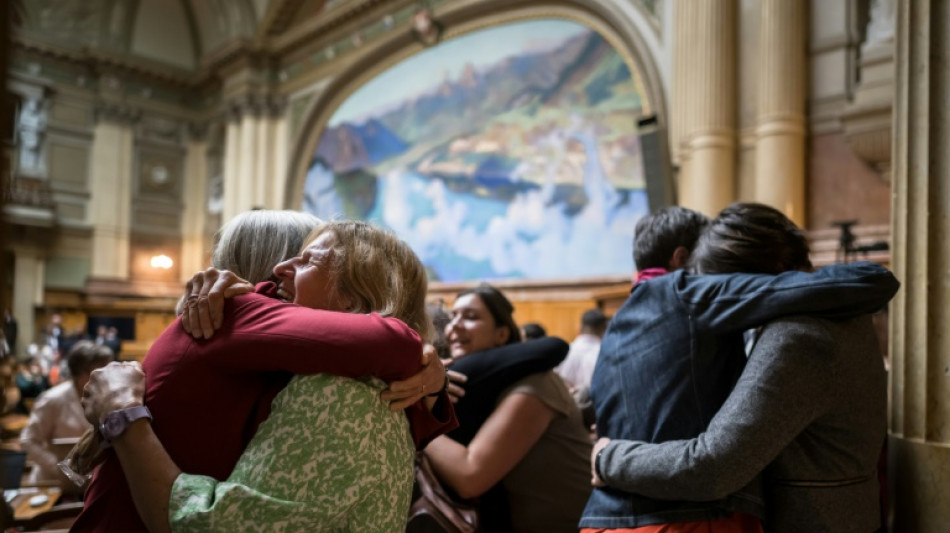
Swiss politics: the art of compromise / Photo: Fabrice COFFRINI - AFP

 Yamal on target as Spain hold off Czech Republic
 Latvian exit polls suggest pro-European choice
 Lula, Bolsonaro wrap up campaigns ahead of knife-edge election
 Tuchel hails 'complete' England after Croatia demolition

 Fury to invite Trump to lead ring walk before Joshua showdown
 Fashion industry in 'precarious moment', says Vivienne Westwood supremo
 Seventh heaven for England in Nations League rout of Croatia
 Storms, flooding cause chaos on Greek holiday island of Crete
 #IAmJaneDoe: online support campaign in US university rape case
 Brazil shine on Selecao's first visit to India
 Zverev sets up Djokovic quarter-final at China Open, Rybakina out
 Happier at home, Bordeaux hammer Lyon in Top 14
 Lula, Bolsonaro in final push for votes ahead of knife-edge election
 Boisterous fashion week barnstorms 'sleepy' Nigerian capital
 UAE investigators say flydubai co-pilot was planning 'terrorist act'
 Rahul smacks century in India v Windies ODI
 Daryz seeks to join exclusive club of dual Arc winners
 Russia warns diplomats to leave Kyiv over new strikes threat
 Olympic champ Zheng rebukes rowdy home crowd at China Open
 World No.1 Sinner pulls out of Shanghai Masters to delay return
 Red Bull's Verstappen grabs pole position for Bahrain GP
 India beat Pakistan in blockbuster as golfer Kim wins 'crazy' gold
 India beat arch-rivals Pakistan to win Asian Games cricket gold
 Ethiopia's Tigray rebels abandon regional capital as govt advances: journalist
 Tom Kim powers to Games gold and exemption from military service

The Swiss political system relies on consensus among the main parties, with power kept as close to the people as possible, including through regular single-issue votes.
On Sunday, Swiss voters headed to polls to elect new members of parliament, who in turn will appoint the federal government in December.
Here is a look at how Switzerland's very distinct political system works:
- Parliament -
The Swiss parliament, called the Federal Assembly, has two houses and meets at the Federal Palace in Bern.
The domed 1902 building is on the Old City's main square. Each statue and painting inside represents a moment in Swiss history.
The National Council, the lower house, represents the people. It comprises 200 lawmakers elected from Switzerland's 26 constituent cantons.
The number from each canton depends on the canton's population. The deputies are chosen by proportional representation within the canton. There are around 40,000 voters per seat.
The Council of States, the upper house, represents the cantons. It is made up of 46 members elected by majority vote.
Each of the 20 full cantons returns two deputies, regardless of size, though the six half-cantons return one each.
Both houses are configured in a hemicycle. They have identical powers and are elected for four-year terms.
They sit only four times a year for three-week sessions -- in March, June, September and November/December.
- Government -
The government, called the Federal Council, has seven members. The seats are shared out among the four main parties according to a so-called magic formula -- a 2-2-2-1 tacit agreement introduced in 1959.
The new Federal Assembly -- all 246 deputies -- will choose the government members in a vote on December 13.
Candidates do not have to come from the assembly.
The assembly tries to ensure that the cantons and language communities are fairly represented within the government.
Barring major power shifts in the assembly, the government members are not expected to change, though President Alain Berset is stepping down from the Federal Council.
- Head of state -
The government meets on Wednesdays in the Federal Palace.
Members, who each take a ministry, are paid 468,276 Swiss francs ($524,000) per year.
The Federal Council operates on collegiality and consensus. All decisions are taken by the government as a whole under collective responsibility.
The government members are collectively the head of state. Andorra, Bosnia-Hercegovina and San Marino are the only other countries without a singular head of state.
That said, the Swiss president is the first among equals. The presidency rotates annually among the ministers.
- Referendums -
Switzerland has direct democracy, with citizens able to trigger popular votes at the national, cantonal and local level.
They can challenge in referendums decisions taken by parliament, and propose new laws themselves in initiatives.
A total of 100,000 valid signatures in 18 months are required to trigger a national initiative. A change of law requires a double majority of voters and cantons.
Popular votes take place every three months.
- Levels of power -
Powers are distributed between the confederation, the 26 cantons and, within them, more than 2,000 local municipalities, or communes.
Power is delegated from the communes upwards, rather than from the top down.
For example, the communes manage their own infrastructure, such as roads, public buildings and schools; cantons look after the education system and policing; while the confederation handles defence and foreign policy.
Each of the three levels raises its own taxes.
The cantons have their own constitutions, parliaments, governments and courts.
In the Glarus and Appenzell Innerrhoden cantons, cantonal votes and elections are still held by "Landsgemeinde": a show of hands in the main square.
S.Barghouti--SF-PST