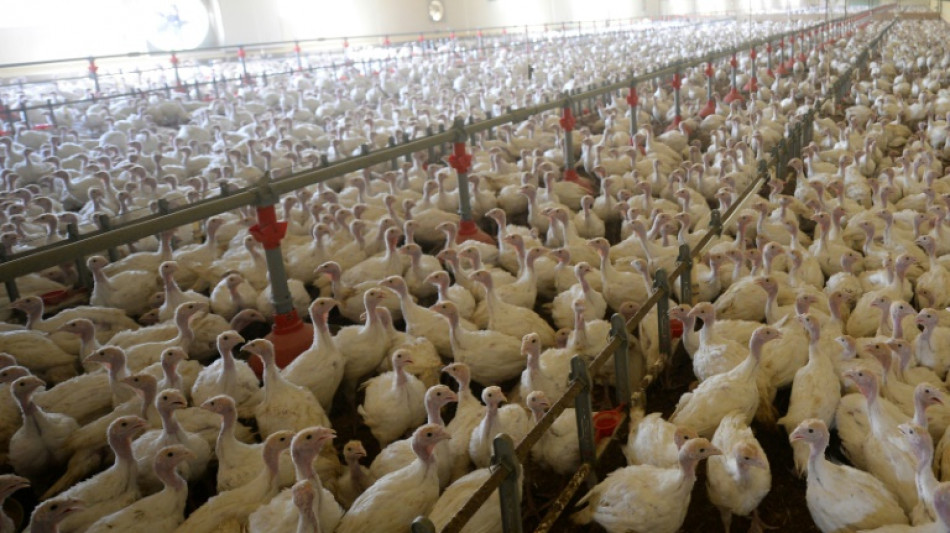
Change in livestock food could feed a billion people: study / Photo: JEAN-FRANCOIS MONIER - AFP/File

 Oil prices spike after Trump rejects Iran truce offer

 Taylor Swift sets new record at MTV VMAs
 Seoul seeks apology after Ukraine reveals transfer of North Korean POWs

 Messi on target again but Miami downed by Columbus

 In Washington's political cauldron, a fight over foie gras

 Flavio Bolsonaro: political heir in his father's shadow

 Ravens grab last-second win in Rio as Commanders stop Seahawks

 USA rallies to capture 11th consecutive Presidents Cup

 Phillies clinch, Astros wrap up division on final day of MLB season

 Commanders hand champion Seahawks their first loss

 Dupont scores twice to send Toulouse top of Top 14

 Ireland beat Israel but no handshakes due to war in Gaza

 Tense standoff over flashpoint N.Ireland parade lasts into night

 Stunned McNulty wins 'miracle' road race world title

 Re-released 'Avengers: Endgame' snaps-up N. America box office lead

 American McNulty wins shock road race world title

 Serbia's President Aleksandar Vucic announces resignation

 Tuchel urges Bellingham to play with 'rage'

 Russian strikes on Ukraine kill 8

 Bavuma, Miller hit centuries as South Africa clinch series

 Spain bring in Le Normand for injured Garcia

 UK Labour party meets buoyed by Burnham but seeking concrete plans

 Nor'easter lashes US east with punishing rain and wind

 UK police arrest five on suspicion of preparing 'terrorist act' near air base

 Washington denounces Iran's truce proposal as 'cynical'

Diverting grain and other feed for livestock to human consumption could boost food supply sufficiently to feed an additional billion people, according to research released on Monday.
Many livestock animals and farmed fish are fed on foods such as cereals, fish and pulses that are edible for humans.
As the world struggles to feed hundreds of millions of people enough calories and nutrients to maintain their health, researchers in Finland examined what would happen if more food grown for animal consumption went to humans.
They analysed global food system data for crop, livestock and aquaculture production, focusing on feed use and the availability of other potential food sources for animals, such as by-products and residues of other farming processes that already exist.
Given the calorific needs of the world's animals and fish stocks, they calculated that switching out otherwise edible feed could increase global human food supply by 13 percent in terms of calories and by 15 percent in terms of protein.
"That's about one billion people," lead study author Vilma Sandstrom, from Finland's Aalto University, told AFP.
Around 15 percent of the more than six billion tonnes of animal feed consumed each year consists of products that could directly be used as human food.
Globally, 49 percent of feed use in aquaculture, 68 percent in poultry and 38 percent in pork meat production consists of food that is edible for humans, the paper showed.
The researchers identified readily available alternatives that are only edible for animals.
These included crop production by-products such as straw, leaves, distiller's grains, sugar beet, rapeseed and cottonseed, as well as animal by-products such as meat and bone meal.
"A lot of these are just left in the field or are wasted," said Sandstrom. "They are not necessarily ready to feed to animals immediately but this is one potential we have."
United Nations Secretary-General Antonio Guterres warned in July that Russia's invasion of Ukraine had combined with the lingering trade impacts of Covid-19 to create an "unprecedented global hunger crisis".
As well as diverting vital calories away from hungry people, growing crops to feed to livestock has an outsized impact on the environment and climate.
Meat production alone accounts for over 14 percent of all greenhouse gas emissions and farming now uses more than three quarters of Earth's available freshwater.
"We are looking at different ways to help supply food for humanity within planetary boundaries," said Sandstrom.
"A lot of the feed that is fed now to livestock and aquaculture is something that we could consume. This is one of the leverage points we were looking for."
The study was published in the journal Nature Food.
M.AlAhmad--SF-PST