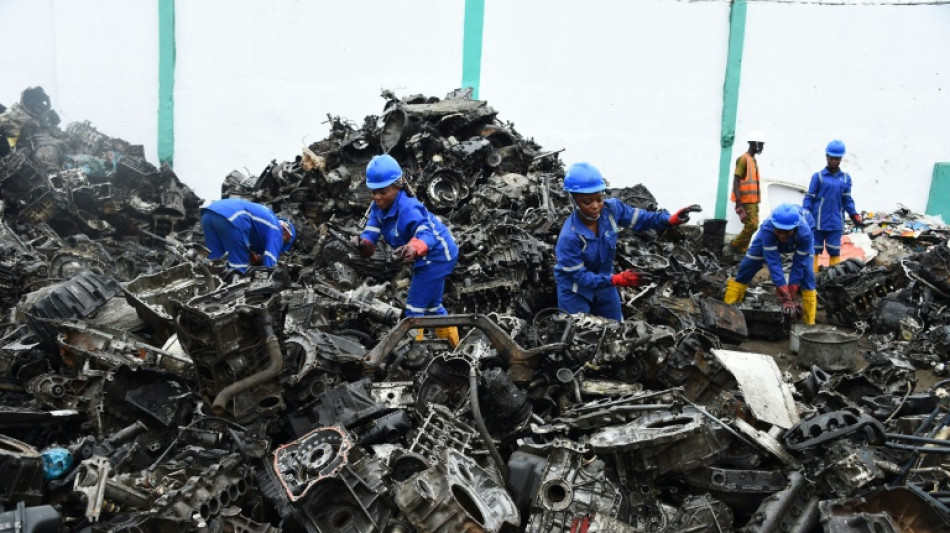
In Nigeria, finding value in waste recycling / Photo: Pius Utomi EKPEI - AFP

 Oil prices spike after Trump rejects Iran truce offer

 Taylor Swift sets new record at MTV VMAs
 Seoul seeks apology after Ukraine reveals transfer of North Korean POWs

 Messi on target again but Miami downed by Columbus

 In Washington's political cauldron, a fight over foie gras
 Flavio Bolsonaro: political heir in his father's shadow

 Ravens grab last-second win in Rio as Commanders stop Seahawks

 USA rallies to capture 11th consecutive Presidents Cup
 Phillies clinch, Astros wrap up division on final day of MLB season

 Commanders hand champion Seahawks their first loss

 Dupont scores twice to send Toulouse top of Top 14

 Ireland beat Israel but no handshakes due to war in Gaza

 Tense standoff over flashpoint N.Ireland parade lasts into night

 Stunned McNulty wins 'miracle' road race world title

 Re-released 'Avengers: Endgame' snaps-up N. America box office lead
 American McNulty wins shock road race world title
 Serbia's President Aleksandar Vucic announces resignation
 Tuchel urges Bellingham to play with 'rage'

 Russian strikes on Ukraine kill 8

 Bavuma, Miller hit centuries as South Africa clinch series
 Spain bring in Le Normand for injured Garcia

 UK Labour party meets buoyed by Burnham but seeking concrete plans

 Nor'easter lashes US east with punishing rain and wind

 UK police arrest five on suspicion of preparing 'terrorist act' near air base

 Washington denounces Iran's truce proposal as 'cynical'

Mounds of waste scattered along roads and vast landfills are a Nigerian eyesore.
In Africa's biggest economy and most populous country, collecting, sorting and recycling trash is despairingly rare.
But there is also good news. Some entrepreneurs are working hard to tackle the rubbish mountain, despite the many challenges.
Romco Metals started recycling aluminium at its factory outside Lagos in 2015, drawn by global demand for the light, strong, flexible metal.
Buoyed by good results, it built a second facility outside Ghana's capital Accra and now plans to open at least three new plants across Africa and triple production by 2025.
Aluminium is the world's second most-used metal after steel and used widely in construction, medicine and car-making.
"Electric vehicles require more durable lighter material such as aluminium, and that’s where our materials end up," said the company's youthful founder, 32-year-old Raymond Onovwigun.
- Job creation -
A British-registered company, Romco melts down and recycles around 1,500 tonnes of discarded aluminium per month, out of a capacity of 3,000 tonnes.
It says it has created 450 direct jobs -- 5,000 in total, in this labour-intensive sector -- and plans to double that number within a year.
"Before... there was no work," community leader Bankole Gbenga known as Chief Abore told AFP during a recent visit to the Lagos facility.
Chief Abore says more than a hundred young people from his community alone now work for Romco in some capacity.
"Some are doing carpentry, some are welders... some of the youth are doing security," said the 40-year-old.
Among those who have most benefited from Romco’s business are material suppliers like Mohammed Ashiru Madugu, who delivers several truckloads of metal scrap each week.
Madugu has a warehouse in northwestern Katsina, where suppliers from across the state and even neighbouring states bring him discarded metal.
He loads the goods onto trucks and sends them -– with escorts because of frequent ambushes by criminal gangs on the road –- all the way to Lagos, more than a thousand kilometres (600 miles) away.
For one truck, he can get paid up to 26 million naira (about $60,000 dollars) although the price fluctuates.
- Vast problem -
Only a tiny fraction of waste is recycled in Nigeria, a country of some 210 million consumers.
Plastic, metal and glass that in advanced economies are routinely picked up and processed are mostly tossed out.
Each year, Nigeria disgorges 200,000 tonnes of plastic into the Atlantic, the UN Industrial Development Organisation reported last year.
In Lagos alone, a city of more than 20 million people, less than 10 percent total recyclables are currently collected, Ibrahim Adejuwon Odumboni, managing director of the Lagos State Management Agency told AFP.
By comparison, in the UK, more than 41 percent of waste picked up by local authorities was recycled last year, according to British statistics.
For Odumboni, recycling initiatives are to be commended but more should be done by the companies making aluminium beverage cans and other products.
"We need the manufacturers to invest in the collection system. In many parts of the world, a portion of what producers sell is going into the recovery of products. We currently don't have that in Nigeria," he said.
If companies selling aluminium products "are not held responsible (for collecting waste) then it doesn’t make any sense -- we're just going round and round in circle."
He blames poor legislation but says an improved law on Extended Producer Responsibility (EPR) is currently being discussed in the state house of assembly.
EPR is an environmental policy in place in many countries that gives producers incentives to take responsibility for their products after they are used.
Another challenge for recyclers is carbon emissions from the energy they use to crush, shred or melt old materials.
Romco, for instance, uses compressed natural gas to turn the aluminium into ingots.
"(It) is still a fossil fuel but the best, most efficient fossil fuel. It doesn’t contain lead or sulphur," said Onovwigun.
The company says, however, that it wants to be independent of fossil fuels and is "exploring the potential of using solar, green hydrogen, and biofuels."
I.Matar--SF-PST