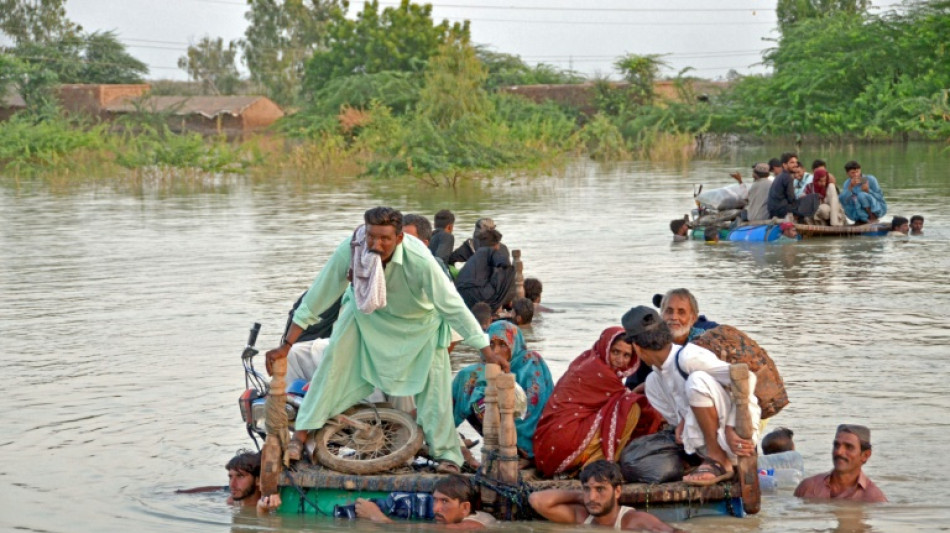
UN chief in Pakistan to boost flood aid for devastated millions / Photo: Fida HUSSAIN - AFP

 Oil prices spike after Trump rejects Iran truce offer

 Taylor Swift sets new record at MTV VMAs
 Seoul seeks apology after Ukraine reveals transfer of North Korean POWs

 Messi on target again but Miami downed by Columbus

 In Washington's political cauldron, a fight over foie gras

 Flavio Bolsonaro: political heir in his father's shadow

 Ravens grab last-second win in Rio as Commanders stop Seahawks

 USA rallies to capture 11th consecutive Presidents Cup

 Phillies clinch, Astros wrap up division on final day of MLB season

 Commanders hand champion Seahawks their first loss

 Dupont scores twice to send Toulouse top of Top 14

 Ireland beat Israel but no handshakes due to war in Gaza

 Tense standoff over flashpoint N.Ireland parade lasts into night

 Stunned McNulty wins 'miracle' road race world title

 Re-released 'Avengers: Endgame' snaps-up N. America box office lead

 American McNulty wins shock road race world title

 Serbia's President Aleksandar Vucic announces resignation

 Tuchel urges Bellingham to play with 'rage'

 Russian strikes on Ukraine kill 8

 Bavuma, Miller hit centuries as South Africa clinch series

 Spain bring in Le Normand for injured Garcia

 UK Labour party meets buoyed by Burnham but seeking concrete plans

 Nor'easter lashes US east with punishing rain and wind

 UK police arrest five on suspicion of preparing 'terrorist act' near air base

 Washington denounces Iran's truce proposal as 'cynical'

United Nations chief Antonio Guterres began a two-day visit to flood-hit Pakistan Friday that officials hope will boost global support for a humanitarian crisis affecting millions.
A third of the country is under water -- an area the size of the United Kingdom -- following record rains brought by what Guterres has described as "a monsoon on steroids".
Pakistan officials say it will cost at least $10 billion to rebuild and repair damaged infrastructure -- an impossible sum for the deeply indebted nation -- but the priority, for now, is food and shelter for millions made homeless.
"Everything is drowned, everything washed away," said Ayaz Ali, suffering from fever as he reluctantly took his place Thursday on a navy boat rescuing villagers from flooded rural communities in southern Sindh province.
In a tweet en route to Pakistan, Guterres said he wanted to "be with the people in their time of need, galvanize international support and bring global focus on the disastrous repercussions of climate change".
Pakistan receives heavy -- often destructive -- rains during its annual monsoon season, which are crucial for agriculture and water supplies.
But a downpour as intense as this year's not been seen for decades, and Pakistan officials blame climate change, which is increasing the frequency and intensity of extreme weather around the world.
Pakistan is responsible for less than one percent of global greenhouse gas emissions, but is eighth on a list compiled by the NGO Germanwatch of countries deemed most vulnerable to extreme weather caused by climate change.
- Tents and tarpaulins needed -
A flood relief plan scaled by the Pakistan government and UN last month called for an immediate $160 million in international funding, and aid is already arriving.
On Thursday a US Air Force C-17 landed -- the first American military plane in Pakistan for years -- bringing desperately needed tents and tarpaulins for temporary shelter.
While Washington is a key supplier of military hardware to Islamabad, relations have been fractious as a result of conflicting interests in neighbouring Afghanistan -- especially since the Taliban returned to power there in August last year.
The meteorological office says Pakistan received five times more rain than normal in 2022 -- Padidan, a small town in Sindh, has been drenched by more than 1.8 metres (70 inches) since the monsoon began in June.
The effect of the heavy rains has been twofold -- flash floods in rivers in the mountainous north that washed away roads, bridges and buildings in minutes, and a slow accumulation of water in the southern plains that has submerged hundreds of thousands of square kilometres (miles) of land.
In Jaffarabad district of Balochistan Thursday, villagers were fleeing their homes on makeshift rafts made from upturned wooden "charpoy" beds.
Thousands of temporary campsites have mushroomed on slivers of dry land in the south and west -- often roads and railway tracks are the only high ground in a landscape of water.
With people and livestock cramped together, the camps are ripe for outbreaks of disease, with many cases of mosquito-borne dengue reported, as well as scabies.
Nearly 7,000 km of roads have been damaged, some 246 bridges washed away and more than 1.7 million homes and businesses destroyed.
K.AbuTaha--SF-PST