Beetles block mining of Europe's biggest rare earths deposit / Photo: Sulejman Alihodzic - AFP

 PU Prime Deepens Argentina Presence Through FX Expo Buenos Aires 2026

 Nothing to seal here: NZ police help stranded pup home

 White House releases list of products US, China could tax less
 'Pseudo-journalism': Partisan 'news' sites target US midterms

 'Currently impossible': North Korea defections in freefall

 Erasmus sizes up 'improved' Wallabies ahead of 2027 World Cup

 Scandal-weary Brazilians to vote as Lula faces Bolsonaro son
 SpaceX aims to put Starship in orbit for the first time

 Pope to speak on united Europe from French border town

 Scheffler makes sportsmanship stand over tee screamer

 Anthropic CEO Amodei to dine with Trump at White House

 Dupont scores twice to send Toulouse to Top 14 summit

 Greece stun Klopp's Germany as Ireland show sorrow for Gaza

 Ramos fires holders Portugal to Nations League win in Norway

 Greece hand Klopp first defeat as Germany manager

 Pope promises French sex abuse victims to prevent further harm

 UK village on edge over threats to air base in terror alert

 Two giant pandas, emblems of China soft diplomacy, arrive in US

 Aleksandar Vucic: from Milosevic minister to long-serving Serbian statesman

 Trump expects new Iran talks despite rejecting deal offer

 Xavi gets first win as Netherlands boss, Denmark beat Wales

 Madrid housing protest camp enters second night as PM vows action

 Tigray TV station hit by drone, rebels advance in north Ethiopia

 Banton hundred paves way for England ODI series win over Sri Lanka

 Milestone man Kohli powers India to big ODI win over West Indies
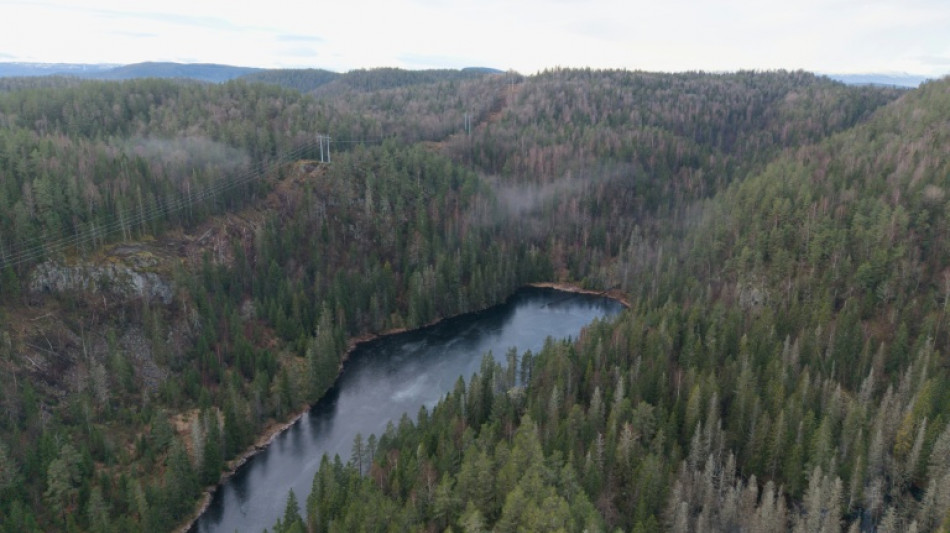
As Europe seeks to curb its dependence on China for rare earths, plans to mine the continent's biggest deposit have hit a roadblock over fears that mining operations could harm endangered beetles, mosses and mushrooms.
A two-hour drive southwest of Oslo, in the former mining community of Ulefoss home to 2,000 people, lies the Fensfeltet treasure: an estimated 8.8 million tonnes of rare earths.
These elements, used to make magnets crucial to the auto, electronics and defence industries, have been defined by the European Union as critical raw materials.
"You have rare earths in your pocket when you carry a smartphone," said Tor Espen Simonsen, a local official at Rare Earths Norway, the company that owns the extraction rights.
"You're driving with rare earths when you're at the wheel of an electric car, and you need rare earths to make defence materiel like F-35 jets," he added.
"Today, European industry imports almost all of the rare earths it needs -- 98 percent -- from one single country: China," he added.
"We are therefore in a situation where Europe must procure more of these raw materials on its own," he said.
In its Critical Raw Materials Act (CRMA) aimed at securing Europe's supply, the EU has set as an objective that at least 10 percent of its needs should be extracted within the bloc by 2030.
No rare earth deposits are currently being mined in Europe.
- 'Rush slowly' -
Due to environmental concerns, Rare Earths Norway has already been forced to push back its schedule. Now it aims to begin mining in the first half of the 2030s.
Its so-called "invisible mine" project is intended to limit the mine's environmental footprint. It plans to use underground extraction and crushing -- as opposed to an open-pit mine -- and re-inject a large part of the mining residue.
But the location of the mineral processing park, where ore extracted underground would be handled and pre-processed, has posed a problem.
The company had planned to transport the minerals on an underground conveyor belt emerging above ground behind a hill, in an area out of sight from the town and largely covered by ancient natural forests, rich in biodiversity.
But experts who examined that site found 78 fauna and flora species on Norway's "red list" -- species at risk of extinction to varying degrees. They included saproxylic beetles (which depend on deadwood), wych elms, common ash trees, 40 types of mushrooms, and various mosses.
As a result, the county governor formally opposed the location during a recent consultation process.
Adding to concerns was the fact that disposing of waste rock would take place within a protected water system.
"We need to start mining as quickly as possible so we can bypass polluting value chains originating in China," said Martin Molvaer, an adviser at Bellona, a Norwegian tech-focused environmental NGO.
"But things should not move so quickly that we destroy a large part of nature in the process: we must therefore rush slowly," he said.
- 'Lesser of two evils' -
Faced with such objections, the municipality has been forced to review the plans and take a closer look at alternate locations for the above-ground part of the mine.
While there is another less environmentally sensitive zone, neither the mining developers nor the local population favour it.
"We accept that we will have to sacrifice a significant part of our nature," local mayor Linda Thorstensen said.
"It comes down to choosing the lesser of two evils."
Thorstensen supports the mine project, given the small town has seen jobs and young people move elsewhere for decades. It is "a new adventure", she said.
"A lot of people live outside the job market, many receive social welfare assistance or disability pensions. So we need jobs and opportunities," she said.
In the almost-empty streets of Ulefoss, locals were cautiously optimistic.
"We want a dynamic that makes it possible for us to become wealthy, so that the community benefits. We need money and more residents," Inger Norendal, a 70-year-old retired teacher, told AFP.
"But mining obviously has its downsides too."
O.Farraj--SF-PST