Turkmenistan's battle against desert sand / Photo: Nikolay Vavilov - AFP

 PU Prime Deepens Argentina Presence Through FX Expo Buenos Aires 2026

 Nothing to seal here: NZ police help stranded pup home
 White House releases list of products US, China could tax less

 'Pseudo-journalism': Partisan 'news' sites target US midterms

 'Currently impossible': North Korea defections in freefall

 Erasmus sizes up 'improved' Wallabies ahead of 2027 World Cup

 Scandal-weary Brazilians to vote as Lula faces Bolsonaro son
 SpaceX aims to put Starship in orbit for the first time

 Pope to speak on united Europe from French border town

 Scheffler makes sportsmanship stand over tee screamer

 Anthropic CEO Amodei to dine with Trump at White House

 Dupont scores twice to send Toulouse to Top 14 summit

 Greece stun Klopp's Germany as Ireland show sorrow for Gaza

 Ramos fires holders Portugal to Nations League win in Norway

 Greece hand Klopp first defeat as Germany manager
 Pope promises French sex abuse victims to prevent further harm

 UK village on edge over threats to air base in terror alert

 Two giant pandas, emblems of China soft diplomacy, arrive in US

 Aleksandar Vucic: from Milosevic minister to long-serving Serbian statesman

 Trump expects new Iran talks despite rejecting deal offer

 Xavi gets first win as Netherlands boss, Denmark beat Wales

 Madrid housing protest camp enters second night as PM vows action

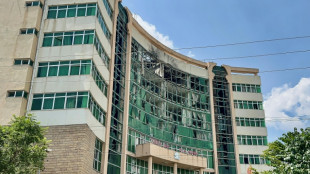 Tigray TV station hit by drone, rebels advance in north Ethiopia

 Banton hundred paves way for England ODI series win over Sri Lanka

 Milestone man Kohli powers India to big ODI win over West Indies

Residents in the remote Turkmen village of Bokurdak have long depended on the Karakum Desert for their livelihoods, cultivating every square metre they can in a constant battle with nature.
It is a battle that some fear they are now losing.
Over recent years, large dunes have started encroaching on the land in the village, while rolling desert sands have forced residents to shift further downhill, local pensioner Kakabai Baimedov told AFP.
For those who live in the desert -- known as "gumli" in Turkmen -- this has been "very difficult", Baimedov said.
"The village of Bokurdak used to be on a hill north of this place. Then, due to the advancing desert, we had to move lower and lower," Baimedov told AFP.
While sand and the steppe have always been part of life in Central Asia, scientists warn climate change and other human activities are accelerating desertification and the degradation of the land.
In addition to being an ecological and social problem, desertification is also an economic burden, costing an estimated six percent of Central Asia's GDP annually, according to the World Bank.
The Karakum Desert covers more than 80 percent of Turkmenistan, a former Soviet republic bordering Iran and Afghanistan.
"If its vegetation and soil cover are not properly managed, the surface is easily subject to erosion, degrading farmland and forming sand dunes," Turkmen scientist Mukhammet Durikov told AFP.
Deforestation is another key culprit, while severe droughts and dry winds fuelled by climate change are making the problem worse, he said.
- Tree-planting campaign -
Central Asia is especially vulnerable to climate change: average temperatures in the region have risen by about twice the global average since 1991, according to UN data.
Authorities in Turkmenistan -- a politically isolated country of seven million people -- have sought to curb desertification through a massive tree-planting campaign.
The government announced in the summer that 162 million trees had been planted over the past 20 years.
"The president himself actively participates in the fight against desertification," an official from the environmental ministry told AFP.
The ministry and regional officials are responsible for planting sites for the trees, overseeing their planting and care, the official said.
AFP was not able to immediately verify the government's claims.
The country bordering the Caspian Sea restricts independent reporting and keeps information about government activities largely secret.
Turkmenistan's two leaders, father-and-son duo Gurbanguly and Serdar Berdymukhamedov, have been keen to show they are taking action in combating desertification.
State media shows Serdar regularly appearing with a shovel in hand planting trees.
"Previously, it was spruces or cedars, but today, we find endemic species better adapted to the climate," Merdan Arazmedov, a member of Turkmenistan's Nature Protection Society, told AFP.
- Keeping water in the soil -
In Bokurdak, scientists have mainly planted saxauls -- a hardy desert shrub whose roots penetrate as much as 15 metres (49 feet) underground to capture water, Arazmedov said.
The saxaul -- which is also being used in Uzbekistan and Kazakhstan -- helps retain sand, improves soil moisture, and also serves as a natural barrier for homes.
Baimedov, who has become an amateur botanist, tends to about 15,000 saplings, which are aimed at forming a green wall against the sand.
"It takes 15-20 years to grow a tree like this," he said, pointing to an eight-metre- (26-foot-) high saxaul.
The saxaul is also being used to protect the capital Ashgabat, where "environmental activists have planted more than 50 hectares of saxaul on the edge of the desert," Arazmedov said.
"Now, the road to the capital is no longer covered in sand, traffic flows smoothly, and the number of accidents has decreased," he added.
But for Baimedov, whose main weapon against the desert is planting trees, the battle has become all the harder due to climate change.
"In the past, it was enough to water young saxaul daily with up to 10 litres of water," he said.
"Today, due to climate change and rising temperatures, it takes up to 20 litres each day to ensure rooting."
Turkmenistan has employed other methods to beat the sand.
Last year, scientists in the country announced they had launched successful trials spraying the soil with cyanobacteria, also known as "blue-green algae" -- a method that helps retain moisture and facilitate tree rooting.
In September, Turkmenistan's president proposed creating a regional centre against desertification in Central Asia.
L.AbuAli--SF-PST