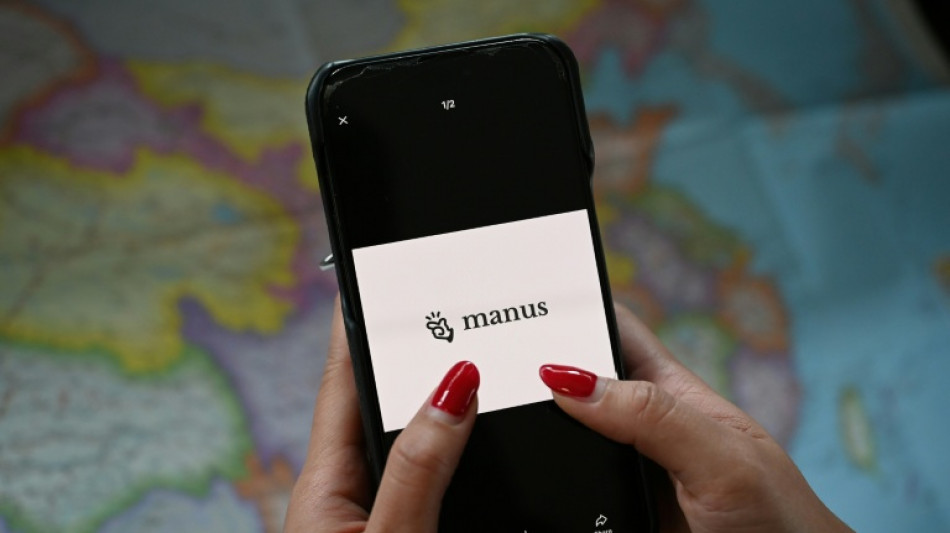
Caught between great powers: the cautionary tale of Manus / Photo: GREG BAKER - AFP

 New four-lane bridge opens between China, North Korea

 Tech stocks lead rout after US inflation fuels rate hike bets

 'No time to recover': UNDP chief sounds alarm on growing poverty after Iran war shock

 Australia says won't let big tech have 'unfettered' access to kids

 Mobile clinics battle Mongolia's childhood dental 'disaster'

 Wallabies back Meredith as playmaker for second New Zealand Test

 Messi's Inter Miami book playoffs with 2-0 win over New York City

 Oil-rich Alberta tests Canada's unity with secession vote

 EU leaders head for showdown over bloc budget

 All Blacks make three changes for second Wallabies Test

 Mourinho blasts 'shameless' timing of Vinicius ban decision

 PSG beat Man City in Champions League thriller, Barcola hits Liverpool hat-trick

 US Treasury chief urges stronger IMF role against 'distortionary policies'

 Giant-killers Bodo sink Dortmund in Champions League

 PSG outgun embattled Man City in six-goal Champions League thriller

 In Chicago, pope's hometown, Catholics express shock and support

 Musk suggests US govt behind any slowdown in Ukraine's Starshield system

 Chiclayo prays for recovery and return of the 'Peruvian pope'

 Barcola scores hat-trick as Liverpool hit LASK for six

 Healthy corals help bleached neighbors regain color: study

 Hope ton helps West Indies level T20 series at 2-2 in India

 Ukraine war reaches shores of Bulgarian fishing village

 Brazil probing 'criminal' origin of forest fires: minister to AFP

 Sally Rooney books cannot be sold in UK amid Palestine Action ban: publisher

 Italian ski stars Goggia and Brignone to miss season opener

Once the envy of China's tech scene, the startup behind the artificial intelligence agent tool Manus has become an example of how rivalry between global powers can ensnare young entrepreneurs' ambitions.
In April, China blocked the acquisition of Manus, an AI-powered app that can carry out tasks for users, by Facebook owner Meta after a regulatory review.
As Manus confirmed its separation from Meta on Tuesday, AFP looks at the rise and fall of its Meta deal:
- 2022-25: Early excitement -
Buzz grew quickly around the AI startup Butterfly Effect, founded in Beijing in 2022.
Manus, its AI agent tool, generated massive interest ahead of its official launch in March 2025.
More than 3.5 million people applied for invitation codes for early access, with some codes fetching thousands of dollars on online resale markets.
At its launch, Chinese state media hailed Manus as a symbol of national innovation.
- Mid-2025: Shift to Singapore -
Soon after the Manus launch, in May 2025, US investors Benchmark Capital led a $75 million funding round in Butterfly Effect, valuing it at nearly half a billion dollars.
The startup was seemingly on track to achieving CEO Xiao Hong's ambition of creating a Chinese company with worldwide recognition.
In a world free of geopolitics, "the Manus story would be a simple story of an incredible AI startup getting rewarded with a big exit", Kyle Chan from the Brookings Institution told AFP.
Manus' trajectory shifted abruptly in mid-2025, when the firm laid off dozens of staff in Beijing and Wuhan and relocated core personnel to Singapore.
It also began blocking access for Chinese users, and withdrew its presence on Chinese social media.
- 2025-26: 'Singapore-washed?' -
Moving to Singapore -- a playbook sometimes dubbed "Singapore-washing" -- can help Chinese startups tap international capital and overseas users, supposedly at a distance from Beijing's legal and political reach.
One source with knowledge of the company told AFP that Butterfly Effect's move was driven primarily by an unexpected US investigation into Benchmark Capital.
The probe fell under Washington's 2025 Outbound Investment Security Program, which restricts investment in Chinese companies in sectors such as AI, semiconductors and quantum computing.
The source said Butterfly Effect had initially planned to move only a small US-facing team to Singapore, but chose to relocate all operations there instead.
AFP contacted the company for comment, but did not receive a response.
- Dec 2025: Meta deal -
As 2025 drew to a close, US tech giant Meta announced that the team behind Manus would join its AI division after the completion of a buyout worth a reported $2 billion.
It was the third largest acquisition deal in Meta's history, following WhatsApp and Scale AI.
"We're excited about what the future holds," CEO Xiao said at the time.
However, trouble was brewing.
"Beijing wants its top tech startups to list in Hong Kong and Shanghai, not fire their Chinese staff and relocate to Singapore... (and) sell out to an American company," sell out to an American company," said Brookings' Chan.
Reports in March 2026 said the Chinese government was reviewing the Meta buyout, and had restricted two Singapore-based Manus co-founders from leaving China.
- April 2026: China block -
China's top economic planning body decreed in a statement in April that it would "prohibit the foreign investment" in the Manus deal and "requires the parties involved to withdraw the acquisition transaction".
The ruling against Manus -- operating from Singapore with Butterfly Effect still registered as a company in China -- was made under measures in place since 2021 to review foreign investments for national security concerns.
In Beijing's view, a Chinese-grown startup handing over talent and tech assets to a US giant would have "set a bad precedent", AI industry analyst Max Liu said.
Sherlock Xia of law firm Yenlex said that China's move had sent a "clear signal" that attempting to shed Chinese identity through overseas relocation was no longer viable.
- August 2026: Manus confirms separation -
The Wall Street Journal had previously reported that Meta was preparing to backtrack on the deal, a complicated U-turn given that investors had already received returns.
Bloomberg News said in June that Meta had cut Manus off from its internal systems as the divorce progressed.
Manus announced on Tuesday that it would "soon return to operating as an independent company".
"This is part of our separation from Meta; we must take this step to comply with regulatory requirements in specific parts of the world," the firm said in a statement posted to its website.
J.AbuHassan--SF-PST


