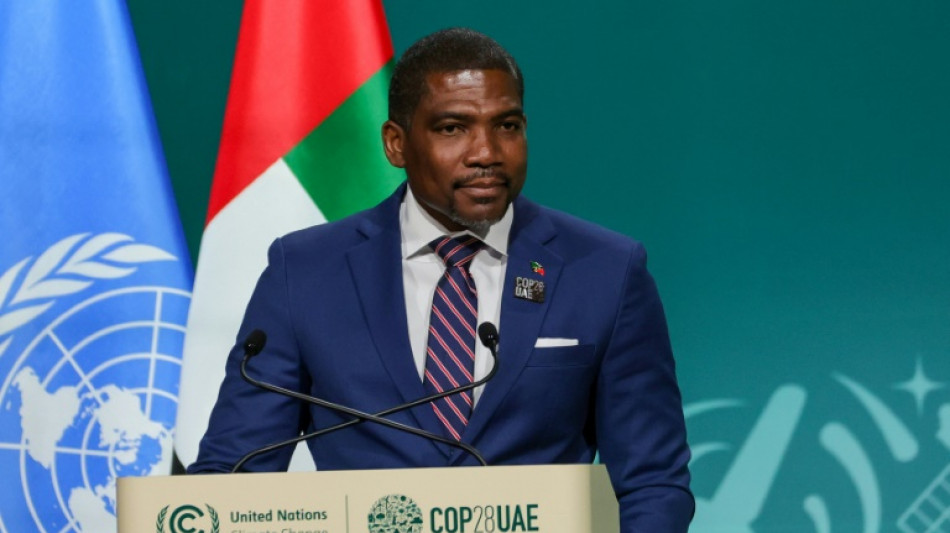
Con job? Climate change is my job, says island nation leader / Photo: Giuseppe CACACE - AFP/File

 Colombian police capture wife, daughter of Ecuador drug lord

 More Asian Games woes as bus takes Pakistan team to wrong venue

 Radio frequencies vital to Earth observation must be protected: UN
 Comedian on trial for insulting Erdogan in standup show

 Women's Fashion Week kicks off in Paris

 Pope arrives in French border city to speak on united Europe
 The wildfires choking Indonesia, sparking regional haze

 PU Prime Deepens Argentina Presence Through FX Expo Buenos Aires 2026

 Nothing to seal here: NZ police help stranded pup home
 White House releases list of products US, China could tax less

 'Pseudo-journalism': Partisan 'news' sites target US midterms

 'Currently impossible': North Korea defections in freefall

 Erasmus sizes up 'improved' Wallabies ahead of 2027 World Cup

 Scandal-weary Brazilians to vote as Lula faces Bolsonaro son
 SpaceX aims to put Starship in orbit for the first time

 Pope to speak on united Europe from French border town

 Scheffler makes sportsmanship stand over tee screamer

 Anthropic CEO Amodei to dine with Trump at White House

 Dupont scores twice to send Toulouse to Top 14 summit

 Greece stun Klopp's Germany as Ireland show sorrow for Gaza

 Ramos fires holders Portugal to Nations League win in Norway

 Greece hand Klopp first defeat as Germany manager

 Pope promises French sex abuse victims to prevent further harm

 UK village on edge over threats to air base in terror alert

 Two giant pandas, emblems of China soft diplomacy, arrive in US

US President Donald Trump may dismiss climate change as a "con job" -- but for the leader of tiny St. Kitts and Nevis, its toll is unmistakable: land swallowed, homes battered, and livelihoods threatened.
Prime Minister Terrance Drew, responding to Trump's blistering attack at the United Nations on the science of planet-warming fossil fuels, said: "Everyone has the opportunity to express themselves."
But for his 45,000 countrymen and women, "it is not a matter of any discussion, it is a reality we are living," Drew told AFP on the sidelines of the world body's high-level week in New York.
"So I would invite persons to come... and see what we are dealing with," he said.
Tourism has long been the mainstay of the economy of St. Kitts and Nevis, a twin island nation famed for its pristine beaches and diverse ecosystems.
Drew said those were now under threat from a type of algae known as sargassum that thrives in warmer waters, piling up along coastlines that were once immaculate.
It "tarnishes the beauty of our beaches," he said. "It's only with accelerated climate change we're seeing this, and it's threatening our most important economic pillar: tourism."
The threats don't stop there.
Extreme weather includes hurricanes that arrive earlier in the season and intensify more quickly. Sea-level rise is "taking away our coastline," Drew said, while shifting rainfall patterns disrupt freshwater supplies vital for both agriculture and drinking.
Such issues are common across the Greater Caribbean.
The sea has long sustained its economies, heritage, and cultures -- but now threatens its very survival.
- Not just a tourism playground -
Rol-J Williams, a 25-year-old medical student and climate activist from Nevis who was also in New York, told AFP he could see the impact of climate change outside his back door.
Erosion on the beach behind his house has caused the coastline to steadily recede, he said, forcing fishing communities to abandon their villages.
"The Caribbean is not just a tourist destination. It's a region that's severely impacted by climate change," he said.
According to a new report by the UN Global Center for Climate Mobility, more than eight million people in the region are projected to move permanently by the middle of the century, leading to population shifts both within and across countries.
"Traditionally, destinations from the region have been a lot to the US, UK and Canada, and that is still projected to still be the case," said Sarah Rosengaertner, the report's lead author.
But the people of the Caribbean remain deeply tied to their homelands and are reluctant to leave.
"What we're trying to do is create a public coalition that can forcefully make the case that this issue needs to be addressed," she said.
Rosengaertner stressed that countries of the region need far more support to adapt, from securing the energy needed to desalinate seawater as rainfall becomes erratic, to ensuring homes are better equipped to withstand storms.
Drew said St. Kitts and Nevis is expanding its geothermal capacity with support from the UN's Green Climate Fund and plans to invest in solar, which generates power at one-third the cost of fossil fuels on the island.
But "nobody is receiving climate finance to the degree that was promised," he told AFP.
Deshawn Browne, a 28-year-old lawyer and activist from neighboring island Antigua -- which is also experiencing intensified hurricanes, drought, and sea-level rise -- said the stakes were too high to ignore.
"I'm one of those who do not want to move at all," she said. "I'm open if I have to... But let's see what we can do so we don't have to."
L.Hussein--SF-PST