Chimps ingest alcohol daily: study / Photo: PATRICK MEINHARDT - AFP

 SGFX Creates a Standout Brand Experience at Forex Expo Dubai 2026

 Pope urges Europe to help combat 'deceit and lies' in international ties

 Injured Buttler to miss England ODI series in Pakistan

 Madrid housing protesters vow to maintain pressure on government
 In kayaks or waist-deep in floodwater, shoppers return to Bangkok markets

 UK police probes Iran link to air base bomb scare: media

 Eala blasts into Asian Games quarters in just 55 minutes

 Taiwan gender-row boxer Lin Yu-ting guarantees Asian Games medal

 Comedian on trial for allegedly insulting Erdogan in standup show

 More Asian Games transport woes as bus takes Pakistan to wrong venue

 Death toll in South Africa bar shooting rises to 18

 Aide to Venezuelan opposition leader returns from exile

 Messi and Alcaraz love it, now padel takes step closer to Olympics

 Tolls mount in Thailand, Myanmar floods

 Why India's opposition wants top poll official out

 PU Prime Strengthens UAE Momentum with Strong Showing at Forex Expo Dubai 2026

 Eight dead in Thailand floods since mid-September

 Oil prices spike after Trump rejects Iran truce offer

 Taylor Swift sets new record at MTV VMAs

 Seoul seeks apology after Ukraine reveals transfer of North Korean POWs

 Messi on target again but Miami downed by Columbus

 In Washington's political cauldron, a fight over foie gras

 Flavio Bolsonaro: political heir in his father's shadow

 Ravens grab last-second win in Rio as Commanders stop Seahawks

 USA rallies to capture 11th consecutive Presidents Cup

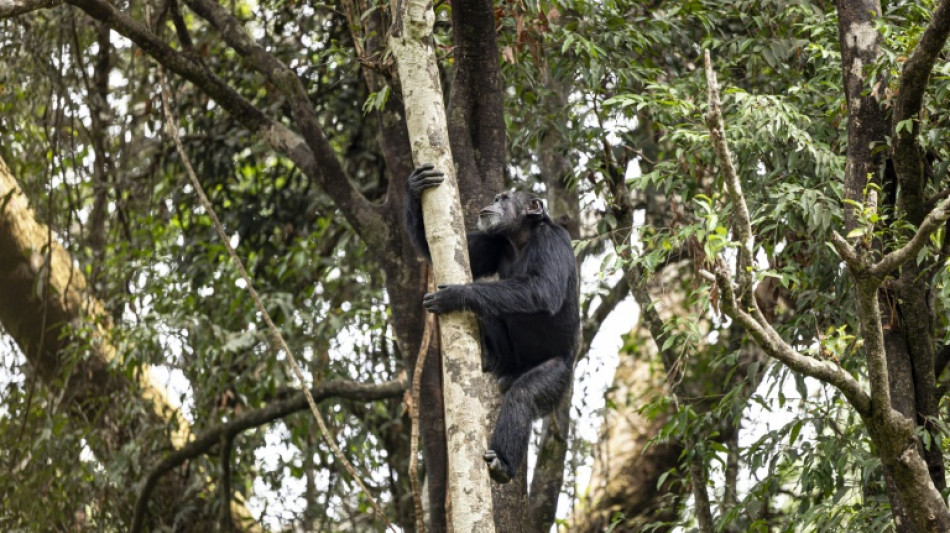
Chimpanzees consume the equivalent of at least one alcoholic drink per day as they eat ripe, fermenting fruit, says a study out Wednesday that addresses one possible reason why humans are drawn to booze.
The study, carried out in the wilds of Africa where the animals live, supports the theory that people may have inherited from primates a taste for alcohol and ability to metabolize it even though it is toxic for us.
The researchers collected fruits that chimps eat and measured their ethanol content, which is produced as sugar ferments. They concluded that these evolutionary cousins of ours consume alcohol on a daily basis.
And not just a little. Through the large amount of fruit that chimps eat, the researchers reckon the animals take in about 14 grams (half an ounce) of alcohol per day.
Correcting for body size, it is like the chimps are drinking a pint of beer per day, Aleksey Maro, lead author of the study published in the journal Science Advances, told AFP.
"It's not an insubstantial amount of alcohol, but very diluted and more associated with food," said the PhD candidate at the University of California, Berkeley.
- The 'drunken monkey' theory -
"We've seen for the first time that, indeed, our closest living relatives are consuming physiologically relevant doses of alcohol routinely daily," Maro said.
This is in line with the "drunken monkey theory" espoused more than a decade ago by US biologist Robert Dudley, who co-authored the new study.
As the theory goes, humans liking alcohol and being able to metabolize it stems from our primate ancestors ingesting it daily through the fruit they eat.
"The drunken monkey hypothesis is becoming more and more a reality," said Maro. "Its name is unfortunate. A better name would be the evolutionary hangover."
The theory was initially met with skepticism among experts. But it has gained traction in recent years as studies showed that some primates eat fermented fruit and, given a choice of nectars with varying amounts of alcohol, they prefer the booziest one.
Nathaniel Dominy, a professor of anthropology and evolutionary biology at Dartmouth College who did not take part in this study, welcomed it enthusiastically.
"The paper is a tour de force," he told AFP.
Dominy also said it "puts to rest the debate over the prevalence of ethanol in tropical fruits."
But he added that the study raises new questions on the biological and behavioral consequences of chronic low-level ethanol exposure for nonhuman primates.
Another unanswered question is whether chimps actively search out boozy fruit or just eat it when they find it. The researchers in this study said they did not know.
The issue of chimps ingesting alcohol will remain under study to learn more about the origins of human alcohol consumption and assess its risks and possible benefits, according to Maro.
"We can learn about ourselves through the chimpanzees," he said.
T.Samara--SF-PST