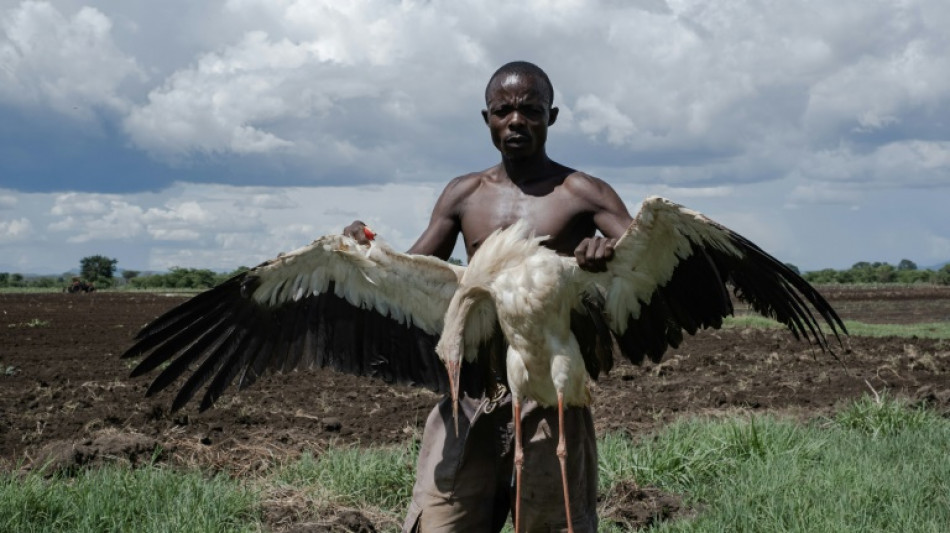
Ugandans kill migrating storks in desperation for food / Photo: Badru Katumba - AFP

 Trump denies offering to sell arms to China's Xi

 Wemby ready for NBA Spurs to move rivals in climb to top

 Ukraine to postpone some spending amid delays in aid: PM

 Tuchel says Czech Republic game 'not yet a must-win'

 MaXhosa puts South Africa on the Paris fashion map

 Rose, Scott among 2027 World Golf Hall of Fame finalists

 Brunson says NBA champion Knicks can't get satisfaction

 France puts out largest wildfire since 1949

 Real Madrid's Perez summoned over Barcelona referee payments comments

 Oil takes off again, Wall Street dips after Trump rejects Iran truce offer

 AlgoQuant Asset Management Selects Liquid Mercury to Enhance Digital Asset Trading Infrastructure

 UK to reopen refugee resettlement scheme to push 'safe' migration

 Pope urges Europe to help combat 'lies and deceit' in world affairs

 Iranian lawyer Nasrin Sotoudeh wins Council of Europe's rights prize

 French far-right's Bardella denies alleged 2013 antisemitic comments

 Oil up, Wall Street dips after Trump rejects Iran truce offer

 Gakpo withdraws from Netherlands squad

 SpaceX puts Starship megarocket in orbit for first time

 Iran denies link to suspected bomb plot at UK airbase used by US

 Ex-boss Mancini says City charges 'not my concern'

 Berlin Marathon winner Assefa finished race with torn Achilles

 Comedian convicted for Erdogan 'insult' but freed pending appeal

 French prosecutors seek two-year sentence for ex-minister Dati in graft case

 Eala makes fast start as weather and transport woes hit Asian Games

 Hurricane Polo approaches Mexico, threatens severe damage

Desperate Ugandans are using poison to kill thousands of migrating white storks and other protected birds because they have so few sources of food.
In Ayoreri, a village on the Kenyan border, Sam Chekwoi, 42, said unpredictable rains and droughts have made it increasingly hard to feed his two wives and 11 children.
"I used to farm but the sun would destroy my food crops. That is when I decided to start catching those birds to provide food for my children and myself," he said.
He showed AFP how locals hunt their prey.
First they catch a mouse and kill it, then pour a mixture of alcohol and rat poison into its mouth and leave it in the field for a bird to spot.
The birds swoop down and quickly feel the impact of the poison. They try to fly away but cannot get very far and the villagers chase them down to finish the kill.
"When the birds eat the trap, they get weak, we catch them, kill them, and then eat them," said Chekwoi.
He estimates he has eaten upwards of 300 storks since moving to the area in 2016.
"If there was an alternative, I would do it," said Chekwoi.
The activity risks heavy fines but locals feel they have no choice.
- 'Only source of protein' -
Joel Cherop, 45, a farmer and conservationist, grew up in the area and is trying to discourage the practice.
He estimates that some 3,000 white storks have been eaten by villagers since the start of the year when the migrating season began.
Cherop described the birds as the "only source of protein" for many in the area. They can sell a stork for around 2,000 shillings or less than a dollar, he said.
He has monitored the birds over the years and knows from tagging that some came from Poland, Czech Republic and Hungary.
Although the nomadic communities in the region have degraded the land by cutting down too many trees for charcoal, Cherop empathises with their difficulties, especially the worsening droughts.
"There is no doubt that crop failure tops the agenda in this community for the last 10 years," he told AFP.
It feels particularly unfair, he said, to think that climate change is the result of industrial practices elsewhere in the world -- "the Americas, the Russias and the Chinas who are emitting billions of (tonnes of) carbon."
Cherop has started planting thousands of fruit trees around his farm in a bid to regenerate the land and is employing as many locals as he can with his limited means.
He says the local villagers are simply trying to survive.
"These are hungry young people who have no food, so they found an alternative in the migratory birds," he said.
T.Khatib--SF-PST