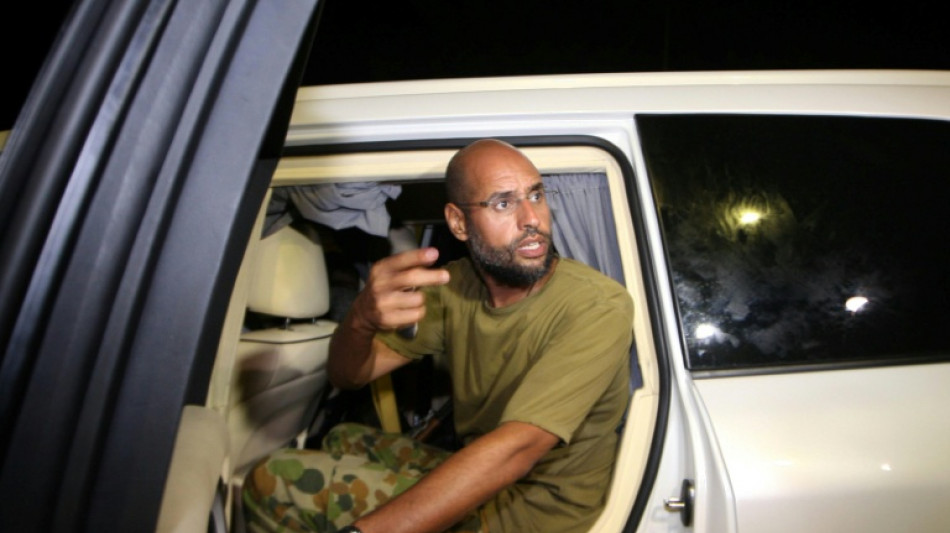
Who is behind the killing of late ruler Gaddafi's son, and why now? / Photo: IMED LAMLOUM - AFP/File

 Middle East fuel crunch drives solar push in tiny Fiji
 Indian rappers use music to sound climate alarm
 Japan probe on its way to Mars moon
 Lula or Bolsonaro's son? Brazil makes a final choice

 EU unveils strategy to boost Arctic presence
 How recent controversies have rocked the US death penalty debate
 Adams facing long injury layoff as Rams' problems deepen
 US judge orders Saudi engineer held in OpenAI case

 Maddison sparkles as Spurs end Premier League winless run

 Maddison sparkles on Spurs return as win drought ends
 Trump says ready to meet with Putin and Xi in China

 The young lawmaker making Brazil's Lula 'king of the selfie'
 Christiane Amanpour to leave CNN after 43 years

 Ronaldo handed 30-day suspension after walking out on Portugal
 Netanyahu basks in Trump endorsement week before election
 Saudi airport closure disrupts life in kingdom's capital

 Ramaphosa tells South Africa to prepare for loss of US-Africa trade deal
 France presses resale platforms to remove 'stolen' goods after unrest
 Yamal v PSG: Ballon d'Or backdrop to Champions League showdown
 Araujo says too soon to talk about permanent Liverpool move
 US wants to be 'strong partner' for central Asia: Rubio
 'Special' to face friend Perez in Champions League, says Liverpool's Iraola
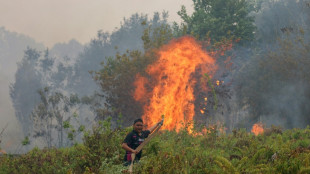 Monitor says Indonesia fires have burned nearly two million hectares
 French PM says could declare state of emergency over unrest 'if needed'

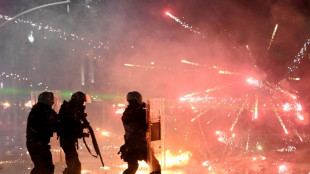 Albanian PM warns of 'red line' after days of unrest
Seif al-Islam, the son of Libya's slain longtime ruler Muammar Gaddafi and once seen by some as his likely heir, has been killed.
Targeted by a warrant from the International Criminal Court for alleged crimes against humanity, and still a player in Libya's turbulent political scene, the 53-year-old was no stranger to violence.
But his sudden assassination has raised many questions:
- Who is behind it? -
Very little has emerged about the identity or motives of the assailants.
Seif's lawyer, Marcel Ceccaldi, told AFP he was killed by an unidentified "four-man commando" who stormed his house on Tuesday afternoon in the city of Zintan, western Libya.
His adviser, Abdullah Othman Abdurrahim, told Libyan media the four unidentified men had stormed the home before "disabling surveillance cameras, then executed him".
Libyan prosecutors said Wednesday they were probing the killing after establishing that "the victim died from wounds by gunfire".
- Why now? -
Claudia Gazzini, a senior Libya analyst at International Crisis Group, described the timing of Seif's death as "odd".
"He had been living a relatively quiet life away from the public eye for many years now," she told AFP.
Seif had announced his bid to run for president in 2021. Those elections were indefinitely postponed, and he had barely made any major public appearances since.
His whereabouts had been largely unknown. Aside from a small inner circle -- and probably the Libyan authorities -- few people knew he lived in Zintan.
Ceccaldi said "he often moved around" but "had been in Zintan for quite some time".
Anas El Gomati, head of the Tripoli-based Sadeq Institute think tank, said the timing was "stark".
His death came just "48 hours after a US-brokered Paris meeting between Saddam Haftar and Ibrahim Dbeibah", respectively the son of eastern Libya's military strongman Khalifa Hafter and the nephew of the Tripoli-based Prime Minister Abdulhamid Dbeibah.
Libya has remained divided between the UN-backed Tripoli government and its rival administration in the east.
- What Seif al-Islam represented -
Experts differ over the extent of Seif's political influence. But there is broad agreement on his symbolic weight as the most prominent remaining figure associated with pre-2011 Libya.
"Seif had become a cumbersome actor" in Libyan politics after announcing his bid for office in 2021, said Hasni Abidi, director of the Geneva-based Centre for Studies and Research on the Arab and Mediterranean World.
His killing "benefits all political actors" currently competing for power in the North African country, Abidi said.
For Gomati, his death "eliminates Libya's last viable spoiler to the current power structure".
"He wasn't a democrat or reformer, but he represented an alternative that threatened both Haftar and Dbeibah," Gomati added. "His removal consolidates their duopoly ... The pro-Gaddafi nostalgia bloc now has no credible leader."
Libya expert Jalel Harchaoui offered a more cautious assessment, saying Seif's death was "no major upheaval".
"He was not at the head of a unified, cohesive bloc exerting real weight in the competition for power, rivalries, or the allocation of territory or wealth," Harchaoui explained.
Still, "he could have played a decisive role under specific circumstances", Harchaoui said, arguing that his mere name on a presidential ballot would have had a substantial impact.
- How has the public reacted? -
Among the public, speculation is rife.
Some have suggested the involvement of a local Zintan-based armed group that may no longer have wanted Seif on its territory.
Others suspect foreign forces may have been involved.
"The operation's sophistication -- four operatives, inside access, cameras disabled -- suggests foreign intelligence involvement, not militia action," said Gomati.
burs-iba-bou/dc
O.Mousa--SF-PST