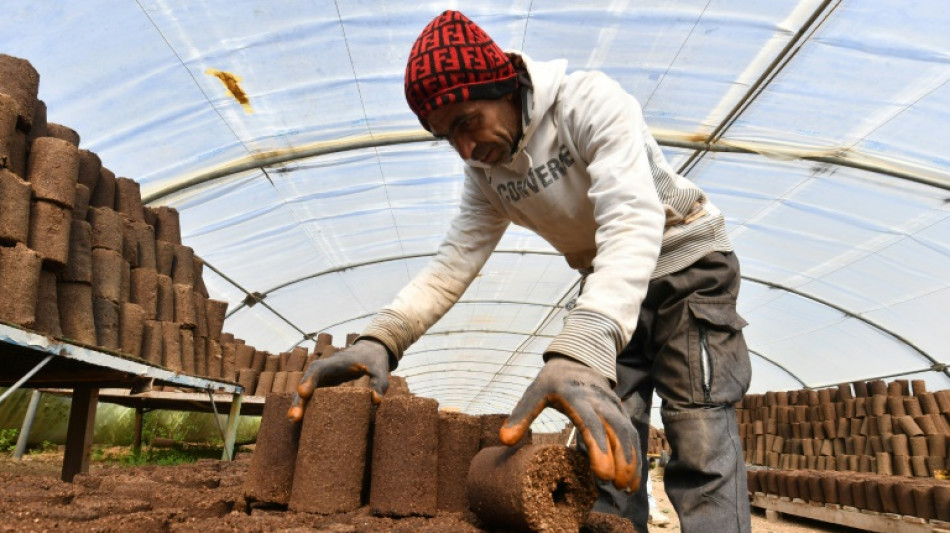
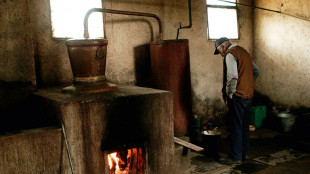
Tunisian startup turns olive waste into clean energy / Photo: FETHI BELAID - AFP

 Trump denies offering to sell arms to China's Xi

 Wemby ready for NBA Spurs to move rivals in climb to top

 Ukraine to postpone some spending amid delays in aid: PM
 Tuchel says Czech Republic game 'not yet a must-win'

 MaXhosa puts South Africa on the Paris fashion map

 Rose, Scott among 2027 World Golf Hall of Fame finalists

 Brunson says NBA champion Knicks can't get satisfaction

 France puts out largest wildfire since 1949

 Real Madrid's Perez summoned over Barcelona referee payments comments

 Oil takes off again, Wall Street dips after Trump rejects Iran truce offer
 AlgoQuant Asset Management Selects Liquid Mercury to Enhance Digital Asset Trading Infrastructure

 UK to reopen refugee resettlement scheme to push 'safe' migration

 Pope urges Europe to help combat 'lies and deceit' in world affairs

 Iranian lawyer Nasrin Sotoudeh wins Council of Europe's rights prize

 French far-right's Bardella denies alleged 2013 antisemitic comments

 Oil up, Wall Street dips after Trump rejects Iran truce offer

 Gakpo withdraws from Netherlands squad

 SpaceX puts Starship megarocket in orbit for first time
 Iran denies link to suspected bomb plot at UK airbase used by US

 Ex-boss Mancini says City charges 'not my concern'

 Berlin Marathon winner Assefa finished race with torn Achilles

 Comedian convicted for Erdogan 'insult' but freed pending appeal

 French prosecutors seek two-year sentence for ex-minister Dati in graft case

 Eala makes fast start as weather and transport woes hit Asian Games

 Hurricane Polo approaches Mexico, threatens severe damage

In a northern Tunisian olive grove, Yassine Khelifi's small workshop hums as a large machine turns olive waste into a valuable energy source in a country heavily reliant on imported fuel.
Holding a handful of compacted olive residue -- a thick paste left over from oil extraction -- Khelifi said: "This is what we need today. How can we turn something worthless into wealth?"
For generations, rural households in Tunisia have burned olive waste for cooking and heating, or used it as animal feed.
The International Olive Council estimated Tunisia will be the world's third-largest olive oil producer in 2024-2025, with an expected yield of 340,000 tonnes.
The waste generated by the oil extraction is staggering.
Khelifi, an engineer who grew up in a family of farmers, founded Bioheat in 2022 to tackle the issue. He recalled watching workers in olive mills use the olive residue as fuel.
"I always wondered how this material could burn for so long without going out," he said. "That's when I asked myself: 'Why not turn it into energy?'"
Beyond profit, Khelifi hopes his startup helps "reducing the use of firewood as the country faces deforestation and climate change".
At his workshop, employees transport truckloads of olive waste, stacking it high before feeding it into the processing machines.
The material is then compacted into cylindrical briquettes and left to dry for a month under the sun and in greenhouses before its packaging and sale.
- The soul of olives -
Khelifi began developing his idea in 2018 after he travelled across Europe searching for a machine to turn the olive paste into long-burning fuel.
Unable to find the right technology, he returned to Tunisia and spent four years experimenting with various motors and mechanical parts.
By 2021, he had developed a machine that produced briquettes with just eight-percent moisture.
He said this amount significantly reduces carbon emissions compared to firewood, which requires months of drying and often retains more than double the amount of moisture.
Bioheat found a market among Tunisian restaurants, guesthouses, and schools in underdeveloped regions, where winter temperatures at times drop below freezing.
But the majority of its production -- about 60 percent -- is set for exports to France and Canada, Khelifi said.
The company now employs 10 people and is targeting production of 600 tonnes of briquettes in 2025, he added.
Selim Sahli, 40, who runs a guesthouse, said he replaced traditional firewood with Khelifi's briquettes for heating and cooking.
"It's an eco-friendly and cost-effective alternative," he said. "It's clean, easy to use, and has reduced my heating costs by a third."
Mohamed Harrar, the owner of a pizza shop on the outskirts of Tunis, praised the briquettes for reducing smoke emissions, which he said previously irritated his neighbours.
"Besides, this waste carries the soul of Tunisian olives and gives the pizza a special flavour," he added.
- 'Protect the environment' -
Given Tunisia's significant olive oil production, waste byproducts pose both a challenge and an opportunity.
Noureddine Nasr, an agricultural and rural development expert, said around 600,000 tonnes of olive waste is produced annually.
"Harnessing this waste can protect the environment, create jobs, and generate wealth," he said.
Nasr believes repurposing olive waste could also help alleviate Tunisia's heavy dependence on imported fuel.
The country imports more than 60 percent of its energy needs, a reliance that widens its trade deficit and strains government subsidies, according to a 2023 World Bank report.
Fuel and gas shortages are common during winter, particularly in Tunisia's northwestern provinces, where households struggle to keep warm.
Redirecting agricultural waste into alternative energy sources could ease this burden.
Yet for entrepreneurs like Khelifi, launching a startup in Tunisia is fraught with challenges.
"The biggest hurdle was funding," he said, lamenting high-interest bank loans. "It felt like walking on a road full of potholes."
But now his goal is "to leave my mark as a key player in Tunisia's transition to clean energy", he added. "And hopefully, the world's, too."
E.AbuRizq--SF-PST