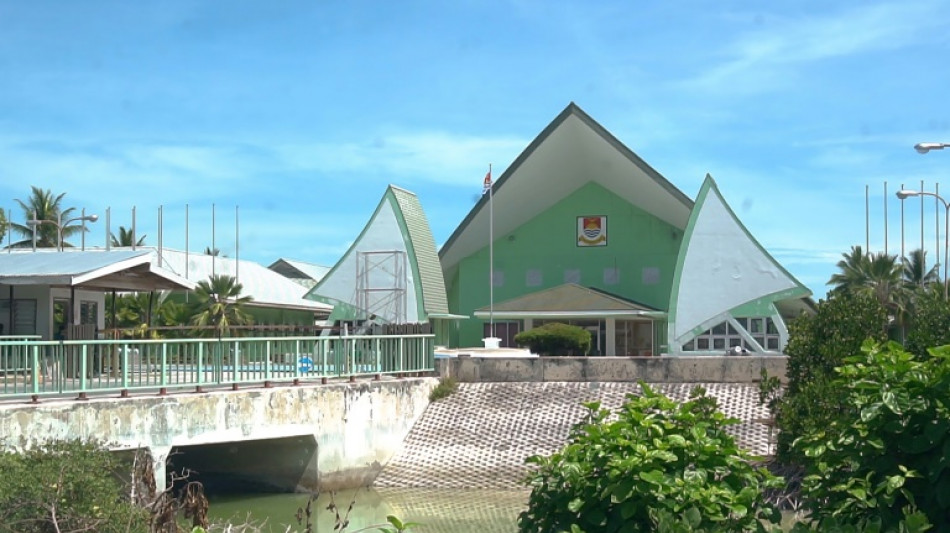
Kiribati eyes deep-sea mining deal with China / Photo: Raimon Kataotao - AFP/File

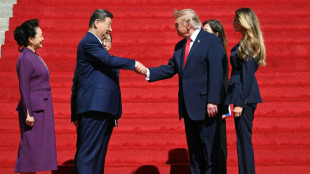
 Trump denies offering to sell arms to China's Xi

 Wemby ready for NBA Spurs to move rivals in climb to top

 Ukraine to postpone some spending amid delays in aid: PM

 Tuchel says Czech Republic game 'not yet a must-win'

 MaXhosa puts South Africa on the Paris fashion map

 Rose, Scott among 2027 World Golf Hall of Fame finalists

 Brunson says NBA champion Knicks can't get satisfaction

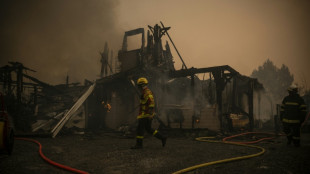 France puts out largest wildfire since 1949

 Real Madrid's Perez summoned over Barcelona referee payments comments

 Oil takes off again, Wall Street dips after Trump rejects Iran truce offer

 AlgoQuant Asset Management Selects Liquid Mercury to Enhance Digital Asset Trading Infrastructure

 UK to reopen refugee resettlement scheme to push 'safe' migration

 Pope urges Europe to help combat 'lies and deceit' in world affairs

 Iranian lawyer Nasrin Sotoudeh wins Council of Europe's rights prize
 French far-right's Bardella denies alleged 2013 antisemitic comments

 Oil up, Wall Street dips after Trump rejects Iran truce offer

 Gakpo withdraws from Netherlands squad

 SpaceX puts Starship megarocket in orbit for first time
 Iran denies link to suspected bomb plot at UK airbase used by US
 Ex-boss Mancini says City charges 'not my concern'

 Berlin Marathon winner Assefa finished race with torn Achilles

 Comedian convicted for Erdogan 'insult' but freed pending appeal

 French prosecutors seek two-year sentence for ex-minister Dati in graft case

 Eala makes fast start as weather and transport woes hit Asian Games

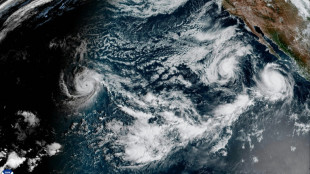 Hurricane Polo approaches Mexico, threatens severe damage

Pacific nation Kiribati says it is exploring a deep-sea mining partnership with China, dangling access to a vast patch of Pacific Ocean harbouring coveted metals and minerals.
Beijing has been ramping up efforts to court Pacific nations sitting on lucrative seafloor deposits of cobalt, nickel and copper -- recently inking a cooperation deal with Cook Islands.
Kiribati opened discussions with Chinese ambassador Zhou Limin after a longstanding agreement with leading deep-sea mining outfit The Metals Company fell through.
"The talk provides an exciting opportunity to explore potential collaboration for the sustainable exploration of the deep-ocean resources in Kiribati," the government said Monday evening in a statement.
Pacific nations Kiribati, Cook Islands and Nauru sit at the forefront of a highly contentious push to mine the depths of the ocean.
Kiribati holds rights for deep-sea mining exploration across a 75,000-square-kilometre swathe of the Pacific, in a region known as the Clarion Clipperton Zone.
Through state-backed subsidiary Marawa Research, Kiribati had been working with Canada-based The Metals Company to explore the mineral deposits.
But that agreement was terminated "mutually" at the end of 2024, The Metals Company told AFP.
A Kiribati fisheries official said the nation was now exploring opportunities with other foreign partners.
The Metals Company said Kiribati's mining rights were "less commercially favourable" than other projects with Pacific nations Nauru and Tonga.
Kiribati's announcement comes as international regulators begin a series of crunch meetings that could decide the fate of the nascent industry.
The Metals Company and other industry players are pushing the International Seabed Authority to set rules allowing large-scale exploitation.
- 'Bending over backwards' -
Kiribati, a climate-threatened archipelago home to some 130,000 people, lays claim to an ocean expanse that forms one of the largest exclusive economic zones in the world.
Under incumbent President Taneti Maamau it severed diplomatic links with Taiwan in 2019, forming deeper ties to China.
Chinese companies have in recent years been granted rights to harvest Kiribati's profitable fisheries -- one of the nation's few natural resources besides minerals.
A visiting cadre of Beijing police have also visited the capital Tarawa to help train local Kiribati forces.
Tessie Lambourne, a leading member of Kiribati's opposition, said China seemed to be seeking access to "our maritime space for its own interest".
"I always say that our government is bending over backwards to please China," she told AFP.
China and Cook Islands struck a five-year cooperation agreement in February to study the Pacific nation's seabed mineral riches.
The deal did not include any exploration or mining licence.
Companies hope to earn billions by scraping the ocean floor for polymetallic rocks, or nodules, that are loaded with manganese, cobalt, copper and nickel -- metals used to build batteries for electric vehicles.
Pacific nations such as Nauru and Kiribati believe the industry holds the key to economic prosperity in a region where scarce land is already under threat from rising seas.
But neighbours Palau, Fiji and Samoa are staunchly opposed, pushing for lingering environmental questions to be cleared up before anyone takes the plunge.
O.Farraj--SF-PST