Main points of the $300 billion climate deal / Photo: STRINGER - AFP

 OpenAI cancels release of newest model due to safety concerns

 AI bosses head to White House as safety pressure builds
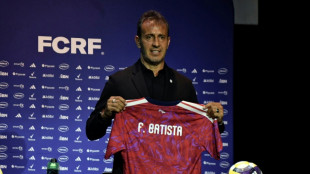 Batista sacked as Costa Rica coach after six months
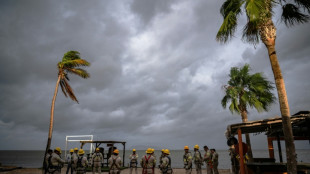 Flooding, power cuts and evacuations as Hurricane Polo slams Mexico

 Dodgers eye three-peat, Red Sox face Yankees as MLB playoffs begin
 Certification of Boeing 737 MAX delayed by software bug

 Celine Dion wows Paris Fashion Week with surprise gig
 AMD buys firm founded by AI 'godmother' Fei-Fei Li
 Italy rebound in Turkey as France win late in Belgium

 Pope says concerns about AI 'should be taken seriously'
 Hurricanes to hoist title banner as NHL season begins
 Justice Alito steps aside from major US climate case

 Willis happy with England exile after retains Top 14 player award
 Spain housing protests keep heat on government as PM seeks new law
 Wissa spoils Zimbabwe homecoming as DR Congo win AFCON qualifier

 UK police release on bail five men held over airbase incident

 Ex-All Black Plummer 'sure' New Zealand will find Super Rugby solution

 Shein sees 1% revenue growth in first half of 2026
 Netherlands regrets Israel retaliation in settlements row
 Moscow seizes Russian assets of German food retailer Metro
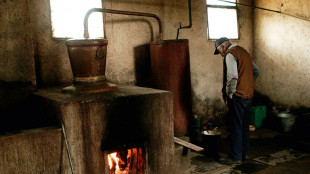 Bulgarian spirits inflamed by new rakia rules

 Documentary turns camera on architect Peter Zumthor
 UK police say releasing on bail five men held over airbase incident
 Trump admin finalizes reversal of US fuel economy standards
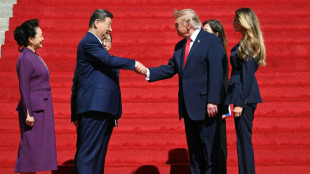 US says no China arms sale plans after envoy cites Trump offer
The deal reached at UN climate talks in Azerbaijan ramps up the money that wealthy historic emitters will provide to help poorer nations transition to cleaner energy and adapt to global warming.
Here are the main points of the agreement reached at COP29 in Baku:
- $300 billion -
Under a framework established by the UN in 1992, 23 developed countries -- and the European Union -- historically responsible for most planet-heating emissions are obliged to contribute to climate finance.
The Baku accord raises the amount of money that developed countries must provide to at least $300 billion per year by 2035.
It is higher than the $100 billion that is currently required under a previous agreement that runs until next year.
But it falls well short of the $500 billion that some developing countries had demanded at the fraught negotiations in Baku.
The deal states that the money will come directly from a "wide variety of sources" including government budgets, private sector investment, and other financing.
It also cites "alternative sources" -- a reference to potential global taxes under discussion on the aviation and maritime industries, and the rich.
The hope is that the money from developed countries will help boost private investment to reach an ambitious goal -- written into the deal -- of delivering at least $1.3 trillion per year by the next decade.
That is the amount that experts commissioned by the United Nations said was needed by 2035.
"With these funds and with this structure, we are confident we will reach the 1.3 trillion objective," EU climate commissioner Wopke Hoekstra told fellow COP29 delegates.
- China role -
The United States and EU had pushed to broaden the donor base to include countries that are still listed as developing but have now become wealthy, such as China and Saudi Arabia.
But China, the world's second-biggest economy and top emitter of greenhouse gases, has steadfastly refused to change its status while recalling that it already provides bilateral aid.
The deal states that developed nations would be "taking the lead" in providing the $300 billion -- implying that others could join.
The text "encourages" developing countries to "make contributions" that would remain "voluntary".
There was one novelty: the climate finance that developing countries such as China provide via multilateral development banks will count towards the $300 billion goal.
"It is also a matter of fairness and of importance to us that all those with the ability to do so should contribute," Hoekstra said.
"Therefore it is good, given the size of the problem, that we enlarge the contributor base on a voluntary basis."
- Share of money -
The negotiations were also the scene of disagreements within the developing world.
The Least Developed Countries (LDCs) bloc had asked that it receive $220 billion per year, while the Alliance of Small Island States (AOSIS) wanted $39 billion -- demands that were opposed by other developing nations.
The figures did not appear in the final deal.
Instead, it calls for tripling other public funds they receive by 2030.
The next COP, in Brazil in 2025, is expected to issue a report on how to boost climate finance for these countries.
C.Hamad--SF-PST