Common water disinfectant creates potentially toxic byproduct: study / Photo: JUSTIN SULLIVAN - GETTY IMAGES NORTH AMERICA/AFP/File

 OpenAI cancels release of newest model due to safety concerns

 AI bosses head to White House as safety pressure builds

 Batista sacked as Costa Rica coach after six months

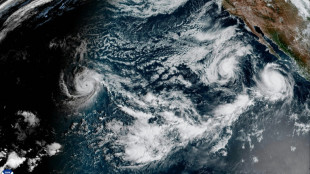
 Flooding, power cuts and evacuations as Hurricane Polo slams Mexico

 Dodgers eye three-peat, Red Sox face Yankees as MLB playoffs begin

 Certification of Boeing 737 MAX delayed by software bug

 Celine Dion wows Paris Fashion Week with surprise gig

 AMD buys firm founded by AI 'godmother' Fei-Fei Li

 Italy rebound in Turkey as France win late in Belgium

 Pope says concerns about AI 'should be taken seriously'

 Hurricanes to hoist title banner as NHL season begins

 Justice Alito steps aside from major US climate case

 Willis happy with England exile after retains Top 14 player award

 Spain housing protests keep heat on government as PM seeks new law

 Wissa spoils Zimbabwe homecoming as DR Congo win AFCON qualifier

 UK police release on bail five men held over airbase incident

 Ex-All Black Plummer 'sure' New Zealand will find Super Rugby solution

 Shein sees 1% revenue growth in first half of 2026

 Netherlands regrets Israel retaliation in settlements row

 Moscow seizes Russian assets of German food retailer Metro

 Bulgarian spirits inflamed by new rakia rules

 Documentary turns camera on architect Peter Zumthor

 UK police say releasing on bail five men held over airbase incident

 Trump admin finalizes reversal of US fuel economy standards

 US says no China arms sale plans after envoy cites Trump offer

A group of chemical compounds used to disinfect water for one-third of the US population and millions of others globally produces a potentially toxic byproduct, according to new research published Thursday, sparking calls for an "immediate" investigation into possible health impacts.
Inorganic chloramines have been used for decades to remove pathogens from public water supplies.
Though chlorine remains the most widely used disinfectant in the US and globally, chloramines have increasingly replaced it in many systems to reduce certain byproducts linked to bladder and colon cancer, low birth weight, and miscarriage.
Today, more than 113 million Americans rely on chloraminated drinking water, with the compound also in use across Canada, Asia, and Europe.
"However, chloramines themselves decompose into products that are poorly characterized," said Julian Fairey, lead author of the study published in the journal Science, during a press briefing.
One such product, identified more than 40 years ago but left chemically unresolved, was simply dubbed the "unidentified product."
Fairey and his team have finally cracked the mystery.
Using a combination of traditional chemistry methods and modern tools like high-resolution mass spectrometry and nuclear magnetic resonance spectroscopy, they identified the compound as "chloronitramide anion."
The compound was detected in all 40 chloraminated drinking water samples tested, with concentrations reaching up to 100 micrograms per liter -- exceeding typical regulatory limits for disinfection byproducts, which range between 60 and 80 micrograms per liter.
Although toxicological studies have yet to be conducted, the researchers sounded a warning.
"The chemical structure looks concerning, as does the concentrations at which this compound is forming, so we certainly think health effects studies are warranted," Fairey said.
Their study calls for the compound to be "an immediate candidate" for quantification in public waters and for closer health and toxicity studies.
Water utilities could consider reverting to chlorine, Fairey suggested, though this would require secondary disinfectants to neutralize the known toxic byproducts chlorine produces.
With further study and regulatory action likely years away, the researchers recommended home filtration systems using activated carbon blocks for people who are concerned.
O.Salim--SF-PST