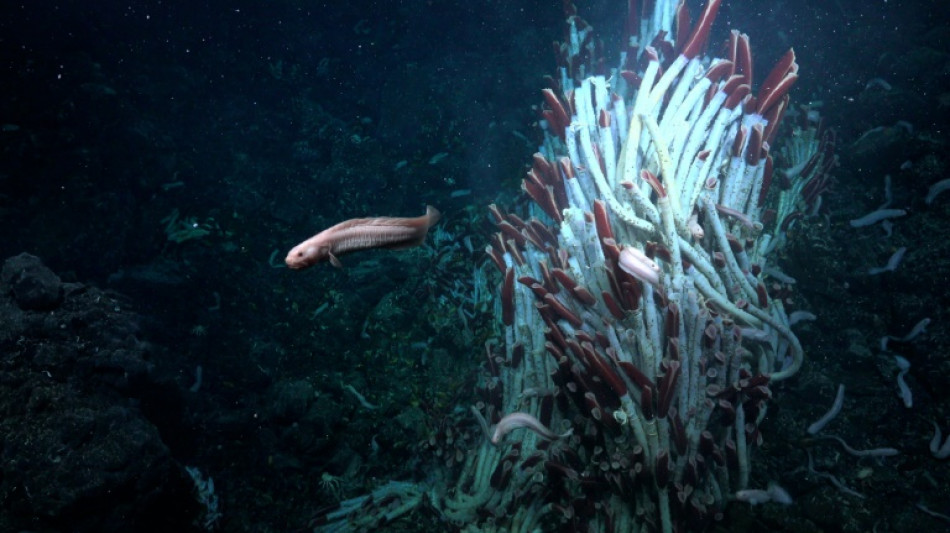
Worms and snails handle the pressure 2,500m below the Pacific surface / Photo: Handout - Schmidt Ocean Institute/AFP

 South Korea team latest to be bussed to wrong Asian Games venue

 Bears thrash Eagles 27-7 as third-string QB Keenum shines

 All Blacks name veteran Taylor captain as Mo'unga seizes 10 jersey

 Race against time as Asian Games cricket quarter-finals washed out
 India turns to corals and seagrass to shield against rising seas

 Manchester City's Premier League charges: What comes next?

 Brazil's cellphone crime: a security nightmare in every pocket

 Russia pummels Kyiv in latest deadly attack
 NFL Giants obtain QB McCarthy from Vikings

 Deal for evicted Spanish pensioner as PM seeks new housing law

 Clippers apologize, warn fans of 'challenges' after Leonard scandal

 Turkish comedian convicted for Erdogan 'insult' freed pending appeal

 Trump announces 'biggest' US steel plant in battleground Iowa

 Olise wonder strike gives Zidane's France win in Belgium

 US stocks fall, bond yields rise as Middle East war drags on

 Trump denies offering to sell arms to China's Xi

 Wemby ready for NBA Spurs to move rivals in climb to top

 Ukraine to postpone some spending amid delays in aid: PM

 Tuchel says Czech Republic game 'not yet a must-win'

 MaXhosa puts South Africa on the Paris fashion map

 Rose, Scott among 2027 World Golf Hall of Fame finalists

 Brunson says NBA champion Knicks can't get satisfaction

 France puts out largest wildfire since 1949

 Real Madrid's Perez summoned over Barcelona referee payments comments

 Oil takes off again, Wall Street dips after Trump rejects Iran truce offer

Giant worms found wriggling under the Pacific seabed have unveiled a thriving ecosystem in a fiercely hostile environment, according to a study published by Nature.
The team found the booming community 2,515 metres (8,250 feet) below the surface just off the coast of central America.
An underwater oasis has been created under a chain of mountains that run from north-to-south in the Pacific. In this part of the chain, two tectonic plates are moving away from each other, opening up hydrothermal vents that let out water heated by magma and loaded with chemical compounds.
The seabed zone was first discovered in the 1970s. But the latest research found tube worms and molluscs that thrive despite water pressure 250 times greater than at the surface and the total darkness.
The inhabitants of the animal Atlantis live off the nutrients produced by bacteria on the seabed.
Scientists are now trying to understand how the tube worm larvae get around so quickly to colonise new areas around the vents created after each underwater eruption.
- Underwater zoo -
One theory is that the larvae get under the crust with cold deep-sea water where it mixes with the hotter water created by earthquakes and eruptions and "and then they get spilled out at the surface and settle", said Monika Bright, a marine biology professor at the University of Vienna and co-author of the Nature study.
The scientists used a remote-controlled submarine, with its own digger for lifting rocks, to collect samples and sea floor images.
"While trying to collect the rocks we discovered that there are cavities below," Bright told AFP.
The cavities hid an underwater zoo of adult worms, limpets in shells, polychaetes, or bristle worms, and marine snails.
Bright said the team's work showed that "unexpected discoveries" can be made even at places that have been studied for more than 30 years, "probably just because nobody was thinking to look into the crust for animals before."
The cavities are about 10 centimetres (four inches) deep and worms up to 41cm long were found.
Bright said the conditions were similar to those at the surface where tube worms live. "The temperatures we measured were up to 25 degrees Celsius, oxygen was present and also toxic hydrogen sulphide in moderate concentrations."
The study said "larvae can disperse in cavities to potentially colonize lava cracks and the seafloor, or even settle and grow to adults and thereby proliferate" in the shallow vents.
Bright said the researchers believe the animals might not go down very far because the temperature rises, there is less oxygen and higher concentrations of hydrogen sulphide the deeper they go.
"It is important to know who lives there and to be able to protect them from deep-sea mining," said Bright. "This fauna is unique and should be protected."
H.Nasr--SF-PST