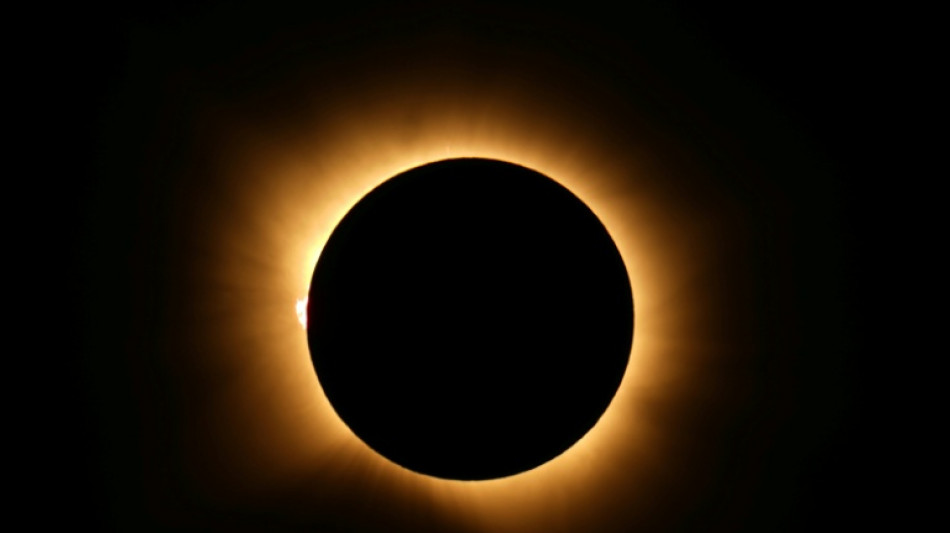
Spain darkens as solar eclipses races south from Arctic / Photo: Cesar MANSO - AFP

 New four-lane bridge opens between China, North Korea

 Tech stocks lead rout after US inflation fuels rate hike bets

 'No time to recover': UNDP chief sounds alarm on growing poverty after Iran war shock

 Australia says won't let big tech have 'unfettered' access to kids

 Mobile clinics battle Mongolia's childhood dental 'disaster'

 Wallabies back Meredith as playmaker for second New Zealand Test

 Messi's Inter Miami book playoffs with 2-0 win over New York City

 Oil-rich Alberta tests Canada's unity with secession vote

 EU leaders head for showdown over bloc budget

 All Blacks make three changes for second Wallabies Test

 Mourinho blasts 'shameless' timing of Vinicius ban decision

 PSG beat Man City in Champions League thriller, Barcola hits Liverpool hat-trick

 US Treasury chief urges stronger IMF role against 'distortionary policies'

 Giant-killers Bodo sink Dortmund in Champions League

 PSG outgun embattled Man City in six-goal Champions League thriller

 In Chicago, pope's hometown, Catholics express shock and support

 Musk suggests US govt behind any slowdown in Ukraine's Starshield system

 Chiclayo prays for recovery and return of the 'Peruvian pope'

 Barcola scores hat-trick as Liverpool hit LASK for six

 Healthy corals help bleached neighbors regain color: study

 Hope ton helps West Indies level T20 series at 2-2 in India

 Ukraine war reaches shores of Bulgarian fishing village

 Brazil probing 'criminal' origin of forest fires: minister to AFP

 Sally Rooney books cannot be sold in UK amid Palestine Action ban: publisher

 Italian ski stars Goggia and Brignone to miss season opener

Day briefly turned to night in Spain on Wednesday, as the country witnessed its first total solar eclipse in more than a century, plunging it into eerie darkness in one of nature's greatest spectacles.
The spectral glow of the Sun's outer corona, shimmering out of the edges of the shadowy Moon, drew gasps and cheers from huge crowds, just 90 minutes after it first appeared in the remote Arctic region of northern Russia.
"This is crazy!" said one woman in Tarragona, on Spain's Mediterranean coast, as the crowd beside her applauded enthusiastically.
The eclipse -- a first in mainland Europe since 2006 -- cast its shadow through parts of Greenland, racing south to smother Keflavik, some 50 kilometres (30 miles) from Iceland's capital, Reykjavik, before arcing across the Atlantic Ocean towards northern Spain.
Reykjavik had not seen a total solar eclipse since 1433.
In Spain, the lunar shadow moved diagonally in a narrow path from the northern coast to the Balearic Islands, where tourists and locals gathered to watch on the beach, many dressed in swimming costumes accessorised with protective glasses.
"Spectacular, very beautiful, truly a unique moment," said Rosa Maria Zamora, 72, who came to watch the eclipse in Colmenar Viejo, some 30 kilometres (19 miles) north of Madrid.
Supplies of special viewing glasses were in high demand, with huge crowds turning out to watch a partial eclipse across Europe, with the event also visible in Canada, the northern United States and northwest Africa.
A partial eclipse began in parts of northern Spain shortly after 1730 GMT, prompting gasps from waiting crowds and applause from South Korean tourists in a field in Lodoso, near the northern city of Burgos, an AFP reporter said.
"How wonderful!" said one woman in the crowd in Colmenar Viejo.
On the summit of the Pic du Midi, in the French Pyrenees, heavy clouds parted minutes beforehand, allowing visitors to see the spectacle, which also drew crowds in London, Paris and across the continent.
- Fleeting -
Throughout human history, eclipses have stirred amazement, fear and reverence, as they appear to momentarily halt the normal course of nature.
The shadow or "umbra" cast by the alignment of Sun and Moon creates a strange twilight during which temperatures drop, shadows appear at strange angles and some animals go to sleep.
But the phenomenon is fleeting, lasting just minutes, with the lunar shadow moving across the surface of the Earth at some 3,430 kilometres (2,130 miles) per hour, according to the Paris Observatory.
The partial eclipse -- which occurs as the Moon starts and finishes crossing the Sun's path, dimming its light -- lasted around one hour and 45 minutes.
Lucie Green, a British solar physicist who has travelled the world to witness eclipses, called it "a moving experience". She came to watch from a boat off the island of Mallorca.
The event, livestreamed by both NASA and the European Space Agency, presents scientists with a rare opportunity to study the Sun's atmosphere and its outermost layer, as they seek to uncover secrets about solar winds and our star's magnetic field.
- Weather -
There were fears that rain could spoil the occasion in the Westfjords region of northwest Iceland.
Scientist and astronomer Saevar Helgi Bragason told AFP in Reykjavik beforehand that he felt "both excitement and heartbreak" because of the unfavourable weather forecast.
But he said he hoped the skies would clear just long enough so he could see "the shortest, most sudden, most beautiful, most unique and, hopefully, most memorable and beautiful nighttime of our life" from his home.
Clear skies helped visibility in Spain, although there were concerns due to high temperatures and the continued risk of wildfires.
Eclipse fever had gripped Spain, with government predictions that nearly 450,000 extra tourists could bring a 347-million-euro ($400-million) boost to the economy.
Interior Minister Fernando Grande-Marlaska said nearly 25,000 police officers had been mobilised to ensure the event goes off without a hitch.
"The path of totality is very narrow. It's only a couple of hundred kilometres wide," British astrophysicist and science communicator Graham Jones told AFP Tuesday from Fontanil de los Oteros in northern Spain.
"That's what's so special about Spain. The path of totality really goes across the Spanish peninsula."
burs-phz/jj
A.AlHaj--SF-PST


