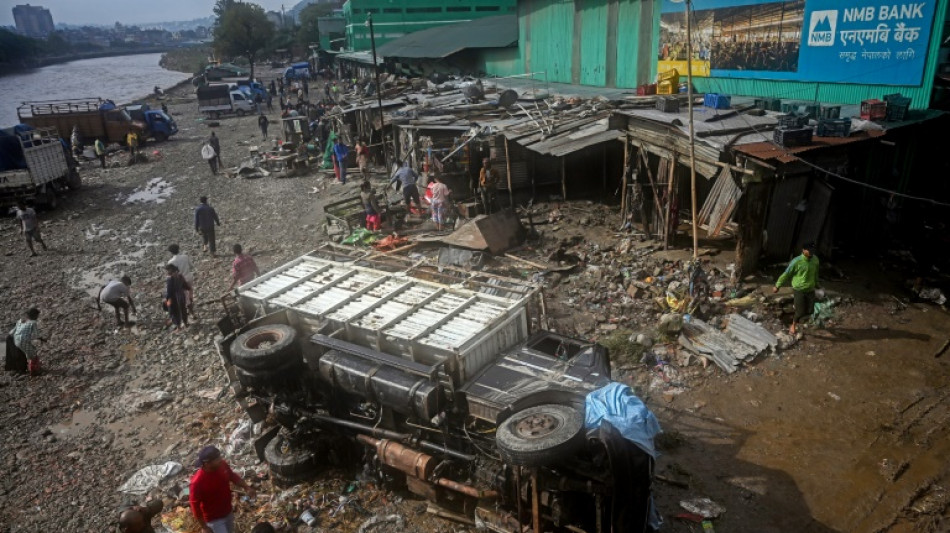
Nepal surveys flood wreckage as death toll reaches 200 / Photo: PRAKASH MATHEMA - AFP

 South Korea team latest to be bussed to wrong Asian Games venue

 Bears thrash Eagles 27-7 as third-string QB Keenum shines
 All Blacks name veteran Taylor captain as Mo'unga seizes 10 jersey
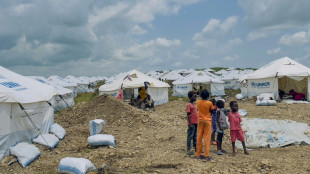
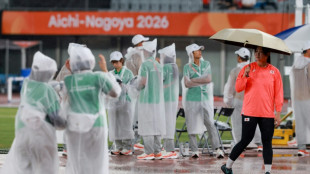 Race against time as Asian Games cricket quarter-finals washed out
 India turns to corals and seagrass to shield against rising seas

 Manchester City's Premier League charges: What comes next?

 Brazil's cellphone crime: a security nightmare in every pocket

 Russia pummels Kyiv in latest deadly attack
 NFL Giants obtain QB McCarthy from Vikings

 Deal for evicted Spanish pensioner as PM seeks new housing law

 Clippers apologize, warn fans of 'challenges' after Leonard scandal

 Turkish comedian convicted for Erdogan 'insult' freed pending appeal

 Trump announces 'biggest' US steel plant in battleground Iowa

 Olise wonder strike gives Zidane's France win in Belgium

 US stocks fall, bond yields rise as Middle East war drags on

 Trump denies offering to sell arms to China's Xi

 Wemby ready for NBA Spurs to move rivals in climb to top

 Ukraine to postpone some spending amid delays in aid: PM

 Tuchel says Czech Republic game 'not yet a must-win'

 MaXhosa puts South Africa on the Paris fashion map
 Rose, Scott among 2027 World Golf Hall of Fame finalists

 Brunson says NBA champion Knicks can't get satisfaction

 France puts out largest wildfire since 1949

 Real Madrid's Perez summoned over Barcelona referee payments comments

 Oil takes off again, Wall Street dips after Trump rejects Iran truce offer
Search and rescue teams in Nepal's capital picked through wrecked homes on Monday after waters receded from monsoon floods that killed at least 200 people around the Himalayan republic.
Deadly floods and landslides are common across South Asia during the monsoon season from June to September but experts say climate change is making them worse.
Entire neighbourhoods in Kathmandu were inundated after the heaviest rains in more than two decades, with the capital temporarily cut off from the rest of Nepal after landslides blocked highways.
"According to the latest figures, 200 have died, 127 are injured and 26 are still missing," home ministry spokesman Rishi Ram Tiwari told AFP.
Police said at least 35 of those killed were buried alive when earth from a landslide careened into vehicles on a highway south of Kathmandu.
Bulldozers were being used to clear nearly two dozen sections of major roads leading into Kathmandu that had been blocked by debris.
The home ministry said it was working to rescue numerous people who had been stranded on the highways.
Rescuers in knee-high rubber boots were using shovels to clear mud from the worst-hit riverside neighbourhoods around Kathmandu, many of them unauthorised slum settlements.
The International Centre for Integrated Mountain Development (ICIMOD), a Nepal-based think tank, said the disaster had been made worse by unplanned urban encroachment around the Bagmati River, which flows through the capital.
Nepal's army said more than 4,000 people had been rescued, with helicopters, motorboats and rafts bringing stranded people to safety.
Nilkantha Pandey of the humanitarian organisation CARE Nepal said many of those affected by the floods needed safe drinking water and temporary housing.
"Mostly informal settlements have been affected," Pandey said. "It is time to respond and not delay."
- 'An extreme event' -
Merchants in Kathmandu said damage to intercity roads had drastically cut the supply of fresh fruit and vegetables into the capital.
"The farmers have their produce ready but with the highways blocked, all of it is stuck," Binay Shrestha, who works at one of the city's main produce markets, told AFP.
Nepal's weather bureau said their preliminary data measured record-breaking rain in the 24 hours to Saturday morning.
A monitoring station at Kathmandu airport recorded about 240 millimetres (9.4 inches) of rain, the highest figure since 2002.
Climate expert Arun Bhakta Shrestha of ICIMOD told AFP that rainfall should be decreasing by late September with the end of the annual monsoon.
"Rainfall of this kind has to be described as abnormal," he said.
"It is an extreme event... I see the possibility of the role of climate change to some extent."
But he added that unplanned urban development had also worsened the impact of the disaster.
The summer monsoon from July to September brings South Asia 70-80 percent of its annual rainfall and is vital for agriculture and food production in a region home to around two billion people.
However, monsoon rains also bring widespread death and destruction in the form of floods and landslides.
Experts say climate change has worsened their frequency and intensity.
More than 300 people have been killed in rain-related disasters in Nepal this year.
L.AbuTayeh--SF-PST