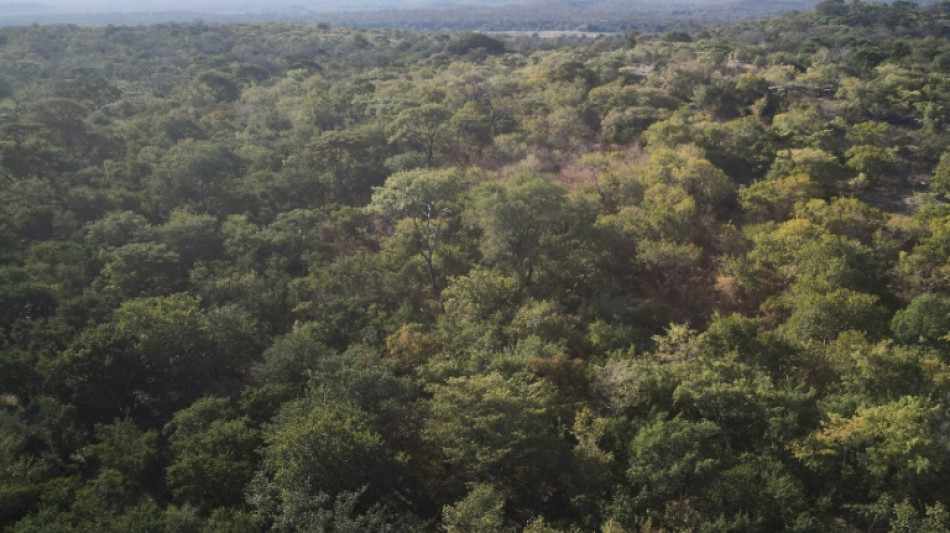
Is planting trees to combat climate change 'complete nonsense'? / Photo: Zinyange Auntony - AFP/File

 All Blacks name veteran Taylor captain as Mo'unga seizes 10 jersey
 Race against time as Asian Games cricket quarter-finals washed out
 India turns to corals and seagrass to shield against rising seas

 Manchester City's Premier League charges: What comes next?

 Brazil's cellphone crime: a security nightmare in every pocket

 Russia pummels Kyiv in latest deadly attack
 NFL Giants obtain QB McCarthy from Vikings

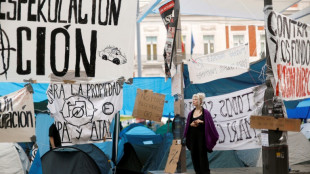 Deal for evicted Spanish pensioner as PM seeks new housing law

 Clippers apologize, warn fans of 'challenges' after Leonard scandal

 Turkish comedian convicted for Erdogan 'insult' freed pending appeal

 Trump announces 'biggest' US steel plant in battleground Iowa

 Olise wonder strike gives Zidane's France win in Belgium

 US stocks fall, bond yields rise as Middle East war drags on

 Trump denies offering to sell arms to China's Xi

 Wemby ready for NBA Spurs to move rivals in climb to top

 Ukraine to postpone some spending amid delays in aid: PM
 Tuchel says Czech Republic game 'not yet a must-win'
 MaXhosa puts South Africa on the Paris fashion map

 Rose, Scott among 2027 World Golf Hall of Fame finalists

 Brunson says NBA champion Knicks can't get satisfaction

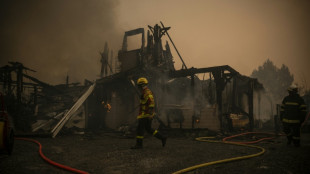 France puts out largest wildfire since 1949

 Real Madrid's Perez summoned over Barcelona referee payments comments

 Oil takes off again, Wall Street dips after Trump rejects Iran truce offer

 AlgoQuant Asset Management Selects Liquid Mercury to Enhance Digital Asset Trading Infrastructure

 UK to reopen refugee resettlement scheme to push 'safe' migration

Bill Gates is emphatic: "I don't plant trees," he declared recently, wading into a debate about whether mass tree planting is really much use in fighting climate change.
The billionaire philanthropist was being probed on how he offsets his carbon emissions and insisted he avoids "some of the less proven approaches."
The claim that planting enough trees could solve the climate crisis is "complete nonsense", he told a climate discussion organised by the New York Times last week.
"Are we the science people or are we the idiots?"
Gates' polemical pronouncements made headlines and prompted criticism from backers of reforestation (planting trees in damaged forests) and afforestation (planting in areas that were not recently forest).
"I have dedicated the last 16 years of my life to making forests part of the climate solution," wrote Jad Daley, head of the American Forests NGO.
"This kind of commentary can really set us back," he said on X, formerly known as Twitter.
Mass tree planting schemes have been gaining ground for years as a way to suck carbon from the atmosphere at scale.
Even notoriously climate change-sceptical US Republicans have introduced legislation to support planting a trillion trees worldwide.
But Gates is far from alone in doubting the benefits of such ambitious plans.
A group of scientists warned on Tuesday that mass tree planting risks doing more harm than good, particularly in tropical regions.
That's primarily because it can replace complex ecosystems with monoculture plantations.
"Society has reduced the value of these ecosystems to just one metric -- carbon," the scientists from universities in Britain and South Africa wrote.
Carbon capture is "a small component of the pivotal ecological functions that tropical forests and grassy ecosystems perform," they said in an article in the Trends in Ecology and Evolution journal.
Jesus Aguirre Gutierrez, an author of the paper, pointed to examples in southern Mexico and Ghana, where once diverse forests "have now transformed into homogenous masses".
This makes them "highly vulnerable to diseases and negatively impacts local biodiversity," the senior researcher at the University of Oxford's Environmental Change Institute told AFP.
- 'Not just running around planting' -
Major tree planting commitments often involve agroforestry or plantations, where the trees will eventually be felled, releasing carbon.
And they are dominated by five tree species chosen largely for their timber and pulp value, or growth speed.
Among them is teak, which can overtake native species, "posing additional risks to native vegetation and the ecosystem", said Aguirre Gutierrez, who is also a Natural Environment Research Council fellow.
Other critiques include the lack of space globally for the many proposed mass planting projects and the risk of competition between smallholder agriculture and planting.
Misclassification of grassland and wetland as suitable for forest and planting poorly adapted or cared-for seedlings have also been problems highlighted by scientists.
So does planting trees really have no value?
Not so fast, says Daley, whose American Forests organisation says it has planted 65 million trees.
It's Gates' premise that is wrong, Daley said.
"Literally no one is saying... that forests alone can save our environment," he told AFP.
He argues that critics ignore carefully calibrated projects involving native species in areas that need reforestation and focus instead on a few poorly conceived schemes.
"This broad brush critique has ignored the fact that much reforestation is driven by the loss of forests that won't regenerate without help."
"We are not just running around planting trees wherever we feel like it to capture carbon."
There are efforts to bridge the gap between critics and proponents, including 10 "golden rules for restoring forests", proposed by Britain's Royal Botanic Gardens, Kew and Botanic Gardens Conservation International.
They advise avoiding grasslands or wetlands, prioritising natural regeneration, and selecting resilient and biodiverse trees.
But they start with a rule that perhaps everyone can agree upon: protect existing forests first.
"It can take over 100 years for these forests to recover, so it is crucial that we protect what we already have before planting more."
L.AbuAli--SF-PST