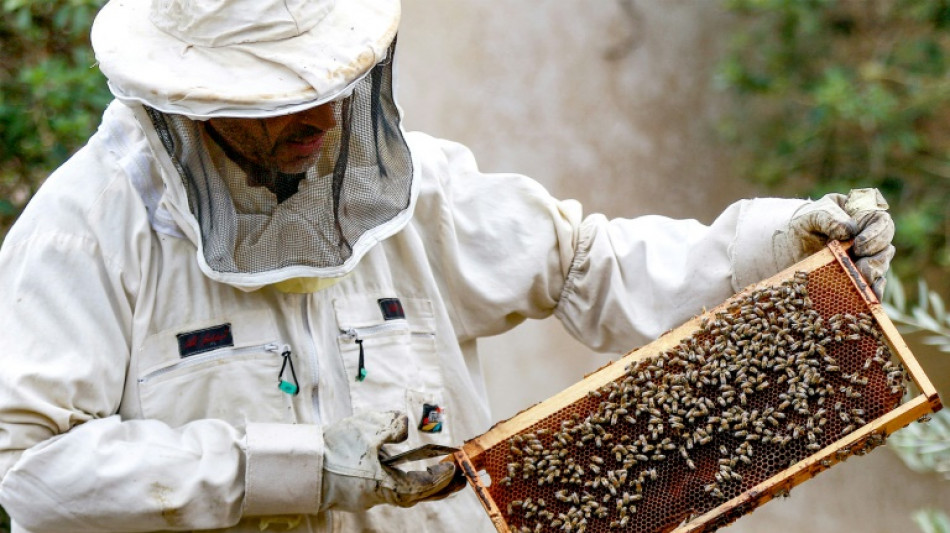
Sweet success: Jordan's beekeepers busy as honey demand soars / Photo: Khalil MAZRAAWI - afp/AFP

 Dodgers eye three-peat, Red Sox face Yankees as MLB playoffs begin

 Certification of Boeing 737 MAX delayed by software bug

 Celine Dion wows Paris Fashion Week with surprise gig

 AMD buys firm founded by AI 'godmother' Fei-Fei Li

 Italy rebound in Turkey as France win late in Belgium

 Pope says concerns about AI 'should be taken seriously'

 Hurricanes to hoist title banner as NHL season begins

 Justice Alito steps aside from major US climate case

 Willis happy with England exile after retains Top 14 player award

 Spain housing protests keep heat on government as PM seeks new law

 Wissa spoils Zimbabwe homecoming as DR Congo win AFCON qualifier

 UK police release on bail five men held over airbase incident

 Ex-All Black Plummer 'sure' New Zealand will find Super Rugby solution

 Shein sees 1% revenue growth in first half of 2026

 Netherlands regrets Israel retaliation in settlements row

 Moscow seizes Russian assets of German food retailer Metro

 Bulgarian spirits inflamed by new rakia rules

 Documentary turns camera on architect Peter Zumthor

 UK police say releasing on bail five men held over airbase incident

 Trump admin finalizes reversal of US fuel economy standards

 US says no China arms sale plans after envoy cites Trump offer

 Dozens kidnapped in two weekend attacks in northern Nigeria

 Next stop the world: Pathirage wins Asian Games javelin gold

 Aster Launches Perpetual Grid Trading 2.0 with Up to 140,000 $ASTER Liquidity Mining Campaign

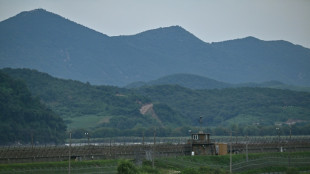 Seoul says North Korean mines 'highly suspected' as cause of DMZ blast

Jordan's key tourism industry may have been hammered by Covid, but the pandemic gave a boost to another sector, keeping its beekeepers busy as demand for honey has soared.
The country's 4,000 apiarists have ramped up output of the sweet and sticky golden substance long praised for its anti-inflammatory and other health benefits.
Even if there is no scientific consensus that honey helps fight Covid, many of those infected have used it to soothe symptoms such as sore throats.
"The Covid period in particular had a great, positive impact on us," said beekeeper Mutasim Hammad, 48, who retired 12 years ago from the public security directorate and turned his hobby into his main job.
"There was good demand for honey, and people got to know it," added Hammad, dressed in a white protective suit while checking on his 80 bee hive boxes on a property in Irbid 90 kilometres (60 miles) north of Amman.
"People have become more aware of the value of honey and are turning to the guaranteed locally produced honey," said Hammad, who sells about 400 kilograms (880 pounds) a year.
The kingdom of Jordan prides itself on its 19 different types of honey, including citrus, eucalyptus and maple varieties, depending on which plants the bees pollinate.
"We have about 2,500 flowering plants," said Mohammad Rababaa, head of the Jordan Beekeeping Association.
"This diversity distinguishes Jordanian honey and means that the therapeutic and nutritional value of this honey is expected to be better than other types."
Rababaa said the slightly bitter maple honey variety, for example, boasts "very high phenolic compounds and antioxidants compared to other types, which indicates that it has a higher value".
- Ecosystem service -
Rababaa also said that, since the Covid pandemic, "demand for locally produced honey has clearly increased".
He said the sector has a much bigger workforce than Jordan's official count of about 1,400 beekeepers.
"The reality is that the number of beekeepers is more than 4,000," said the professor of Natural Resources and Environment at the Jordan University of Science and Technology.
They produce about 700 to 800 tonnes annually, or about 70 percent of Jordan's annual domestic needs, he said.
"We are very close to self-sufficiency," said Rababaa, adding that "imports must be stopped".
A fellow enthusiast, Mohammad Khatib, 49, also pointed to the pandemic and lockdown periods, saying it "helped me and gave me enough time to learn about bees and take good care of them".
A French language professor at Al-Bayt University, he now works about 15 bee boxes in his garden, which he said earns him a nice side income.
"People are looking for reliable honey" and some customers place their orders a year in advance, he said.
Jordanian honey sells for 15 to 30 dinars ($21 to $42) per kilogram, depending on the type.
Rababaa said the economic benefit "is not limited to honey as it also produces pollen, royal jelly, wax, propolis and bee venom, which is included in many therapeutic compounds".
Crucially, healthy populations of bees and other insects provide an almost immeasurable ecosystem service by pollinating plants.
While the beekeeping sector generates about $28 million a year, Rababaa said, "the indirect value of crop pollination exceeds $100 million".
C.AbuSway--SF-PST