Facing housing crunch, Toronto cuts into once-protected lands / Photo: Cole BURSTON - AFP

 Trump denies offering to sell arms to China's Xi

 Wemby ready for NBA Spurs to move rivals in climb to top

 Ukraine to postpone some spending amid delays in aid: PM
 Tuchel says Czech Republic game 'not yet a must-win'

 MaXhosa puts South Africa on the Paris fashion map

 Rose, Scott among 2027 World Golf Hall of Fame finalists

 Brunson says NBA champion Knicks can't get satisfaction

 France puts out largest wildfire since 1949

 Real Madrid's Perez summoned over Barcelona referee payments comments
 Oil takes off again, Wall Street dips after Trump rejects Iran truce offer
 AlgoQuant Asset Management Selects Liquid Mercury to Enhance Digital Asset Trading Infrastructure
 UK to reopen refugee resettlement scheme to push 'safe' migration

 Pope urges Europe to help combat 'lies and deceit' in world affairs
 Iranian lawyer Nasrin Sotoudeh wins Council of Europe's rights prize

 French far-right's Bardella denies alleged 2013 antisemitic comments

 Oil up, Wall Street dips after Trump rejects Iran truce offer

 Gakpo withdraws from Netherlands squad

 SpaceX puts Starship megarocket in orbit for first time
 Iran denies link to suspected bomb plot at UK airbase used by US
 Ex-boss Mancini says City charges 'not my concern'

 Berlin Marathon winner Assefa finished race with torn Achilles

 Comedian convicted for Erdogan 'insult' but freed pending appeal

 French prosecutors seek two-year sentence for ex-minister Dati in graft case

 Eala makes fast start as weather and transport woes hit Asian Games

 Hurricane Polo approaches Mexico, threatens severe damage
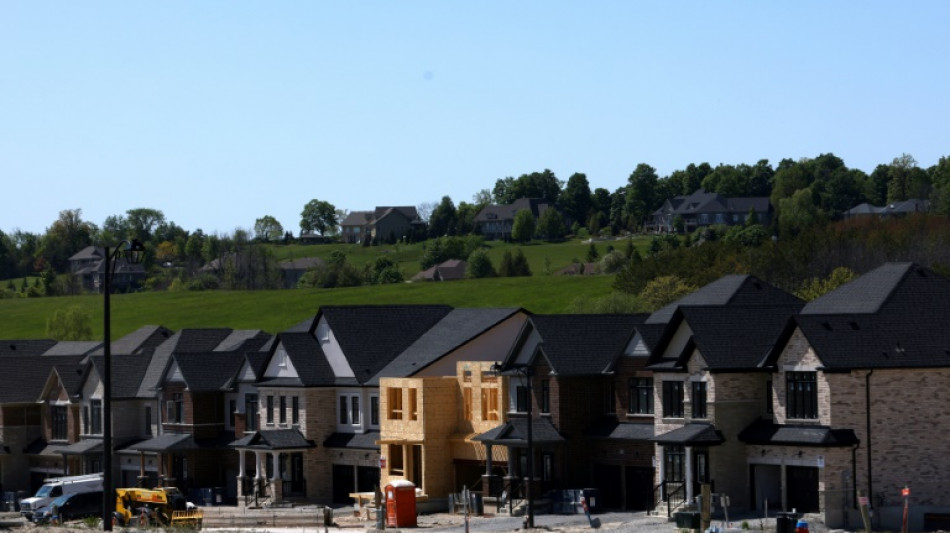
A billboard at the foot of a field on Toronto's far outskirts heralds the coming construction of new homes, but it also highlights a broken promise never to permit encroachment into this vast green space, and the backlash which has ensued.
Among the many anti-development protesters, a group led by concerned grandmothers has staged demonstrations outside Ontario lawmakers' offices decrying the loss of swaths of this so-called "Greenbelt" around Canada's largest metropolitan city.
"My (trust) in the democratic process is destroyed by this move," says protestor Christine Hutchinson.
A resident of Oakville, west of Toronto, she adds that she is, however, heartened to see pushback from several area municipalities affected by the policy switch.
By opening 3,000 hectares for new housing in recent months, Doug Ford, the province's conservative leader with close ties to local developers, went back on a 2018 election pledge not to touch what the foundation tasked with its conservation describes as "the world's largest" greenbelt.
The horseshoe-shaped 810,000-hectare ring of fertile farmlands, forests and wetlands edge Toronto and nearby cities that hug the north and west shores of Lake Ontario -- the most densely populated and industrialized region of Canada.
A mix of private and public lands, they have been protected since 2005 in an effort to limit urban sprawl.
"These lands should be used to feed the local population, as food supply problems increase with climate change," said Brigitte Sopher, a resident of Whitevale, close to one of the new building areas.
The Ford government has designated 15 locations to build 50,000 homes and contribute to the goal of adding 1.5 million new residences in Ontario by 2031.
To justify his reversal, Ford cited soaring real estate prices and a flood of newcomers needing to be housed, as Prime Minister Justin Trudeau's government aims to boost annual immigration to Canada to 500,000, the majority of whom are likely to settle in large urban centres.
- Edge of urban boundaries -
The Canadian housing crunch is most acute in the Toronto area, which is expected to see its population rise from 6.8 million to 10.2 million in the next 25 years, according to government projections.
The average price of a house in Ontario, meanwhile, has almost tripled since 2011 and rent for a two-room apartment now exceeds Can$2,500 (US$1,800) monthly.
The greenbelt lands "play a vital role for flood protection. We know that with climate change we will face more risks of extreme weather and by doing so, the rainwater is going to end up in our basements," said Mike Schreiner, the first and only Green Party member of the Ontario legislature.
They also "help to filter the waterways that come down from all the rivers from the region and that end up in Lake Ontario, where we pump our drinking water," adds Mark Winfield, a professor of environmental and urban change at York University in Toronto.
Opponents of development in the greenbelt point to an Ontario government report that states there is sufficient land available outside the greenbelt to achieve its housing objective.
"Basically, this is about enabling sprawl, there is no other way to put it," laments Winfield. "It is just giving the development industry everything they want."
But history, he adds, "tells us that for-profit developers will not build affordable housing unless you make them."
"The problem is not a shortage, there are a lot of new apartments being built, but they are unaffordable," adds Barbara Ceccarelli, general manager of social housing agency Heritage Reception Center.
The controversy has attracted federal attention, with Environment Minister Steven Guilbeault stepping in to protect the Rouge National Urban Park on the eastern edge of the greenbelt.
He has ordered a study on "the potential effects" on the park of proposed development on adjacent lands, and said Ottawa could use federal environmental laws to block some development.
Sopher fears that the government study will come too late since "the real estate promoters are already preparing the ground" for construction.
jfge/tib/amc/mdl/des
L.AbuAli--SF-PST