Syrians turn plastic waste into rugs to make a living / Photo: Aaref WATAD - AFP

 Trump denies offering to sell arms to China's Xi

 Wemby ready for NBA Spurs to move rivals in climb to top

 Ukraine to postpone some spending amid delays in aid: PM
 Tuchel says Czech Republic game 'not yet a must-win'

 MaXhosa puts South Africa on the Paris fashion map

 Rose, Scott among 2027 World Golf Hall of Fame finalists

 Brunson says NBA champion Knicks can't get satisfaction

 France puts out largest wildfire since 1949

 Real Madrid's Perez summoned over Barcelona referee payments comments

 Oil takes off again, Wall Street dips after Trump rejects Iran truce offer
 AlgoQuant Asset Management Selects Liquid Mercury to Enhance Digital Asset Trading Infrastructure

 UK to reopen refugee resettlement scheme to push 'safe' migration

 Pope urges Europe to help combat 'lies and deceit' in world affairs

 Iranian lawyer Nasrin Sotoudeh wins Council of Europe's rights prize

 French far-right's Bardella denies alleged 2013 antisemitic comments

 Oil up, Wall Street dips after Trump rejects Iran truce offer

 Gakpo withdraws from Netherlands squad

 SpaceX puts Starship megarocket in orbit for first time
 Iran denies link to suspected bomb plot at UK airbase used by US
 Ex-boss Mancini says City charges 'not my concern'

 Berlin Marathon winner Assefa finished race with torn Achilles

 Comedian convicted for Erdogan 'insult' but freed pending appeal

 French prosecutors seek two-year sentence for ex-minister Dati in graft case

 Eala makes fast start as weather and transport woes hit Asian Games

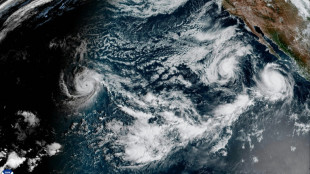 Hurricane Polo approaches Mexico, threatens severe damage
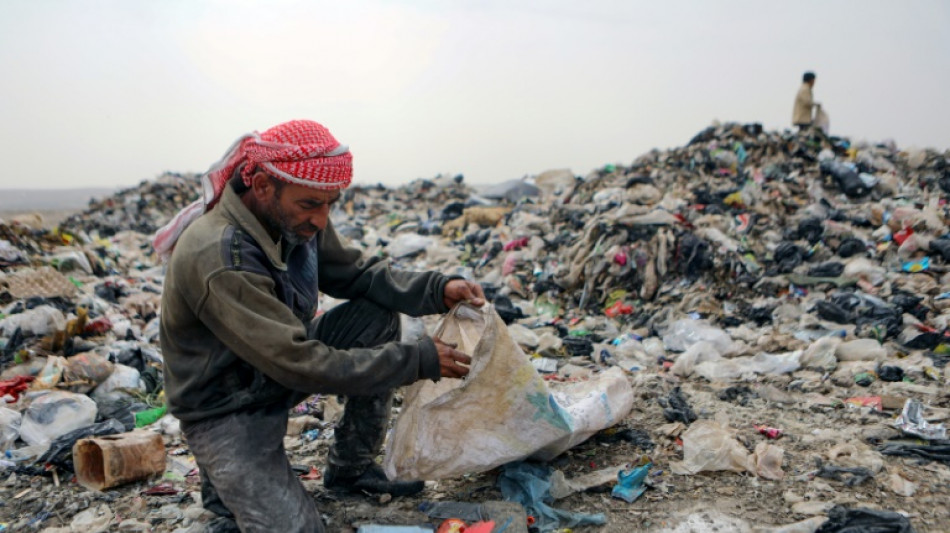
At a rubbish dump in northwest Syria, Mohammed Behlal rummages for plastic to be sold to recyclers and transformed into floor rugs and other items in the impoverished rebel enclave.
In rebel-held Syria, recycling is rarely an environmental impulse but rather a grim lifeline for needy residents looking for work or items they otherwise could not afford.
Braving the stench, insects and risk of disease, 39-year-old Behlal hacks through the rubbish pile with a scythe and his bare hands.
He and two of his six children earn a living sifting through the refuse in Idlib province's village of Hezreh, earning $7 to $10 a week each.
"It's tiring... but what can we do, we have to put up with this hard labour," said Behlal, who was displaced from neighbouring Aleppo province during Syria's civil war.
"Thank God, at least we have work with the trash," he added.
Behlal was shot in the leg during fighting and has had trouble finding employment.
Hunched over to collect pieces of plastic or metal, he throws everything into a bag to sell to a nearby scrap facility.
Syria's conflict has killed more than 500,000 people, and around half of the country's pre-war population has been forced from their homes since fighting broke out in 2011.
More than four million people, most of them dependent on aid, live in areas controlled by jihadists and Turkish-backed groups in Syria's north and northwest.
In a large scrapyard next to agricultural fields, workers sort plastic junk loosely into piles according to colour.
They then cut it up and crush it into small pieces that are washed and melted into plastic pellets.
- Plastic thread -
Farhan Sleiman, 29, is among those who handle the material brought in from the landfill.
"We buy plastic from roaming trash-picker trucks and children," said Sleiman, originally from Homs province.
He expressed fear of the risk of contracting "cholera or chronic illnesses" from working with the rubbish.
Elsewhere in northern Idlib province, workers at a factory making mats and rugs churn out brightly coloured plastic thread while large weaving machines click and clack.
Factory owner Khaled Rashu, 34, says rug-making is a family tradition.
"We have more than 30 employees" at the factory, he boasted as a significant feat in a region where many are jobless.
Large mats featuring geometric designs, some made with striking red or purple plastic thread, emerge from the weaving machines and are stacked into piles.
Shop owner Mohammed al-Qassem, 30, is among those selling the mats, which he says are a hit in an area where many people are displaced and live in basic tents or makeshift dwellings.
The mats made from recycled plastic cost between $5 and $15, while traditional Persian-style rugs are around $100.
"In summer, demand for plastic mats increases" because they retain less heat, Qassem said from his shop in Maaret Masrin, a town in Idlib province.
But "they can also be used in winter and are less costly", he added.
J.AbuHassan--SF-PST