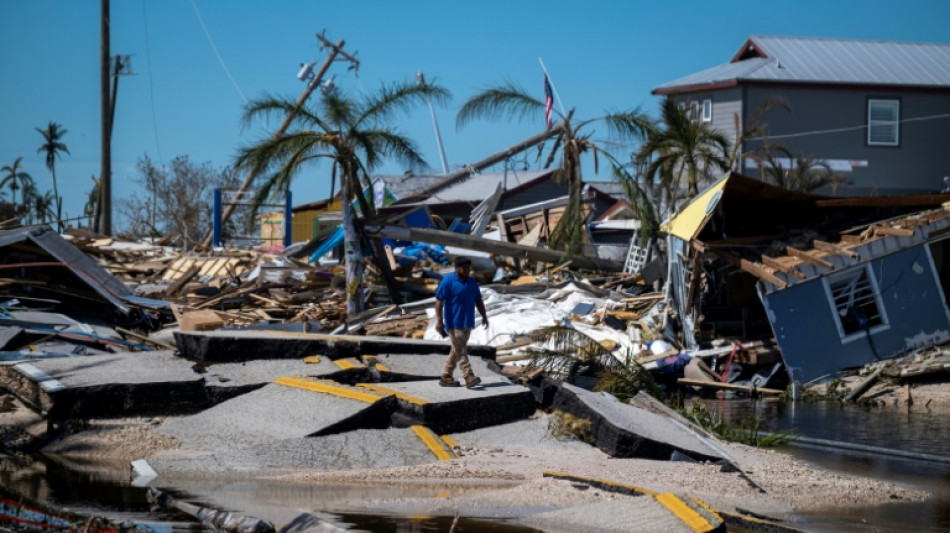
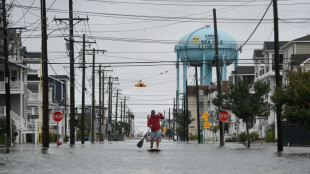
Natural disasters, inflation upped insurers' costs in 2022: Swiss Re / Photo: Ricardo ARDUENGO - AFP/File

 Oil up, Wall Street dips after Trump rejects Iran truce offer

 Gakpo withdraws from Netherlands squad

 SpaceX puts Starship megarocket in orbit for first time

 Iran denies link to suspected bomb plot at UK airbase used by US
 Ex-boss Mancini says City charges 'not my concern'

 Berlin Marathon winner Assefa finished race with torn Achilles

 Comedian convicted for Erdogan 'insult' but freed pending appeal

 French prosecutors seek two-year sentence for ex-minister Dati in graft case

 Eala makes fast start as weather and transport woes hit Asian Games

 Hurricane Polo approaches Mexico, threatens severe damage

 Energy markets rally after Trump rejects Iran truce offer
 Japanese convenience store enlists Lady Gaga to bolster recruitment

 Seoul summons Ukraine envoy in row over North Korean POWs

 Ireland 'raised awareness worldwide' in Israel game: Hallgrimsson

 Colombian police capture wife, daughter of Ecuador drug lord

 More Asian Games woes as bus takes Pakistan team to wrong venue

 Radio frequencies vital to Earth observation must be protected: UN

 Comedian on trial for insulting Erdogan in standup show

 Women's Fashion Week kicks off in Paris

 Pope arrives in French border city to speak on united Europe

 The wildfires choking Indonesia, sparking regional haze

 PU Prime Deepens Argentina Presence Through FX Expo Buenos Aires 2026

 Nothing to seal here: NZ police help stranded pup home

 White House releases list of products US, China could tax less

 'Pseudo-journalism': Partisan 'news' sites target US midterms

Natural disasters increased insurers' costs in 2022, with inflation pushing up the bill even more, reinsurer Swiss Re said Wednesday, warning of likely further rises in the future due to climate change.
Economic losses caused by natural disasters amounted to $275 billion in 2022, down 5.8 percent compared to the $303 billion in 2021, said the Zurich-based group, which acts as an insurer for insurers.
But of those losses, $125 billion were covered by insurance -- up 3.3 percent on 2021 -- making it the second consecutive year in which insured losses from natural catastrophes topped the $100 billion mark, Swiss Re said.
"The magnitude of losses in 2022 is not a story of exceptional natural hazards, but rather a picture of growing property exposure, accentuated by exceptional inflation," said Martin Bertogg, head of catastrophe perils at Swiss Re.
Inflation drove up compensation costs, particularly for buildings, homes and vehicles damaged by natural disasters.
Rising material costs and labour shortages have also led to higher claims to cover the costs of building repairs. In the United States, the aggregate replacement cost of buildings in 2022 has risen by an estimated 40 percent since the start of 2020.
"While inflation may subside, increasing value concentration in areas vulnerable to natural catastrophes remains a key driver for increasing losses," said Bertogg.
Swiss Re said there had been a five to seven percent uptrend in average annual losses over the last 30 years.
"We expect the trend to continue. The growth has been and will be largely driven by rising loss severity of individual catastrophes... and a backdrop of hazard intensification due to climate change effects," the reinsurance giant said.
- Costly Hurricane Ian -
Hurricane Ian was by far last year's costliest event, resulting in estimated insured losses of $50-65 billion. The storm ranks as the second-costliest natural catastrophe insured loss event after Hurricane Katrina in 2005.
A category-four hurricane, Ian caused more than 150 deaths, almost all in Florida, where it made landfall on September 28.
One of the most powerful storms ever to hit the United States, it flattened whole neighbourhoods and knocked out power for millions of people. Storm surges and immense downpours left even inland neighbourhoods submerged.
Each region of the world suffered a major event, the report said.
In February 2022, storms Eunice, Dudley and Franklin in northwestern Europe triggered combined insured losses of over $4 billion.
France saw its highest ever annual loss ($5 billion) from hailstorms.
Global losses from floods were above average, the main event being flooding in eastern Australia in February-March 2022.
"This resulted in insured losses of $4.3 billion -- the biggest natural catastrophe claims event ever in Australia," Swiss Re said.
In Brazil, monsoon rains were below average, with crop yields, particularly soybean and corn, suffering most, resulting in insured losses of $1 billion.
Z.AbuSaud--SF-PST