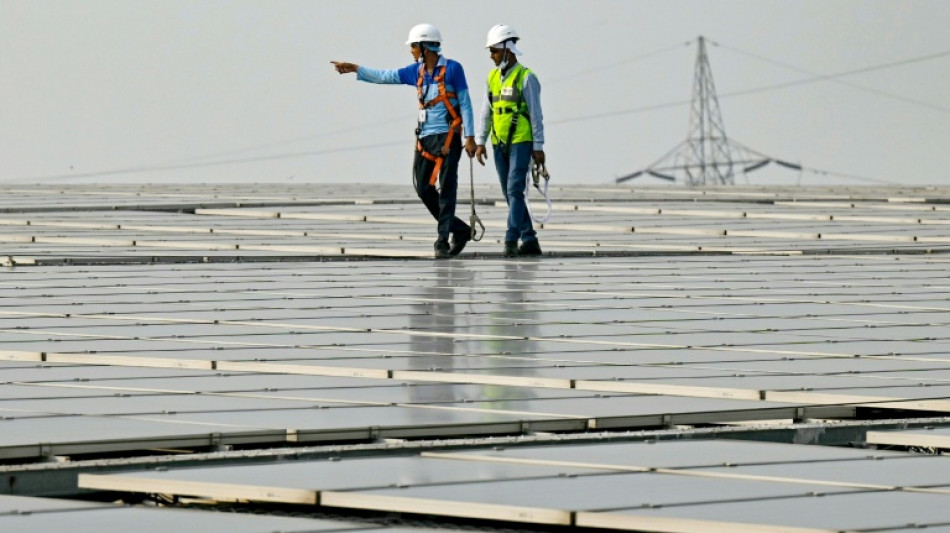
Green goals versus growth needs: India's climate scorecard / Photo: Money SHARMA - AFP/File

 WhiteBIT Launches Bitcoin Lightning Network Support, Powered by Voltage

 Oil surges, stocks sink as US reportedly eyes fresh Iran strikes

 Anne Carson: modern takes on Greek classics

 Canada's Anne Carson wins Nobel literature prize

 Ethiopia drones hit Eritrean troops in Tigray

 Russian strike on buses kills 30 in frontline Ukrainian city

 Thailand begins extradition process against Chinese journalist

 Quarantine, unease and rumours: Russian city grapples with plague scare

 Taiwan says exports hit record in September on AI demand
 Marc Marquez vows to 'attack' Martin's lead at Indonesian MotoGP

 Diplomats, schools in Saudi take safety measures after blasts heard: sources to AFP

 In Beijing, EU trade envoy says deficit with China 'unsustainable'

 Sri Lanka's de Silva quits as Test captain

 Alcaraz feeling 'mentally fresh' ahead of Shanghai return

 Israel drastically reduces British diplomatic presence in Jerusalem

 Stocks fall further as oil surge fans fresh inflation worries

 North Korea demands South show 'utmost respect' to restore relations

 Saudi says three dead in airport attacks claimed by Houthis

 'Mad dream': New showcase for African film opens in London

 All Blacks coach Rennie says Wallabies exit 'part of the game'

 The growing protests against India's poll body - and PM Modi

 Stocks fall further as oil spike fans fresh inflation worries

 Bad COP, worse COP? EU tempers hopes for UN climate summit

 Rookie Henry named in Wallabies midfield to face All Blacks

 Housing crisis set to dominate Spain's snap election

India is the world's most populous country, the third-biggest emitter of greenhouse gases, and remains deeply dependent on polluting coal to meet soaring energy demand.
It is also a climate diplomacy heavyweight, representing developing economies.
Ahead of the COP30 climate talks in Brazil this month, here is a look at India's commitments:
- Emissions -
India emitted 4.4 billion tonnes of carbon dioxide equivalent -- a measure of all planet-warming greenhouse gases -- in 2024, according to UN figures, behind only China and the United States.
But with a population of 1.4 billion people, its per capita emissions and historical contributions to global warming are much smaller.
India is committed to reaching net-zero emissions by 2070, and is on track to meet and exceed a pledge to reduce emission intensity 45 percent from 2005 levels by 2030.
- Electricity -
India's emissions are dominated by coal, which generates around 75 percent of the country's electricity.
This year, non-fossil fuels hit half of India's installed energy capacity, a target reached five years earlier than planned.
But that capacity has not translated into generation, and India's remains the world's second largest coal consumer.
Its electricity needs are expected to more than double by 2047, according to the country's Center for Science and Environment.
And so far it remains off-track on an ambitious domestic goal to reach 43 percent renewable energy generation by 2030.
Just 2.5 percent of cars sold in the country last year were electric, according to S&P Global.
- Future goals -
Like all parties to the Paris Agreement, which set a goal of limiting long-term global warming to 1.5 degrees Celsius, India must soon present a roadmap for its climate commitments, with goals to reach by 2035.
Aman Srivastava, climate policy fellow at Sustainable Futures Collaborative, said those targets would likely be cautious, allowing India to meet and possibly exceed them.
One major announcement could be a peak emissions year, perhaps around the 2040-45 range, he told AFP.
That "then allows it to kind of ramp down its emissions over the subsequent 30 years or so" towards its 2070 net-zero target, he added.
India could also increase its emission intensity target, shifting it to the 50 to 55 percent range.
Srivastava said it would also be useful for India to shift from setting renewable energy capacity targets to "speaking about actual generation coming from non-fossil sources".
- Challenges -
India has led the charge among developing countries seeking more financial assistance to both mitigate climate change and deal with its effects.
A recent report suggests India believes it will need up to $21 trillion to meet climate goals while securing the needs of its population.
"India faces multiple priorities," including job creation, infrastructure and energy demand, and growth to lift people out of poverty, said Nakul Sharma and Madhura Joshi of climate think tank E3G.
Its "climate agenda is deeply intertwined with its development and energy-security priorities," added Sharma, senior policy advisor on India, and Joshi, programme lead for Asia.
- Climate diplomacy -
India has positioned itself as a voice for developing countries and was unhappy with the climate funding target set at last year's COP meeting, deeming it insufficient.
It could even offer two sets of climate targets, with more ambitious goals conditioned on receiving more finance, Srivastava said.
It is likely to push for more support from rich nations, and emphasise their historic responsibility for climate change at COP.
"Restoring trust in multilateralism will be really important" at this year's meeting, Srivastava added.
O.Farraj--SF-PST