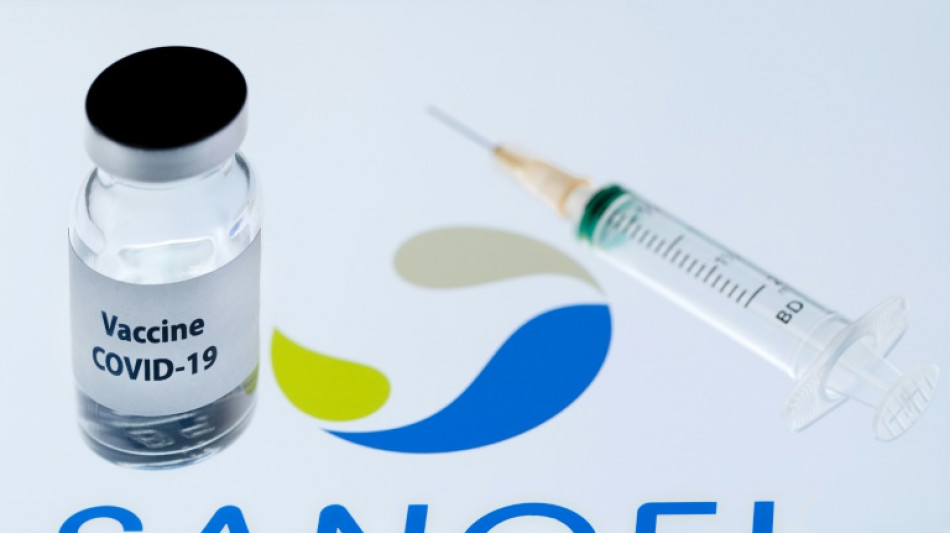
EU watchdog backs Sanofi Covid booster jab / Photo: JOEL SAGET - AFP/File

 EU trade chief seeks to dial down China tensions

 'Never again Bolsonaro': thousands march ahead of Brazil election runoff

 After botched execution, US woman was nearly taken off life support before revival

 Searing AIDS drama 'Elsinore' opens London film festival

 Evicted pensioner who sparked Spain housing protests dies: tenant union

 Golf star Rahm quitting LIV tour over 'unacceptable' terms
 Thousands march fearing return of a Bolsonaro presidency in Brazil

 French PM denies police ordered to confront student protesters

 Rubio touts US power, calls on Europe to emerge from 'slumber'

 Trump says 'we don't think' Russian plague is bio-weapon

 Five children among 26 killed in Ukraine after Russian strikes

 Man City should 'accept' punishment for rule breaches, says Lineker

 US woman who survived botched execution is awake and speaking

 From 1800s to modern pharma: a Nobel-winning chemistry quest

 Southampton boss Eckert given suspended ban over 'Spygate'
 Russia warns of 'false' information as second plague case reported

 IEA ready to release more oil reserves if necessary

 HSBC 'consults' over UK unit job cuts amid AI adoption

 UK court quashes five ex-traders' Libor rate rigging convictions
 XM Receives “Global Customer Experience Leader Award 2026” at the TrustFinance Performance Awards

 Stocks slide as oil climbs on Mideast flareup

 Heavy casualties in Ukraine after Russian strikes
 French wine harvest set to hit historic low

 Kyiv 'cannot agree' to EU membership limiting food exports: minister
 Arteta targets more Arsenal glory after signing new deal until 2030

The EU on Thursday approved a Covid booster vaccine by French drug maker Sanofi and Britain's GSK after it gave positive results against the Omicron variant in trials.
The approval of the "next generation" jab by the European Medicines Agency (EMA) is a shot in the arm for Sanofi and GSK, which have lagged behind rivals in offering a vaccine.
The VidPrevtyn Beta jab could be used as a booster in adults previously given mRNA jabs like those from Pfizer/BioNTech and Moderna, or viral vector vaccines made by AstraZeneca and Johnson & Johnson, the EMA said.
"A booster dose of VidPrevtyn Beta is expected to be at least as effective as Comirnaty (Pfizer's vaccine) at restoring protection against Covid-19," the Amsterdam-based EMA said.
A trial of 162 adults given the Sanofi-GSK booster showed that it triggers a higher production of antibodies against the Omicron BA.1 subvariant than Pfizer's jab, the regulator said.
A second study restored immunity in 627 adults who received other vaccines for their first course of jabs.
Sanofi said it was ready to start its first shipments of the booster in Britain and the EU, in line with advance contracts for 70 million doses.
"Today's approval validates our research in developing a novel solution for the Covid-19 pandemic," Thomas Triomphe, Sanofi executive vice president for vaccines, said.
The vaccine combines a Sanofi-developed antigen based on the Beta variant, which stimulates the production of germ-killing antibodies, with GSK's adjuvant technology, a substance that bolsters the immune response triggered by a vaccine.
- End of a long road -
Sanofi and GSK developed the jab at the same time that they are waiting for regulatory approval for their first-generation vaccine.
The approval marks the end of a long journey for Sanofi to bring a Covid vaccine to market. The French pharma giant, considered to be a world leader on vaccines, has come under huge scrutiny at home for failing to roll out a Covid jab earlier.
The firm vowed to produce a billion vaccine doses in 2021, only for a dosage problem during clinical trials to send its researchers back to the drawing board. It also tried to develop a vaccine based on mRNA technology, only to abandon that plan as well.
While it struggled, Pfizer/BioNTech and Moderna brought their vaccines to market at a pace never before seen in history. Both vaccines were approved nearly two full years before Sanofi's breakthrough on Thursday.
"It is, it must be recognised, a failure... compared to the speed that was needed," Sanofi chairman Serge Weinberg told a shareholders' meeting in May.
While Sanofi has finally managed to get a Covid vaccine approved, the question remains about how much demand remains in an already crowded market.
Last week frontrunner Pfizer raised the annual sales forecast for its vaccine to $36 billion on the back of new deals for boosters.
Moderna meanwhile slashed the sales forecast for its own vaccine by $2-$3 billion dollars due to shipment delays.
On Thursday, French-Austrian biotech Valneva announced it will cut up to a quarter of its workforce.
Valneva became the first French firm to get a Covid vaccine approved by the EMA in June. It suspended production a month later, however, after the EU slashed its initial order of 60 million doses to just 1.25 million.
N.Shalabi--SF-PST