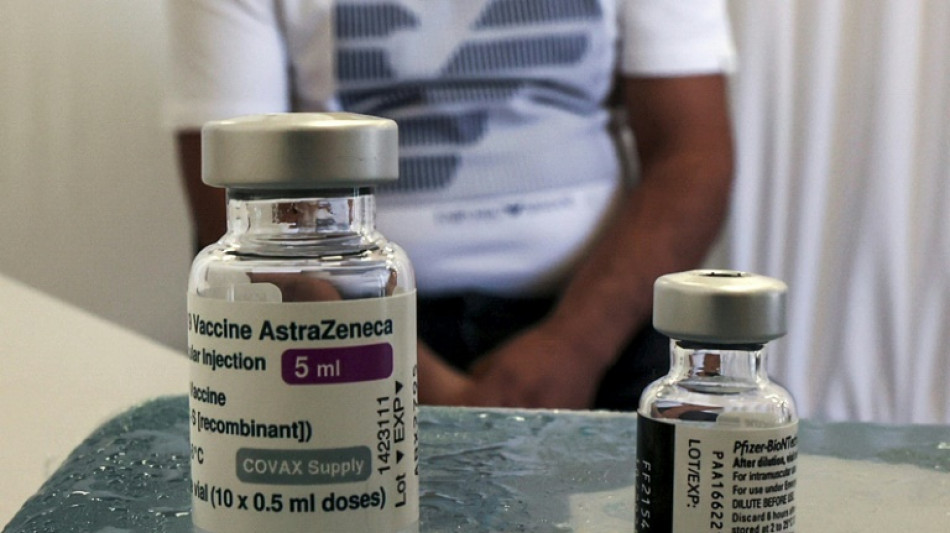
Study confirms AstraZeneca jab's higher risk of very rare clot / Photo: ABBAS MOMANI - AFP/File

 'Never again Bolsonaro': thousands march ahead of Brazil election runoff

 After botched execution, US woman was nearly taken off life support before revival

 Searing AIDS drama 'Elsinore' opens London film festival

 Evicted pensioner who sparked Spain housing protests dies: tenant union

 Golf star Rahm quitting LIV tour over 'unacceptable' terms

 Thousands march fearing return of a Bolsonaro presidency in Brazil

 French PM denies police ordered to confront student protesters

 Rubio touts US power, calls on Europe to emerge from 'slumber'

 Trump says 'we don't think' Russian plague is bio-weapon

 Five children among 26 killed in Ukraine after Russian strikes

 Man City should 'accept' punishment for rule breaches, says Lineker

 US woman who survived botched execution is awake and speaking

 From 1800s to modern pharma: a Nobel-winning chemistry quest

 Southampton boss Eckert given suspended ban over 'Spygate'

 Russia warns of 'false' information as second plague case reported

 IEA ready to release more oil reserves if necessary

 HSBC 'consults' over UK unit job cuts amid AI adoption

 UK court quashes five ex-traders' Libor rate rigging convictions
 XM Receives “Global Customer Experience Leader Award 2026” at the TrustFinance Performance Awards

 Stocks slide as oil climbs on Mideast flareup

 Heavy casualties in Ukraine after Russian strikes

 French wine harvest set to hit historic low

 Kyiv 'cannot agree' to EU membership limiting food exports: minister

 Arteta targets more Arsenal glory after signing new deal until 2030

 Russell hit with Singapore grid penalty for taking new power unit

AstraZeneca's Covid vaccine has been linked to a 30-percent higher risk of getting a very rare blood clotting condition compared to the Pfizer jab, a large international study said Thursday.
Several countries have already altered their advice after previous research indicated that -- in a tiny number of cases -- thrombosis with thrombocytopenia syndrome (TTS) can be a possible side effect of Covid vaccines that use an adenovirus vector, or "engineered" virus, such as those from AstraZeneca and Johnson & Johnson.
Thrombocytopenia produces potentially life-threatening blood clots with low levels of blood platelets -- the small cell fragments in our blood that prevent bleeding.
The new study, published in the journal BMJ, was the first to compare thrombocytopenia rates between adenovirus and mRNA vaccines -- such as Pfizer -- across multiple countries.
The international research team analysed health data from more than 10 million adults in France, Germany, the Netherlands, Spain, the United Kingdom and the United States who received at least one vaccine dose between December 2020 and mid-2021.
In Germany and the UK, they matched the data of 1.3 million people who had a first dose of AstraZeneca to 2.1 million who took Pfizer.
There were a total of 862 "thrombocytopenia events" recorded in the 28 days after a first dose of AstraZeneca, compared to 520 for Pfizer, the study said.
That meant AstraZeneca's vaccine had a 30-percent higher risk of thrombocytopenia than Pfizer.
However when it came to a second dose, there was no additional risk between any of the vaccines.
The study was observational, meaning it could not show cause and effect. But the researchers said that additional analysis found the results to be consistent.
While very rare, these risks "should be considered when planning further immunisation campaigns and future vaccine development," the study said.
- 'Safe and effective' -
Sarah Pitt, a microbiologist at the UK's Brighton University who was not involved in the research, said the "well-designed" study "adds to the data showing that all vaccines are safe and effective".
The "extremely rare" cases of thrombocytopenia occurred after just 0.04 percent of vaccine doses in Germany and the UK, she told AFP.
Most countries had already been avoiding using adenovirus Covid vaccines for the older and young age groups who are more at risk, she added.
European countries have largely pivoted towards mRNA vaccines. AstraZeneca's jab was never authorised in the US, which limited the use of the Janssen (Johnson & Johnson) COVID-19 jab to certain individuals earlier this year
However both AstraZeneca and Johnson & Johnson's vaccines play a pivotal role in Covax global vaccine distribution scheme, which provides doses to lower-income countries.
G.AbuHamad--SF-PST