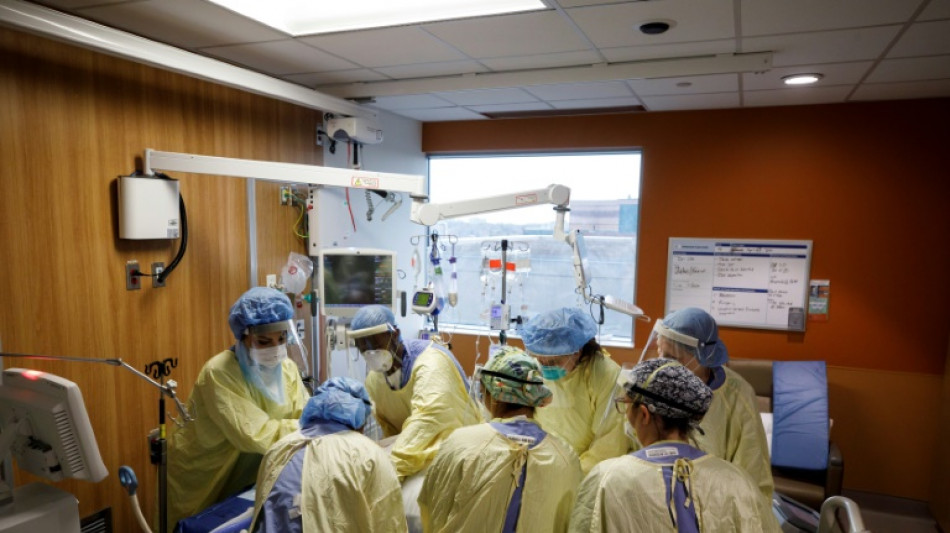
Nursing shortage forces emergency room closures across Canada / Photo: Cole Burston - AFP/File

 'Never again Bolsonaro': thousands march ahead of Brazil election runoff

 After botched execution, US woman was nearly taken off life support before revival

 Searing AIDS drama 'Elsinore' opens London film festival

 Evicted pensioner who sparked Spain housing protests dies: tenant union

 Golf star Rahm quitting LIV tour over 'unacceptable' terms

 Thousands march fearing return of a Bolsonaro presidency in Brazil

 French PM denies police ordered to confront student protesters

 Rubio touts US power, calls on Europe to emerge from 'slumber'

 Trump says 'we don't think' Russian plague is bio-weapon

 Five children among 26 killed in Ukraine after Russian strikes

 Man City should 'accept' punishment for rule breaches, says Lineker

 US woman who survived botched execution is awake and speaking
 From 1800s to modern pharma: a Nobel-winning chemistry quest

 Southampton boss Eckert given suspended ban over 'Spygate'

 Russia warns of 'false' information as second plague case reported

 IEA ready to release more oil reserves if necessary

 HSBC 'consults' over UK unit job cuts amid AI adoption

 UK court quashes five ex-traders' Libor rate rigging convictions

 XM Receives “Global Customer Experience Leader Award 2026” at the TrustFinance Performance Awards

 Stocks slide as oil climbs on Mideast flareup

 Heavy casualties in Ukraine after Russian strikes

 French wine harvest set to hit historic low

 Kyiv 'cannot agree' to EU membership limiting food exports: minister

 Arteta targets more Arsenal glory after signing new deal until 2030

 Russell hit with Singapore grid penalty for taking new power unit

An acute nursing shortage is clogging or even closing hospital emergency rooms across Canada, pushing an already stressed national health system to the brink with potentially severe consequences for patient care.
Burnout from the Covid-19 pandemic, abuse from patients and salary discontent have seen nursing staff quitting their jobs in droves, and experts say the situation is only likely to worsen.
The impact on emergency care is such that Ottawa police recently had to take a shooting victim to hospital in their squad car, rather than wait for an ambulance, and an elderly woman who fell and broke her hip was forced to wait six hours for help from paramedics based 100 kilometers (62 miles) away.
Over the summer and into the fall, staffing shortages meant dozens of emergency rooms were forced to close -- sometimes for a night or a weekend, sometimes longer.
Wait times to see an ER doctor have soared to 12, 16, 20 hours -- or more.
"They're numb, deflated and feeling hopeless," said Cathryn Hoy, president of the Ontario Nurses' Association. Herself a nurse for 20 years, she described the situation as "critical."
Amelie Inard, 32, was taken to an ER in Montreal this week, in extreme pain and peeing blood.
The place was packed, and an overwrought nurse told her to describe her condition "in one sentence, really quickly, because of how busy they were," Inard said.
She eventually left in frustration, without seeing a doctor.
Hospital workloads are rising, Hoy said, along with patients' exasperation over extended wait times, leading to a spiking of violence against nurses.
Several nurses told AFP they had been punched, scratched or spat on, and had trays, dishes and feces thrown at them.
- 'Crazy conditions' -
In the capital Ottawa, ambulances were unavailable on more than 1,000 occasions from January to July, as paramedics were stuck waiting to unload patients at crowded ERs.
A hospital in Peterborough, east of Toronto, in the past week was forced to treat patients on gurneys in the parking lot because its ER was full, said Hoy.
In Manitoba, doctor Merril Pauls said there had been "multiple times throughout the summer when we had to shut down beds in the emergency room" at Winnipeg's Health Sciences Centre because of the nursing shortage.
On one recent Sunday, he said, "We had too many people coming in and had no place to put them. We literally were double-bunking critical patients in a resuscitation bay.
"Our nurses are really working in crazy conditions."
It's a "really significant phenomenon going on across the country," the doctor added, and it's "getting worse."
- High turnover -
A recent survey by the Canadian Union of Public Employees, the country's largest labor union, found that 87 percent of nurses have considered leaving their job "because of the thankless and grueling working conditions."
"Even new graduates are quitting," Hoy said.
Federal health minister Jean-Yves Duclos has vowed to make it easier for foreign credentials to be recognized. That could help 11,000 internationally trained doctors and nurses get jobs in their field in Canada.
But that won't be nearly enough, with 34,400 nursing positions now vacant, according to government data.
Compounding the problem, many Canadians -- like Inard -- don't have a family doctor and turn to emergency rooms for care.
"It's just so difficult to find a family doctor," she said.
And a frequent shortage of regular hospital beds often means long waits to transfer patients out of ERs to wards.
Ontario passed a bill at the end of September permitting transfers of patients awaiting long-term care to facilities up to 150 kilometers away.
Provincial Health Minister Sylvia Jones said it would "ease pressures on crowded emergency departments."
But critics say it could force frail, elderly people into care homes far from their loved ones.
For now, almost everyone needing treatment is eventually seen. But delays can pose long-term consequences for patients' health.
"If a stroke patient doesn't get access to a clot-busting medicine fast, brain cells will die and the patient will end up being more disabled than they would have been," Pauls said.
Serious infections can be deadly if not treated in time. So, too, can cancers and other diseases, he added.
Pauls recalled routinely telling discharged patients "to come back if things get worse."
"But now they laugh at us. They say: 'You're crazy. There's no way I'm going to go through this again.'"
M.Qasim--SF-PST