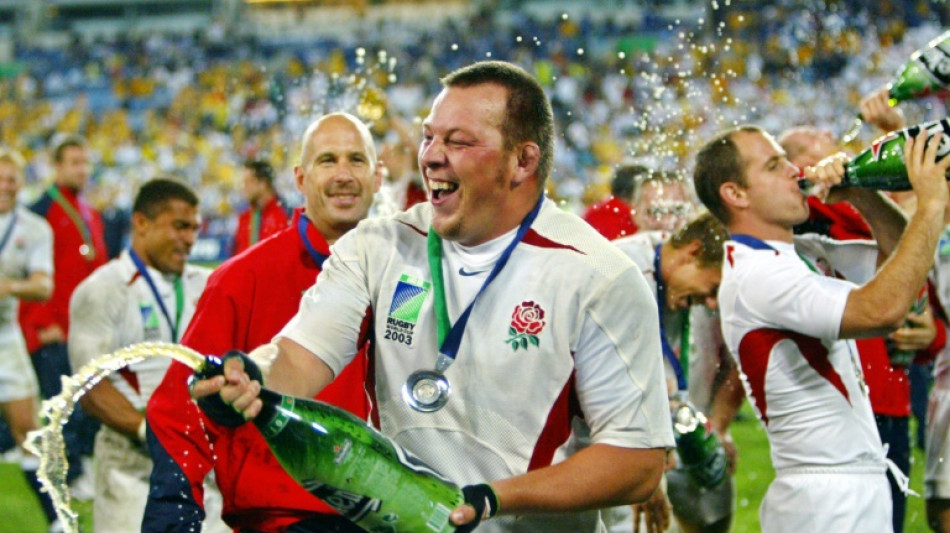
Rugby World Cup winner Thompson says dementia makes him feel 'phoney' / Photo: ODD ANDERSEN - AFP/File

 'Never again Bolsonaro': thousands march ahead of Brazil election runoff

 After botched execution, US woman was nearly taken off life support before revival

 Searing AIDS drama 'Elsinore' opens London film festival

 Evicted pensioner who sparked Spain housing protests dies: tenant union

 Golf star Rahm quitting LIV tour over 'unacceptable' terms

 Thousands march fearing return of a Bolsonaro presidency in Brazil

 French PM denies police ordered to confront student protesters

 Rubio touts US power, calls on Europe to emerge from 'slumber'

 Trump says 'we don't think' Russian plague is bio-weapon

 Five children among 26 killed in Ukraine after Russian strikes

 Man City should 'accept' punishment for rule breaches, says Lineker

 US woman who survived botched execution is awake and speaking

 From 1800s to modern pharma: a Nobel-winning chemistry quest

 Southampton boss Eckert given suspended ban over 'Spygate'

 Russia warns of 'false' information as second plague case reported

 IEA ready to release more oil reserves if necessary

 HSBC 'consults' over UK unit job cuts amid AI adoption

 UK court quashes five ex-traders' Libor rate rigging convictions

 XM Receives “Global Customer Experience Leader Award 2026” at the TrustFinance Performance Awards

 Stocks slide as oil climbs on Mideast flareup

 Heavy casualties in Ukraine after Russian strikes

 French wine harvest set to hit historic low

 Kyiv 'cannot agree' to EU membership limiting food exports: minister

 Arteta targets more Arsenal glory after signing new deal until 2030

 Russell hit with Singapore grid penalty for taking new power unit
Former England rugby star Steve Thompson says he feels like a "phoney" because he cannot remember being part of the 2003 World Cup-winning team, two years after being diagnosed with early onset dementia.
The ex-hooker, 44, is one of scores of former players who have decided to sue a number of governing bodies for negligence.
Thompson features in a BBC documentary: "Head On: Rugby, Dementia and Me" to be aired on Wednesday -- a day after new research was published suggesting elite players could be at a significantly greater risk of developing neurodegenerative diseases such as motor neurone disease, Parkinson's and dementia.
Glasgow consultant neuropathologist Willie Stewart, who led the research team, has called for urgent action, saying the sport should minimise contact training and reduce its global calendar.
Thompson, diagnosed with early onset dementia and probable CTE (chronic traumatic encephalopathy) in November 2020, has packed away his medals and trophies.
"Around four years ago some of my strongest memories started disappearing, precious private moments and all the career highlights of two decades of rugby. So much so I packed away all my most precious memorabilia because having it around was just too painful," he said in the documentary.
He added: "When people say 'Oh, you got a World Cup medal' and all this I feel like a phoney.
"Because it feels like I haven't done it because I can't remember it and it doesn't feel like me so sometimes when people in public talk about it I get embarrassed by it."
Thompson, who sometimes forgets the names of his children in the film, said he believes he is suffering as a result of multiple head impacts he endured as a player, saying concussion protocols at the time were not safe.
"If you were knocked out and you came back to, you were just told to get on with it," he said.
"If you had a headache, you were just given headache pills. It wasn't known as an injury. It would be like: 'At least you haven't pulled your hamstring, so you can still run.'"
He said rugby authorities, including the Rugby Football Union (RFU), which is the game's governing body in England, could do more.
"There's been no support from the RFU," he said. "Since I started the legal action, they've even stopped sending me the birthday card I got every year."
World Rugby last year issued guidance advising limiting full contact training to just 15 minutes per week and in July extended its minimum concussion stand-down period to 12 days.
But Thompson feels the sport could go further.
"It's a little start, but, to be honest, it needs to be three weeks at least," he says, adding he would still not feel comfortable allowing his children to play full-contact rugby.
B.Mahmoud--SF-PST