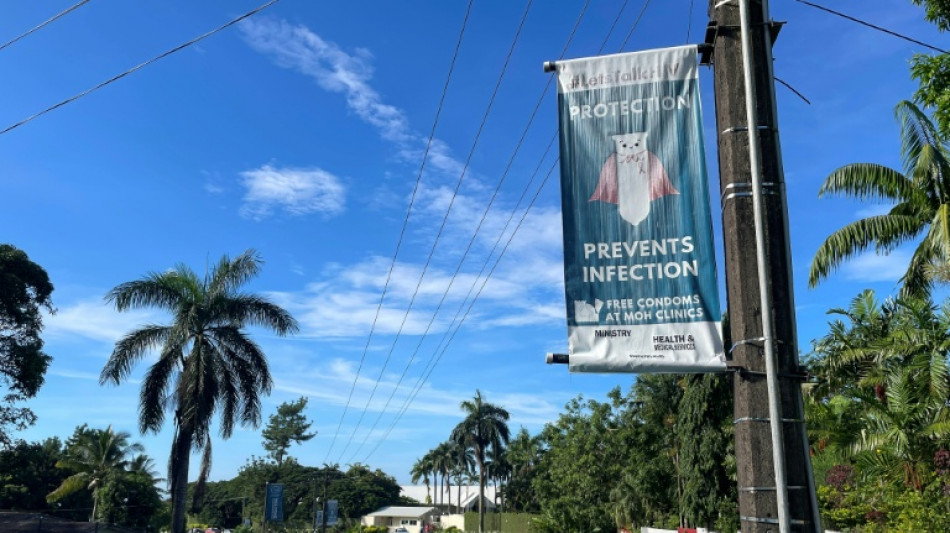
'Spreading like wildfire': Fiji grapples with soaring HIV cases / Photo: STR - AFP

 Hotel Blacklist Launches New Accommodation Industry Risk Assessment Tool

 Bangladesh nuclear plant draws hope -- and worry

 US beat Canada 1-0 to wrap up four-win international break
 Turkey, Australia's joint COP31 leadership raises doubts

 For Turkish NGOs, COP31 offers rare space for action

 Sleep, appetite, gene-editing experts contend for Nobel chemistry prize
 Nobel Peace Prize haunted by the 'spectre' of Trump

 Africa launches own credit agency in bid for cheaper borrowing

 US, China, EU: three paths to regulating AI

 Australia's High Court rules against coal mine in landmark climate case
 Australia touts new funds for Pacific infrastructure at Fiji 'pre-COP'

 Eva Marie Saint, Oscar winner of Hollywood classics, dies at 102

 Australia probes app used in cheap smart glasses over privacy fears

 England needed to 'move on' from World Cup pain, says Tuchel

 O'Neill to stay at Celtic after period of "reflection"

 Kane marks 125th England cap with Wembley Nations League double

 Quebec's incoming separatist leader wants to block Crown from swearing-in

 Emmys gala will now stream its premier television awards

 Paramount completes Warner Bros takeover, creating Skydance
 Trump blames France unrest on Islam, migration

 Apple's Cook praises EU over efforts to protect children online
 Nobel winner Halzen says years of October 'misery' finally over

 Quebec separatist win rattles Carney's unity push

 'Itching' for change: Shiffrin cuts back slaloms this season

 'Gen Z has risen up': Tens of thousands mass for tense France school protests

As evening falls in Fiji's capital, a steady stream of people approaches a makeshift clinic that is a first line of defence against one of the world's fastest-growing HIV epidemics.
In the South Pacific nation -- a popular tourist destination of just under a million people -- there were over 2,000 new HIV cases recorded last year, a 26 percent increase from 2024.
The government has declared an HIV outbreak and described it as a national crisis.
"It's spreading like wildfire," Siteri Dinawai, 46, who came to be tested, told AFP.
The Moonlight Clinic, a converted minibus parked in a suburban cul-de-sac in Suva, is part of a push to bring testing into neighbourhoods.
Volunteers from the Survival Advocacy Network -- a group supporting sex workers -- and Rainbow Pride Fiji, which works with LGBTQ+ communities, are on hand to speak to those who may be reluctant.
Ana Fofole and her team at Medical Services Pacific, which runs the clinic, hand out condoms as part of their awareness drive and test for syphilis and hepatitis B.
"We don't just turn up anywhere -- we have to do it the right way," says Fofole.
Irinieta Foi, 45, is among those Medical Services Pacific hopes to reach by bringing testing into neighbourhoods.
Foi, who is able to get a result in 15 minutes, says she stumbled upon the clinic.
"I decided, OK, why not?"
Many stay away for fear of returning a positive result, said 28-year-old Ecelina Lalabaluva, who also got tested.
- Transit hub for drugs -
Clinics like this raise awareness about the blood-borne disease and can help pin down just how many people are living with HIV in Fiji and refer them to treatment.
The number of known cases is around 5,000, according to Renata Ram, country director for Fiji and the Pacific at UNAIDS, who says the crisis has been building for years.
That number was as low as 500 in 2014, according to estimates by UNAIDS, which classifies Fiji as having among the world's fastest-growing HIV epidemics.
Transmission rates began to increase around 2019, when a group of "very high-risk" injecting drug users emerged, primarily in the sex worker community, Ram explained.
"Fiji, like other Pacific islands, for a long time have been transit hubs for drugs from Latin America and Asia destined for Australia and New Zealand," said Virginia Comolli, Pacific programme head at the Global Initiative against Transnational Organized Crime.
The flow of highly addictive drugs such as methamphetamine and cocaine to those lucrative markets rose sharply after a lull during the Covid pandemic, she explained.
Those drugs are increasingly seeping into the Pacific's domestic markets -- in part due to foreign criminal syndicates opting to pay their local facilitators in kind, she said.
For those living with the virus, the social stigma can weigh heavy in a country where conservative values largely prevail.
- 'Wait to die?' -
One of the few public faces of the crisis is Mark Lal, who was diagnosed with HIV two years ago.
"In Fiji, whenever the topic of sex comes up, everyone just disperses," says Lal, 24, a gay man who said he is not a drug user.
He originally knew little about HIV and the available treatment.
"When I was diagnosed, the first thing I asked the doctors was: 'What now? Do I just wait to die?'"
On his "Living Positive Fiji" page on Facebook, Lal has fielded questions from more than a hundred people.
Most are aged 17 to 20 and are unsure whether to disclose their HIV status out of fear of discrimination.
"If you come out publicly as someone living with HIV, there's a chance where you might actually not get a good reaction," Lal said.
His own hospital visit for his initial diagnosis left its mark.
"I saw some walking out with fear in their eyes, and I was like: 'I want to change this. I want to help people'."
Fiji has a tough task to rein in case numbers, according to Ram of UNAIDS, who said the country is "15 to 20 years behind" in its HIV efforts.
"A needle-syringe programme is what is very much needed right now."
The government has said it will adopt a plan to prevent the spread of disease through drug injections, but implementation of its programme to provide safe injecting equipment has been delayed.
For Foi, one of the women attending the outreach clinic, the task is simple.
"It's really important for everybody to get tested."
R.Shaban--SF-PST