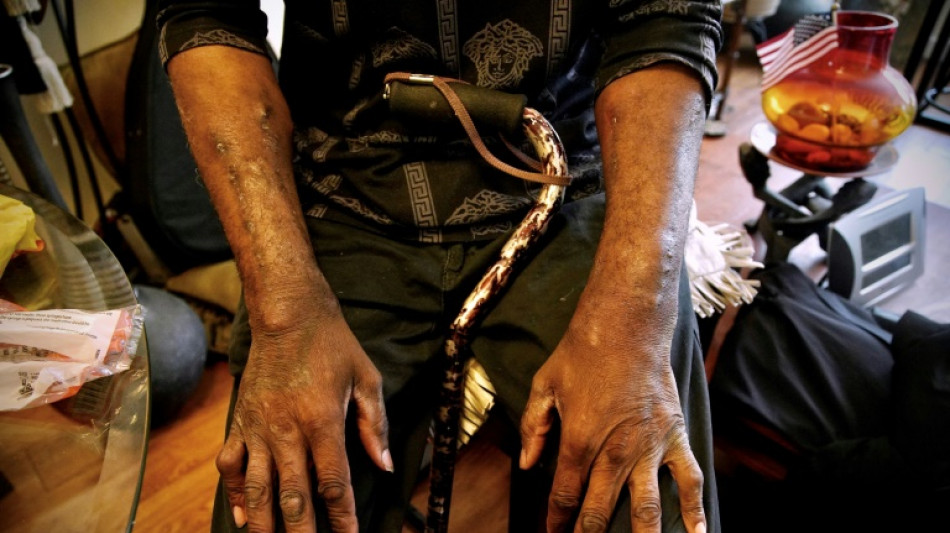
US overdose deaths shot up for Black, Native people during pandemic / Photo: Agnes BUN - AFP/File

 US woman who survived botched execution is awake and speaking

 From 1800s to modern pharma: a Nobel-winning chemistry quest

 Southampton boss Eckert given suspended ban over 'Spygate'

 Russia warns of 'false' information as second plague case reported

 IEA ready to release more oil reserves if necessary

 HSBC 'consults' over UK unit job cuts amid AI adoption

 UK court quashes five ex-traders' Libor rate rigging convictions
 XM Receives “Global Customer Experience Leader Award 2026” at the TrustFinance Performance Awards

 Stocks slide as oil climbs on Mideast flareup

 Heavy casualties in Ukraine after Russian strikes

 French wine harvest set to hit historic low

 Kyiv 'cannot agree' to EU membership limiting food exports: minister

 Arteta targets more Arsenal glory after signing new deal until 2030

 Russell hit with Singapore grid penalty for taking new power unit

 Spotify expands audiobooks to more than 180 markets

 French-Japanese duo wins chemistry Nobel for solving molecular 'mystery'

 England's Nations League surge helps heal World Cup wounds

 Mayor of opposition stronghold Izmir defects to Erdogan party

 Mertens beats Gauff to set up Swiatek clash at China Open

 Benin full of pride at role in Messi's last dance

 France suspends stun grenade use at student protests ahead of PM speech

 Indonesian court hears 'negligence' complaint against state over fires, haze

 Rubio in Greece to urge against Western civilisation 'decline'

 Micron workers at Taiwan plant vote in favour of strike

 In 'The Social Reckoning,' Jeremy Allen White takes on Facebook's 'frightening' ambition

Overdose deaths increased 44 percent for Black people and 39 percent for American Indians in 2020 compared to 2019, as the Covid-19 pandemic disrupted access to care and exacerbated racial inequality, an official report showed Tuesday.
"Racism, a root cause of health disparities, continues to be a serious public health threat that directly affects the well-being of millions of Americans," US Centers for Disease Control and Prevention (CDC) acting principal deputy director Debra Houry said in a briefing.
"The disproportionate increase in overdose death rates among Black and American Indian/Alaskan Native people may partly be due to health inequities, like unequal access to substance use treatment and treatment biases."
Recent increases in deaths were largely driven by illegally manufactured fentanyl and fentanyl analogs (IMFs), according to the report from the CDC.
Before the pandemic, the overdose death rate was similar for Black, Native and white people, at 27, 26 and 25 per 100,000 people in 2019.
But that changed dramatically in 2020, when the respective figures were 39, 36 and 31 per 100,000 people.
Though the increase among white people was not as great as for Black people and American Indians, the new rate is still a historic high.
Among key findings, the overdose death rate among Black males 65 years and older was nearly seven times that of their white counterparts.
Black people 15-24 years old experienced the largest rate increase, 86 percent, compared to changes seen in other groups.
"There was a substantially lower percentage of people in racial and ethnic minority groups showing evidence of ever receiving treatment for substance use, compared to white people," CDC health scientist Mbabazi Kariisa said during the briefing.
In fact, most people who died by overdose had no evidence of getting prior substance use treatment before their death.
Areas with a wider income gap between rich and poor had the highest death rates.
Being impoverished "can lead to lack of stable housing, reliable transportation and health insurance, making it even more difficult for people to access treatment, and other support services," said Kariisa.
In terms of recommendations, Houry said it was vital to raise awareness about the lethality of the illicit drug supply, particularly fentanyl -- and encouraging the public to carry the life-saving treatment Naloxone.
Improving access to treatment and offering structural support, such as transport assistance and child care, can improve care access.
"Combining culturally appropriate traditional practices, spirituality and religion with evidence based substance use disorder treatment also helps raise awareness and reduce stigma," she said.
"While we have made so much progress in treating substance use disorders as chronic conditions, rather than moral failings, there is still so much more work to do, including making sure that all people who need these services can get them," Houry concluded.
T.Khatib--SF-PST