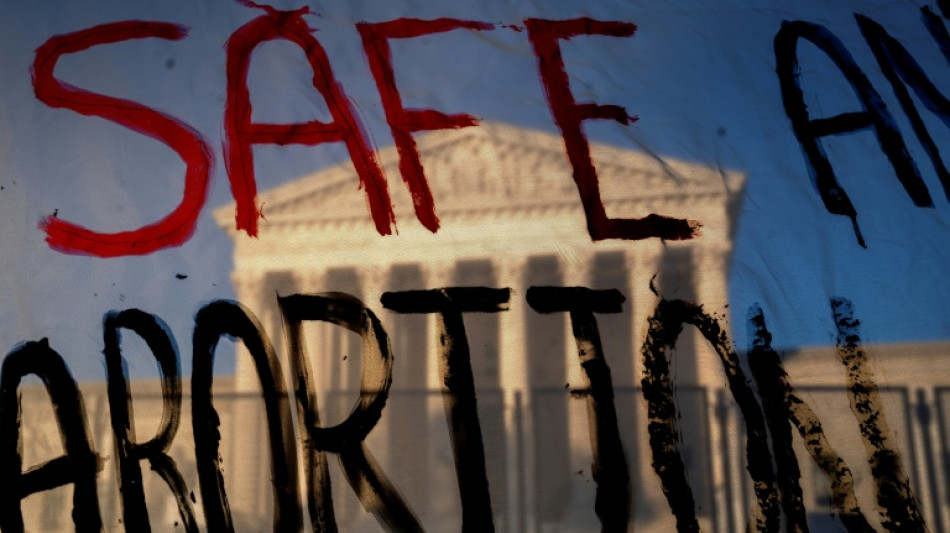
US doctors embroiled in sudden legal uncertainty over abortions / Photo: Stefani Reynolds - AFP/File

 US woman who survived botched execution is awake and speaking

 From 1800s to modern pharma: a Nobel-winning chemistry quest

 Southampton boss Eckert given suspended ban over 'Spygate'

 Russia warns of 'false' information as second plague case reported

 IEA ready to release more oil reserves if necessary

 HSBC 'consults' over UK unit job cuts amid AI adoption

 UK court quashes five ex-traders' Libor rate rigging convictions

 XM Receives “Global Customer Experience Leader Award 2026” at the TrustFinance Performance Awards

 Stocks slide as oil climbs on Mideast flareup

 Heavy casualties in Ukraine after Russian strikes

 French wine harvest set to hit historic low

 Kyiv 'cannot agree' to EU membership limiting food exports: minister

 Arteta targets more Arsenal glory after signing new deal until 2030

 Russell hit with Singapore grid penalty for taking new power unit

 Spotify expands audiobooks to more than 180 markets

 French-Japanese duo wins chemistry Nobel for solving molecular 'mystery'

 England's Nations League surge helps heal World Cup wounds

 Mayor of opposition stronghold Izmir defects to Erdogan party

 Mertens beats Gauff to set up Swiatek clash at China Open

 Benin full of pride at role in Messi's last dance

 France suspends stun grenade use at student protests ahead of PM speech

 Indonesian court hears 'negligence' complaint against state over fires, haze

 Rubio in Greece to urge against Western civilisation 'decline'

 Micron workers at Taiwan plant vote in favour of strike

 In 'The Social Reckoning,' Jeremy Allen White takes on Facebook's 'frightening' ambition

Days after the US state of Ohio banned abortions once a fetal heartbeat is detected, doctor Mae Winchester had a patient who needed to terminate her pregnancy to save her life.
Her patient, who was 19 weeks pregnant, asked if "legally she was going to be OK and if legally I was going to be OK," Winchester told AFP.
It wouldn't have been a question when the nationwide right to abortion was still protected under the US constitution.
But the Supreme Court overturned the 1973 Roe v. Wade ruling on June 24 -- and some states, including Ohio, moved quickly to restrict the procedure, sometimes only with exceptions for medical necessity.
Doctors across the country were thrust into an ambiguous legal landscape that they say threatens both their ability to do their jobs and their patients' health.
While her patient had a clear medical emergency, with the rug pulled out from under the nearly 50-year-old right, that night Winchester made a call to the hospital's lawyers.
"I know what I need to do medically. But from a legal standpoint, how do I protect her? How do I protect myself? How do I protect our institution? Our nurses and anesthesiologist that are going to be involved with this case? It affects everybody," she said.
Such concerns echoed by doctors from varying specialities caught in the crosshairs of new laws, as well as health care lawyers working to help providers navigate the shifting ground.
"It's a bizarre situation where doctors have to be nervous even when they're providing legitimate care for potentially life-threatening conditions," said Harry Nelson, managing partner at health care law firm Nelson Hardiman, which advises physicians.
- Lose license? Face jail? -
The penalties in new legislation can be severe and not limited to losing one's medical license, but also possible felony charges, years in jail and thousands of dollars in fines.
Even the threat of litigation will take a toll, said Nelson, noting that few organisations and individuals can withstand the financial, logistical and mental cost "without a significant level of stress."
Some authorities in states with tight abortion restrictions have said the concern is misplaced because of laws' exceptions for medical endangerment, with anti-abortion advocates accusing opponents of "fear mongering."
But the risk is taken seriously by the Department of Health and Human Services.
It has said the Emergency Medical Treatment and Labor Act (EMTALA) supersedes state abortion laws if the procedure is needed to stabilize a pregnant patient -- a move praised by abortion rights supporters, who have pressured President Joe Biden's administration to preserve access to the procedure.
But the guidance has come under fire, with Texas Attorney General Ken Paxton suing the administration, saying it "seeks to transform every emergency room in the country into a walk-in abortion clinic."
It's unclear how zealous prosecutors will be, and a group of some 90 elected prosecutors from across the country as of July 14 have already said they will not pursue abortion cases.
But in Indiana, where abortion is still legal up to 22 weeks and the Republican-dominated legislature is considering tighter abortion restrictions, a doctor has already been threatened with investigation over performing the procedure for a 10-year-old rape victim who had to cross from neighboring Ohio.
The obstetrician-gynecologist (OB-GYN) was accused of not reporting the case, as state law requires in case of sex crimes involving minors -- an accusation has been disproved.
Nelson and other lawyers said much of the rhetoric amounts to "scare tactics" and political capitalization to garner support around one of the most hot-button issues in the country.
But he underscored that in states like Texas, Idaho and Oklahoma, which allow for civil lawsuits against anyone who knowingly "aids or abets" an abortion, there is real risk from "single issue agitated people who are... looking to make examples."
- 'Rock and a hard place' -
It's not only OB-GYNs who may be caught in the net, with doctors voicing fear over the impact on care for pregnant patients with diseases such as cancer, the treatment for which could harm a pregnancy.
Health care providers in states where abortion access is still available also are seeking advice, Nelson said, as anti-abortion leaders eye cross-border care as their next battleground.
"Because every situation is so different it's really hard for us to write guidelines, and everybody is asking for guidelines," said Wisconsin-based OB-GYN Kristin Lyerly, a legislative chair for the American College of Obstetricians and Gynaecologists (ACOG).
ACOG has joined some 75 other health care organizations in condemning legislative interference in the patient-doctor relationship after the Supreme Court ruling.
"Pregnancy management is complicated but doctors have to do it, not politicians," Lyerly told AFP.
Since Roe v Wade was overturned she's heard from colleagues feeling "stuck between a rock and hard place."
"What are you supposed to do? Commit malpractice or go to jail for being a criminal for performing an abortion?"
D.Qudsi--SF-PST