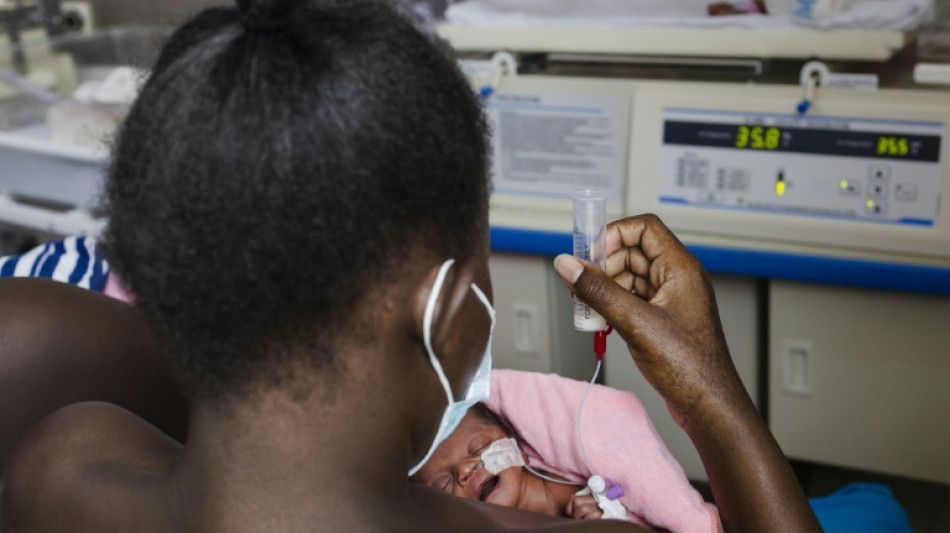
Kenya's only breastmilk bank, lifeline for premature babies / Photo: Tony KARUMBA - AFP

 Indonesian court hears 'negligence' complaint against state over fires, haze

 Rubio in Greece to urge against Western civilisation 'decline'
 Micron workers at Taiwan plant vote in favour of strike
 In 'The Social Reckoning,' Jeremy Allen White takes on Facebook's 'frightening' ambition
 Chip industry activists call for South Korea to recognise cancer cases
 Famine-scarred southern Madagascar braces for El Nino
 How the EU regulates lobbyists
 I.Coast refuge offers lifelong care for youngsters scorned as 'sorcerers'

 Indian central bank hikes rates for first time in more than 3 years
 Hotel Blacklist Launches New Accommodation Industry Risk Assessment Tool
 Bangladesh nuclear plant draws hope -- and worry

 US beat Canada 1-0 to wrap up four-win international break
 Turkey, Australia's joint COP31 leadership raises doubts

 For Turkish NGOs, COP31 offers rare space for action
 Sleep, appetite, gene-editing experts contend for Nobel chemistry prize

 Nobel Peace Prize haunted by the 'spectre' of Trump

 Africa launches own credit agency in bid for cheaper borrowing

 US, China, EU: three paths to regulating AI
 Australia's High Court rules against coal mine in landmark climate case
 Australia touts new funds for Pacific infrastructure at Fiji 'pre-COP'

 Eva Marie Saint, Oscar winner of Hollywood classics, dies at 102
 Australia probes app used in cheap smart glasses over privacy fears

 England needed to 'move on' from World Cup pain, says Tuchel

 O'Neill to stay at Celtic after period of "reflection"

 Kane marks 125th England cap with Wembley Nations League double

Surrounded by incubators, a red tube snaking into her tiny nose, four-day-old Grace-Ella is being fed donated breastmilk at the only facility in Kenya that offers the life-giving service.
The breastmilk bank at Pumwani Maternity Hospital is one of very few across sub-Saharan Africa, and is especially helpful for premature babies, of which roughly 134,000 are born each year in Kenya.
Mothers who give birth prematurely are often unable to produce breastmilk and must rely on formula, which can be less nutritious and increases the risk of infection, especially since water is often contaminated.
The milk bank in Nairobi, established in 2019 with the support of British aid money and PATH, an NGO, allows babies like Grace-Ella to benefit from the generosity of others.
"It was super-exciting," her mother Margaret Adhiambo, 28, told AFP, adding she had not heard of the programme before she delivered prematurely at 30 weeks.
"Before I accepted, I was a bit sceptical because it gave me some feeling of guilt like I could not give my daughter my own breastmilk."
But "it helped me because my daughter didn't starve, at least she got some food," she added.
- 'Good to help' -
Underweight babies face a daunting array of risks, and breastmilk can, quite literally, tip the scales in their favour.
"When we feed them human milk we find they are growing faster compared to a baby who is getting formula," said Muthoni Ogola, the doctor heading the programme.
Yet the World Health Organization (WHO) says fewer than half of all infants worldwide are exclusively breastfed.
A key advantage of breastmilk is the antibodies passed to the infant, said Pumwani nurse Hannah Wangeci Maina.
She moves with the efficiency needed for a maternity ward that cares for at least 90 mothers and babies at a time.
"We usually have many mothers lining up to receive the expressed breastmilk," she said.
On a recent visit by AFP, she helped first-time mother Esther Wanjiru, 22, through the process of donating.
Wanjiru was given counselling and tests for diseases including HIV and hepatitis before sitting to pump her breastmilk.
The milk was then tested, both pre- and post-pasteurisation, and then frozen, allowing it to be stored for up to a year.
"It feels good to help... It sort of feels like a massage," Wanjiru told AFP with a shy grin.
- Funding shortfall -
For the hospital team, it is frustrating that they only have enough equipment to provide milk to hospitalised children on the ward, as well as occasional donations to two other hospitals.
It is a much cheaper option than formula, but the equipment is expensive, said hospital CEO Christine Kiteshuo.
"Some of this equipment can only be found in Europe (or) the US, so it becomes a problem for us to procure," Kiteshuo told AFP.
The hospital would love to help mothers out in the community, especially since many live in informal settlements without fridges or clean running water.
"That becomes one of the challenges that we experience right now -- that we cannot help the mothers outside the facility," said Kiteshuo.
I.Matar--SF-PST