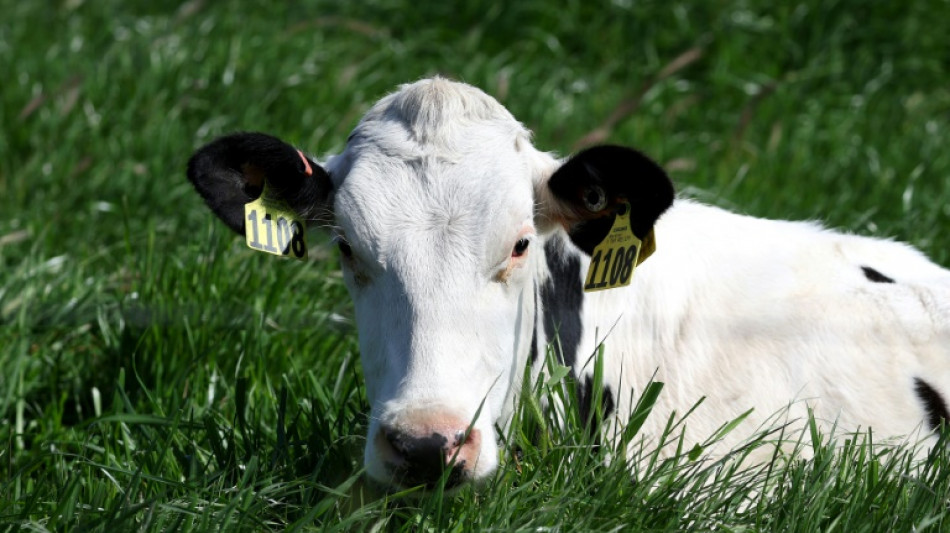
Painting stripes on cows to lizards' pizza pick: Ig Nobel winners / Photo: JUSTIN SULLIVAN - GETTY IMAGES NORTH AMERICA/AFP/File

 Indonesian court hears 'negligence' complaint against state over fires, haze

 Rubio in Greece to urge against Western civilisation 'decline'

 Micron workers at Taiwan plant vote in favour of strike

 In 'The Social Reckoning,' Jeremy Allen White takes on Facebook's 'frightening' ambition

 Chip industry activists call for South Korea to recognise cancer cases
 Famine-scarred southern Madagascar braces for El Nino

 How the EU regulates lobbyists
 I.Coast refuge offers lifelong care for youngsters scorned as 'sorcerers'

 Indian central bank hikes rates for first time in more than 3 years
 Hotel Blacklist Launches New Accommodation Industry Risk Assessment Tool
 Bangladesh nuclear plant draws hope -- and worry

 US beat Canada 1-0 to wrap up four-win international break
 Turkey, Australia's joint COP31 leadership raises doubts
 For Turkish NGOs, COP31 offers rare space for action

 Sleep, appetite, gene-editing experts contend for Nobel chemistry prize
 Nobel Peace Prize haunted by the 'spectre' of Trump

 Africa launches own credit agency in bid for cheaper borrowing

 US, China, EU: three paths to regulating AI
 Australia's High Court rules against coal mine in landmark climate case

 Australia touts new funds for Pacific infrastructure at Fiji 'pre-COP'

 Eva Marie Saint, Oscar winner of Hollywood classics, dies at 102

 Australia probes app used in cheap smart glasses over privacy fears
 England needed to 'move on' from World Cup pain, says Tuchel

 O'Neill to stay at Celtic after period of "reflection"

 Kane marks 125th England cap with Wembley Nations League double
Painting zebra stripes on cows to fend off flies, lizards' favourite pizza toppings and how booze helps you speak another language: these were some of the winners at the Ig Nobel prizes, which celebrate the sillier side of science.
The 35th edition of the annual awards, which are organised by the science humour magazine Annals of Improbable Research, were held just a few weeks before the real Nobel prizes.
Here are the 10 prize winners, which were announced at a raucous ceremony at Boston University on Thursday night.
- Painting stripes on cows -
A team of Japanese researchers won the Ig Nobel biology prize for showing that painting zebra stripes on cows meant that flies were less likely to bite them.
While one of the researchers accepted the award, his colleagues buzzed sticks bearing images of flies around him --- until he took off his jacket to reveal a zebra-striped shirt.
- Lizard pizza preference -
When rainbow lizards steal pizza from resorts in Togo, four cheeses is their preferred topping, according to research which won the nutrition prize.
The team "simply wanted to answer the age-old scientific question: what happens when a lizard discovers cheese and carbs," Italian researcher Luca Luiselli said in an acceptance speech read out by French economic Nobel laureate Esther Duflo.
"Now we know -- and the answer is: they behave like Italians."
- Drunken language -
Drinking alcohol can help you speak a foreign language more clearly -- within reason, according to research by a Dutch-German-UK team that won the peace prize.
The scientists came up with the idea while drinking at a bar during an international conference, noticing that "drunken Germans usually pronounce Dutch better than sober Germans," they said in a statement read at the ceremony.
They found that a small dose of alcohol, less than a pint of beer, can boost confidence. But this was only in moderation -- the researchers did not recommend using booze as a language-learning tool.
- Pasta physics -
The physics prize went to European researchers for "discoveries about the physics of pasta sauce" -- in particular, how to avoid clumpiness while making the iconic Italian dish cacio e pepe.
"You all might think that this work confirms all the stereotypes about Italians, like that we only think about food -- but this is not true," one of the Italian researchers told the ceremony, while wearing a fake moustache and giant chef hat.
- Drunk bats -
The aviation prize went to researchers who discovered that alcohol in fermented fruit impairs the ability of bats to fly -- and to use echolocation to orient themselves.
For the research, the scientists had to give the bats ethanol. "The problem is that the bats -- they like it," one researcher told the ceremony.
- Watching fingernails grow -
The literature prize went to the late US researcher William B. Bean for "persistently" recording and analysing the growth of his fingernails over 35 years.
"He would file a little mark" on his fingernails "then watch carefully as they grew," Bean's son Bennett told the ceremony.
- Special and they know it -
What happens when you tell a narcissist they are intelligent? It was probing this subject that won a Polish-Canadian-Australian team the psychology prize.
The researchers led the enthusiastic crowd in a sing-a-long to: "if you're special and you know it, clap your hands".
- Babies like garlicky breast milk -
The paediatrics prize was awarded to a US duo who studied what a nursing baby experiences when its mother eats garlic.
While mothers had previously been told to eat bland food, the researchers showed that "infants savoured the flavour of garlic," prize-winner Julie Mennella told the ceremony.
- Eating Teflon -
The chemistry prize went to a US-Israel team for research aiming to find out if eating Teflon -- a chemical coating used in non-stick cookware -- made people feel fuller without increasing their calorie intake.
- Smelly shoes -
The engineering prize was awarded to two Indian researchers for probing "how foul-smelling shoes affect the good experience of using a shoe-rack".
Sensors to detect smell levels "failed us, so we recruited brave human noses," the researchers said.
Y.Shaath--SF-PST