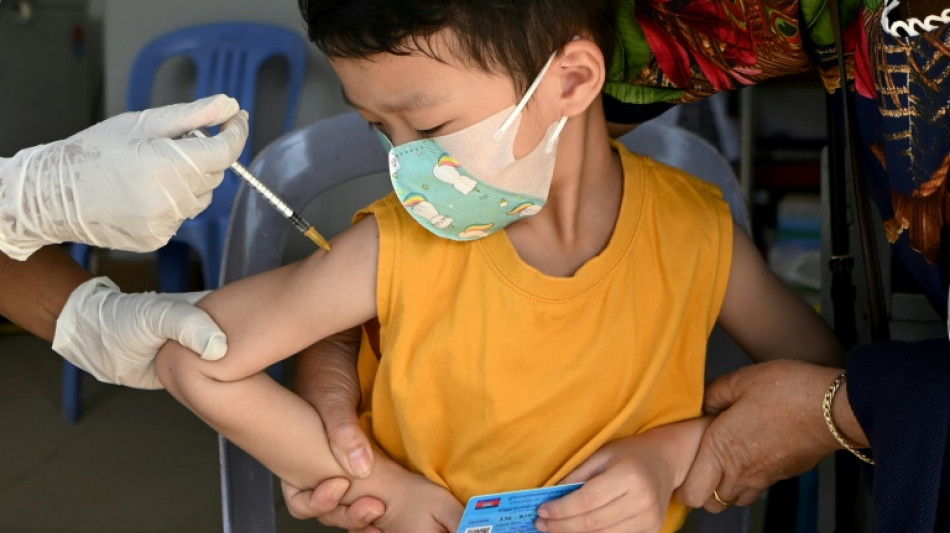
Covid vaccines saved 20 million lives in first year: study / Photo: TANG CHHIN Sothy - AFP

 HSBC 'consults' over UK unit job cuts amid AI adoption

 UK court quashes five ex-traders' Libor rate rigging convictions
 XM Receives “Global Customer Experience Leader Award 2026” at the TrustFinance Performance Awards

 Stocks slide as oil climbs on Mideast flareup

 Heavy casualties in Ukraine after Russian strikes

 French wine harvest set to hit historic low

 Kyiv 'cannot agree' to EU membership limiting food exports: minister

 Arteta targets more Arsenal glory after signing new deal until 2030

 Russell hit with Singapore grid penalty for taking new power unit

 Spotify expands audiobooks to more than 180 markets

 French-Japanese duo wins chemistry Nobel for solving molecular 'mystery'

 England's Nations League surge helps heal World Cup wounds

 Mayor of opposition stronghold Izmir defects to Erdogan party

 Mertens beats Gauff to set up Swiatek clash at China Open

 Benin full of pride at role in Messi's last dance

 France suspends stun grenade use at student protests ahead of PM speech

 Indonesian court hears 'negligence' complaint against state over fires, haze

 Rubio in Greece to urge against Western civilisation 'decline'

 Micron workers at Taiwan plant vote in favour of strike

 In 'The Social Reckoning,' Jeremy Allen White takes on Facebook's 'frightening' ambition

 Chip industry activists call for South Korea to recognise cancer cases

 Famine-scarred southern Madagascar braces for El Nino

 How the EU regulates lobbyists

 I.Coast refuge offers lifelong care for youngsters scorned as 'sorcerers'

 Indian central bank hikes rates for first time in more than 3 years

Covid vaccines prevented nearly 20 million deaths in the first year after they were introduced, according to the first large modelling study on the topic released Friday.
The study, published in The Lancet Infectious Diseases, is based on data from 185 countries and territories collected from December 8, 2020 to December 8, 2021.
It is the first attempt to estimate the number of deaths prevented directly and indirectly as a result of Covid-19 vaccinations.
It found that 19.8 million deaths were prevented out of a potential 31.4 million deaths that would have occurred if no vaccines were available.
It was a 63 percent reduction, the study found.
The study used official figures -- or estimates when official data was not available -- for deaths from Covid, as well as total excess deaths from each country.
Excess mortality is the difference between the total number of people who died from all causes and the number of deaths expected based on past data.
These analyses were compared with a hypothetical alternative scenario in which no vaccine was administered.
The model accounted for variation in vaccination rates across countries, as well as differences in vaccine effectiveness based on the types of vaccines known to have been primarily used in each country.
China was not included in the study because of its large population and strict containment measures, which would have skewed the results, it said.
The study found that high- and middle-income countries accounted for the largest number of deaths averted, 12.2 million out of 19.8 million, reflecting inequalities in access to vaccines worldwide.
Nearly 600,000 additional deaths could have been prevented if the World Health Organization's (WHO) goal of vaccinating 40 percent of each country's population by the end of 2021 had been met, it concluded.
"Millions of lives have probably been saved by making vaccines available to people around the world," said lead study author Oliver Watson of Imperial College London.
"We could have done more," he said.
Covid has officially killed more than 6.3 million people globally, according to the WHO.
But the organisation said last month the real number could be as high as 15 million, when all direct and indirect causes are accounted for.
The figures are extremely sensitive due to how they reflect on the handling of the crisis by authorities around the world.
The virus is on the rise again in some places, including in Europe, which is seeing a warm-weather resurgence blamed in part on Omicron subvariants.
Y.AlMasri--SF-PST