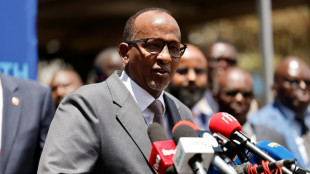
'History will not forgive' failure to seal pandemic deal: WHO chief / Photo: Aubin Mukoni - AFP

 HSBC 'consults' over UK unit job cuts amid AI adoption
 UK court quashes five ex-traders' Libor rate rigging convictions
 XM Receives “Global Customer Experience Leader Award 2026” at the TrustFinance Performance Awards
 Stocks slide as oil climbs on Mideast flareup
 Heavy casualties in Ukraine after Russian strikes
 French wine harvest set to hit historic low
 Kyiv 'cannot agree' to EU membership limiting food exports: minister

 Arteta targets more Arsenal glory after signing new deal until 2030

 Russell hit with Singapore grid penalty for taking new power unit
 Spotify expands audiobooks to more than 180 markets

 French-Japanese duo wins chemistry Nobel for solving molecular 'mystery'

 England's Nations League surge helps heal World Cup wounds

 Mayor of opposition stronghold Izmir defects to Erdogan party
 Mertens beats Gauff to set up Swiatek clash at China Open
 Benin full of pride at role in Messi's last dance

 France suspends stun grenade use at student protests ahead of PM speech
 Indonesian court hears 'negligence' complaint against state over fires, haze

 Rubio in Greece to urge against Western civilisation 'decline'
 Micron workers at Taiwan plant vote in favour of strike
 In 'The Social Reckoning,' Jeremy Allen White takes on Facebook's 'frightening' ambition
 Chip industry activists call for South Korea to recognise cancer cases
 Famine-scarred southern Madagascar braces for El Nino
 How the EU regulates lobbyists
 I.Coast refuge offers lifelong care for youngsters scorned as 'sorcerers'

 Indian central bank hikes rates for first time in more than 3 years
The head of the UN's health agency warned Friday that history would not forgive countries if they failed to strike a pandemic treaty at the last hurdle
World Health Organization leader Tedros Adhanom Ghebreyesus made the comments with progress slow and time running out for the talks.
Countries had reached the cusp of concluding a landmark agreement on how to tackle future pandemics together, as they wrapped up the penultimate week of talks, said Tedros.
"You have made progress -- maybe not as much as you would have hoped but still there is progress," he said as the penultimate round of talks closed at the WHO headquarters in Geneva.
"We are at a crucial point as you move to finalise the pandemic agreement" in time for the WHO's annual decision-making assembly in May.
"You are so close. Closer than you think. You are on the cusp of making history."
But with only five more days of formal negotiations left, scheduled for April 7-11, countries agreed to hold informal meetings in March to try to find compromises on the trickiest issues.
Tedros urged countries not to sink the agreement on a word, a comma or a percentage in the text, imploring them not to make perfect the enemy of the good.
"History will not forgive us if we fail to deliver," he warned.
- US walks away -
The 13th round of talks kicked off under a cloud.
The United States, having already quit the WHO under President Donald Trump, informed the UN health agency they would play no further part in the treaty talks.
European diplomatic sources said Washington walking away had not dampened optimism for a deal.
"The world needs a sign that multilateralism still works," Tedros insisted Friday. "Reaching a WHO pandemic agreement in the current geopolitical environment is that sign of hope."
In December 2021, fearing a repeat of Covid-19 -- which killed millions of people, crippled health systems and crashed economies -- countries decided to draft an accord on pandemic prevention, preparedness and response.
While much of the draft text has been agreed, there are still disputes over sharing access to pathogens with pandemic potential and the sharing of benefits derived from them -- vaccines, tests and treatments.
The Philippines, speaking for 11 nations including Australia, Brazil, Britain and Mexico, said despite only "incremental improvements" this week, countries had done enough to sustain optimism.
"The conclusion of the agreement in May will be a testimony to our commitment to global health -- and the continuing relevance of the WHO in a time of major political challenges," the group said.
Eswatini, speaking for 49 African countries, said they were "ready to burn the midnight oil", despite the sluggish pace.
"We are optimistic that the remaining issues, though critical, are manageable," it said.
Ethiopia feared losing momentum, but pledged to "work hard to narrow the gap".
- 'Improvement' to status quo-
Civil society organisations closely following the talks broadly lamented the slow progress. Fearing time running out, some urged countries to strive for a solid foundational agreement, banking gains that could be built on later.
Nina Jamal from Four Paws said that while some core articles were "full of caveats and weak language... this treaty, as it stands right now... won't deliver everything we want but it's an improvement to the status quo".
James Love, the director of Knowledge Ecology International, felt "some doubt about how much some parties, particularly the EU, want to have an agreement in May", amid rising right-wing populism and "the US pulling out of everything".
Tedros hit out at mis- and disinformation surrounding the agreement, saying "false claims" that it would cede sovereignty to the WHO "will not succeed".
Love urged the WHO to webcast the closed-door plenary sessions as "there's this big anti-vaxxer movement (and)... the secrecy of the negotiations just feeds into the paranoia and conspiracy theories".
J.AbuHassan--SF-PST