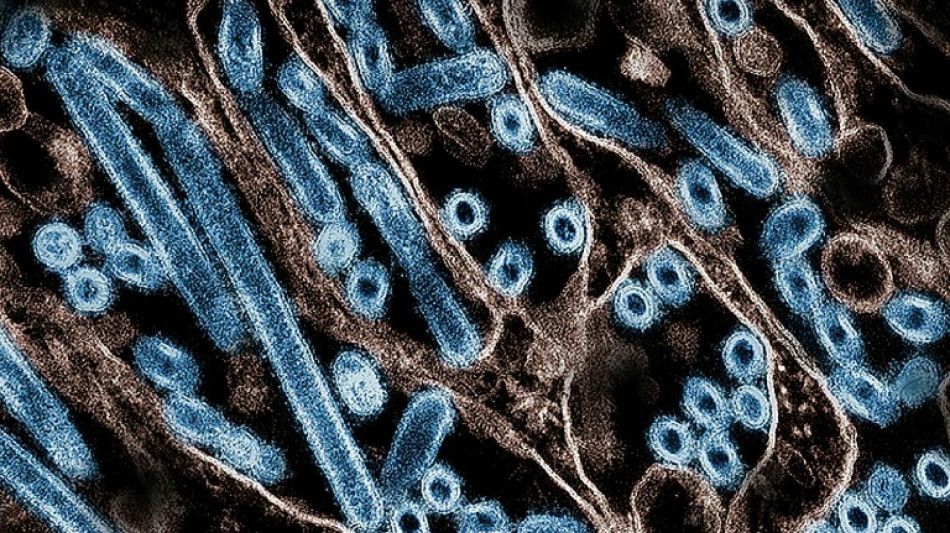
New bird flu mutation discovered in US as cat infections cause alarm / Photo: HANDOUT - National Institute of Allergy and Infectious Diseases/AFP/File

 US woman who survived botched execution is awake and speaking

 From 1800s to modern pharma: a Nobel-winning chemistry quest

 Southampton boss Eckert given suspended ban over 'Spygate'

 Russia warns of 'false' information as second plague case reported

 IEA ready to release more oil reserves if necessary

 HSBC 'consults' over UK unit job cuts amid AI adoption

 UK court quashes five ex-traders' Libor rate rigging convictions

 XM Receives “Global Customer Experience Leader Award 2026” at the TrustFinance Performance Awards

 Stocks slide as oil climbs on Mideast flareup

 Heavy casualties in Ukraine after Russian strikes

 French wine harvest set to hit historic low

 Kyiv 'cannot agree' to EU membership limiting food exports: minister

 Arteta targets more Arsenal glory after signing new deal until 2030

 Russell hit with Singapore grid penalty for taking new power unit

 Spotify expands audiobooks to more than 180 markets

 French-Japanese duo wins chemistry Nobel for solving molecular 'mystery'

 England's Nations League surge helps heal World Cup wounds

 Mayor of opposition stronghold Izmir defects to Erdogan party

 Mertens beats Gauff to set up Swiatek clash at China Open

 Benin full of pride at role in Messi's last dance

 France suspends stun grenade use at student protests ahead of PM speech

 Indonesian court hears 'negligence' complaint against state over fires, haze

 Rubio in Greece to urge against Western civilisation 'decline'

 Micron workers at Taiwan plant vote in favour of strike

 In 'The Social Reckoning,' Jeremy Allen White takes on Facebook's 'frightening' ambition

The ongoing spread of bird flu in the United States has alarmed experts -- not just because of human cases causing severe illness, but also due to troubling new instances of infections in cats.
A sample of the virus found in a critically ill patient in the United States has shown signs of mutating to better suit human airways, although there is no indication it has spread beyond that individual, authorities report.
Earlier this month, officials announced that an elderly Louisiana patient was in "critical condition" with a severe H5N1 infection.
An analysis posted by the Centers for Disease Control and Prevention (CDC) Thursday revealed that a small percentage of the virus in the patient's throat carried genetic changes that could increase the virus's ability to bind to certain cell receptors found in the human upper respiratory tract.
Importantly, the CDC noted that these changes have not been detected in birds -- including in the backyard poultry flock believed to have been the source of the patient's initial infection.
Instead, the agency said the mutations were "likely generated by replication of this virus in the patient with advanced disease," emphasizing that no transmission of the mutated strain to other humans had been identified.
Several experts contacted by AFP cautioned that it was too early to determine whether these changes would make the virus more transmissible or more severe in people.
Angela Rasmussen, a virologist at the University of Saskatchewan in Canada, explained that while the mutation might help the virus enter cells more easily, additional evidence -- such as animal testing -- would be needed to confirm any effect on transmissibility.
Moreover, similar mutations have occurred in previous critically ill patients without leading to broader outbreaks.
"It's good to know we should be looking out for this," Rasmussen said, "but it doesn't actually tell us, 'Oh, we're this much closer to a pandemic now.'"
Thijs Kuiken of Erasmus University Medical Center in the Netherlands agreed.
"Efficient attachment to human upper respiratory tract cells is necessary, but not sufficient, for more efficient transmissibility between people," he said, adding that the process is just one among several steps required for successful viral replication.
Rather than intensifying disease, Kuiken pointed out, such adaptations might actually result in milder infections by favoring cells in the upper respiratory tract -- causing symptoms like a runny nose or sore throat -- rather than affecting the lower respiratory tract, which leads to more severe pneumonia.
- 'Rapid evolutionary leaps' possible -
Rasmussen expressed bigger concerns about the sheer volume of bird flu currently circulating.
The CDC has reported 65 confirmed human cases in 2024, and many more may go undetected among dairy and poultry workers.
This widespread circulation, Rasmussen warned, increases the likelihood of the virus mixing with seasonal influenza, potentially triggering "rapid evolutionary leaps," similar to events that caused the 1918 and 2009 flu pandemics.
Researchers are also keeping a close eye on the mounting cases of bird flu infections in cats.
A cat in Oregon died after consuming raw pet food confirmed to be contaminated with H5N1, prompting a recall of Northwest Naturals' Feline Turkey Recipe raw and frozen pet food.
"This cat was strictly an indoor cat; it was not exposed to the virus in its environment," said state veterinarian Ryan Scholz in a statement. Genome sequencing showed that the virus in the pet food matched exactly the strain found in the cat.
In Washington State, twenty big cats at a sanctuary also died recently after contracting bird flu, the Wild Felid Advocacy Center of Washington wrote on Facebook.
Rasmussen warns that infected outdoor cats could return home and expose people to the virus through close contact.
"If you have an outdoor cat that gets H5 from eating a dead bird," she explained, "and that cat comes back into your house and you're snuggling with it, you're sleeping with it... that creates additional exposure risk."
R.Halabi--SF-PST